There Are No Speed Limits On The Road To Perfection
If you want to do something, in all likelihood you will have some hesitation at the outset, because a first-timer has no experience. Hesitation is the result of no or little experience. But you need not worry, because your lack of experience is not going to pose any problem, if you are determined to set out for the attainment of your goal. It is your willpower which will help you throughout your journey to your goal. The greatest wit and one of the greatest playwrights of modern times, George Bernard Shaw has said, “Men are wise in proportion, not to their experience, but to their capacity for experience.” In other words, if you have capacity for adding experience while you try to do things, you get wiser. Every experience only adds to your wisdom that leads you on the right way to the accomplishment of your task.
In order to get over the difficulty your lack of experience may pose at the outset, you should identify someone who has done a work similar to yours’ and get in touch with him/her. As you will interact, you will be surprised at how easy it is to find out how he/she started out and what he/she learned along the way. It is learning along the way which leads one to perfection. Every trifling thing you learn along the way helps you in accomplishing your task in the best possible way. In the words of the great artist, Michelangelo—”Trifles make perfection, and perfection is no trifle.”
In- fact, when you proceed on your way to the accomplishment of the task, you get armed with knowledge of the pitfalls involved and get better prepared and able to navigate your way around your first successful step towards your final destination. If you have some expert coach or an experienced senior to help you achieve yo^jr goal, he/she will start from the belief that you already have the solutions to the things that are challenging you or preventing you from realising your dreams. He/She will tell you to focus your attention on the things you want. It is the degree of your attention which determines the depth of your desire for the thing you want to possess. Always remember that there is nothing good or bad, but thinking makes it so. In other words, never think that any of your endeavours was bad or a waste of time, because it did not succeed. In fact, failures are the pillars of success. They act as the guide that leads to the right way. There is a wise saying—Nothing is a waste of time if you use the experience wisely.
Never forget to draw upon your resources in full measure. Always try to find out all your resources, as they are helpful in your pursuit of a goal of your choice. The moment you decide to use your resources, you will find that you rarely need to look outside the network of friends and acquaintances or other contacts you already have to help you achieve your goals. You will find that none of the resources you need is beyond your grasp.
You were ignorant of your resources because you had not previously concenra*ed on looking for them. When you become aware of what it is that you want to achieve, you will certainly be in a better,position to zero in on the things and people you want or need *o realise your dreams with the help of. This realisation of yours will be your best guide on the road to excellence. You will march ahead very confidently. To quote David W. Johnson—”There are no speed limits on the road to perfection.”
Wishing you perfection in whatever you do,
It is interview season once again. After Civil Services (Main) Examination, results the air gets full of expectations. We are here with small interview tips that may effective.
Let me tell you, the interviews are composed of one most important ingredient and that is “you”. Everything else that goes on in an interview is peripheral or secondary.
Talking about oneself is not easy for any one in such a situation. Yet that, precisely, is what you are required to do in an interview.
Your past achievements, present inclinations and vision for the future are what you must be ready to talk about in a clear-headed manner in an interview for any job. An interview is a celebration of “you” from start to finish. So, at least the main theme of the interview is not covered by any amount of fog or mist.
The preparation for an interview, therefore, should begin by keeping yourself at the centre. In fact, viewed from a social perspective, we all love to talk about ourselves and we never tire of telling others how we feel, what we think, why we acted the way we did and when we felt stumped or clueless, who then rescued us and where all that finally led us to. We are usually full of ourselves, if not self-obsessed.
The interviewers have two major concerns in their mind:
(a) the personality issue and
(b) the knowledge aspect of the candidate.
Now, in case of the Civil Services, the knowledge aspect is taken care of by an elaborate written examination, which has already been done. What remains to be evaluated is the personality aspect of the candidate. It is for this reason the interview has been, at times, also called “die Personality Test”. In a situation like Civil Services, the personality aspect worries the selectors more than the qualification aspect, since the Civil Services do not require any critical technical qualification for the day-to-day administrative business of the Government.
The personality of a person has been variously defined to include a vast number of qualities of head and heart. The personality of any person is the sum total of what he/she has experienced, seen, heard, read or felt from the very moment of his/her birth onwards. In short, what the Government is looking for in a candidate is a man of substance who possesses the mind and courage to take on any job and gives his/her best to it, without flinching even for a moment. Ultimately, it is the contents of his/her character that any employer looks for in a new employee and not just his/her outer persona.
We all do have some fear at the time of going for an interview and that is quite natural, so this is acceptable. However, what is not acceptable is fear morphing into panic, which can diminish a performance in many ways.
It is, therefore, perfectly natural to be a bit nervous before an interview, but there is an element of energy present even in this nervousness and if properly harnessed, this energy can help you to present yourself with agility, passion and conviction. It can give you the edge that you need to perform well.
But in order to do so you need to control your nerves in a positive way. Believe me, you have done it many times earlier, so you can do it again, when required. Before the interview, you should try to visualize an enthusiastic interviewer, who is reacting positively to your responses.
Picture yourself delivering a clear and interesting presentation, admit to yourself that you may be nervous, but you are going to convert your nervousness into energy, in a positive way.
Here are some last minute interview tips
You will do well to keep in your mind to enhance your performance in front of the Interview Board.
Intelligent Listening: Eye contact should be maintained to show that you are listening attentively.
The eye contact can be a little relaxed while speaking.
Low Peripheral Movement (LPM): It shows that you are used to people listening to you carefully, when you talk to them.
Cut your answers short to the required patience shown by the members of the Board, talking to you.
They usually like to talk more, so listen carefully and think for a few seconds before you start answering. This will show, you are organising your thoughts in your mind, before starting to speak.
Bring in qualifiers while talking, so as to leave some room for difference in opinion.
Do take a stand, but do not be adamant or unwilling to appreciate the Board’s opinion.
Use a couple of words from the question while answering it. It shows you have listened to the question very carefully.
Carefully use of limited number of technical jargon.
Do not rely upon guesses or speculation, if you are not sure about something.
Listen very keenly, reply with respect, in brief. Do not go in for introductions, come to the central issue of the inquiry immediately.
Even if there has been some initial mistake, keep playing with confidence and do not think you have already lost the game. They are looking for warm, sensitive, respectful and attentive youngsters and not a quiz master.
Talk humbly about your achievements and hobbies, though you may not be a great expert in those fields. You may have mentioned some of your hobbies in the Interview/Personality Test Form, without a serious background in them.
Say less to convey more. Less is more these days, as per the minimalist creed.
Argue logically and generalize correctly, if you have to and add a rider (other things being equal as they do in economics).
Do not try to “read too much between the lines”.
Civil Services Examination interviews are not content driven but form-driven. Yet, you must speak sensibly about your knowledge.
Do not start evaluating your performance while still sitting in the Boardroom.
Remember, while answering any question, what is “easy to see” is “easy to miss”.
We often tend to miss the obvious and go for some non-crucial aspects of the subject.
Remember that the interviewers are not your adversaries and they are not attending the interview in order to pull you apart. Their interest lies in what you have to say and show them about yourself.
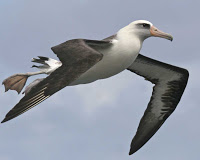
Albatross: Large sea birds. Alpaca: South American mammal giving long, silky wool.
Amoeba: A microscopic fresh water animal. Its body has simplest struicture consisting of jelly like protoplasm and a nucleus.
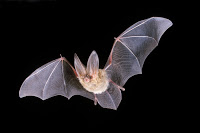
Bat: Fat mammals whose wing consisting of a membrane of skin stretching between the fingers of the fore limbs.
Beaver: A vegetarian fur-bearing mammal, found in Asia, America and Europe, lives in burrows on river banks and cut down trees to dam streams to raise the water level in order to cover the mouth of its burrows.
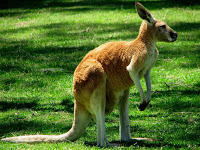
Kangaroo: Mammals of Australia and New Guinea having small fore legs and very strong hind laga, which give it great leaping power.The female has a pouch (marsupium) in front, in which she carries her baby.
Koala: Grey, the furry mammal of Australia having marsupium, eats leaves of Eucalyptus.
Kiwi: Wingless bird of New Zealand having a hair-like feather.
Laimpreys: Fish like creatures with no jaws but having large round mouth by which they attach themselves to fish,upon which they prey.
Leeches: Worms living in ponds and streams, live by sucking blood of animals.
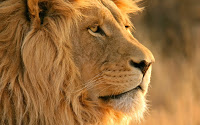
Lion: Large,strong carnivorous mammal found in Africa and S.Asia.
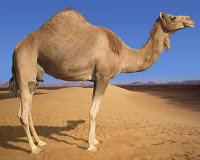
Llama: South American mammal somewhat like a camel, but smaller and without a hump.
Musk deer: Small horniess deer of Central Asia, the male of which has a gland containing strong scent of musk.
Mustang: A wild horse of America.
Nightingale: A singing bird of India.
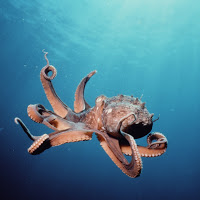
Octopus: Sea mollusc bearing eight tentacles.
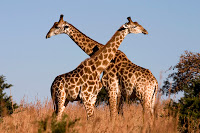
Okalpi: Mammal found in West Africa forest, nearly related to Giraffe but with shorter neck.
Ostrich: A tall African and arabian bird with large feathers, runs swiftly but cannot fly.
Pelican: Large,fish-eating water bird with a pouch for storing food.
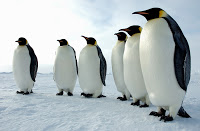
Penguin: Sea bird found in southern hemisphere.
Puma: Large American wild cat carnivorous in habit, also called mountain lion.
Rein Deer: A large deer having branching horns, found in Siberia.
Rhea: Large bird of South America that is much like the Ostrich but smaller.
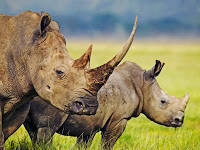
Rhinoceros: Large thick, skinned mammal of Africa and Asia with one or two upright horns on the snout.
Salamandar: An animal shaped like a lizard but belonging to the group of amphibia.
Salmon: A large fish with silvery scales and yellowish pink flesh which is edible.
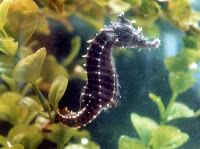
Sea horse: Small fish with a head like that of a horse.
Seal: A sea carnivorous mammal.
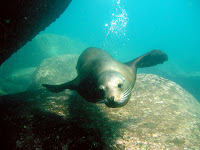
Sea Lion: Large seal of the Pacific coast of America.
1. Who among the following is one of the recipients of the Nobel Peace Prize – 2011 ?(1) Ellen Johnson Sitleaf(2) Jules A. Hoffmann(3) Brude A. Beutler(4) Adam G. Riess(5) Tomas Transtromer2. The Food Security Bill-2011 which is in the process of becoming an Act, divides the entire population of the country into two groups. Which of die following are these two groups ?
(1) Below poverty line and above poverty line
(2) General population and excluded population
(3) Included households and excluded households
(4) Covered under PDS and not covered under PDS
(5) General households and priority households
3. RBI has recently deregulated the rates of interest to be provided by various Banks to their depositors/ customers with effect from 25-10-2011 on their accounts.
(1) Time deposit (2) Saving bank
(3) Loan (4) Fixed deposit
(5) Current
4. Which of the following is the main advantage of “ASBA” with the applicants for share allotment ?
(1) ASBA applicant has got secured allotment of shares
(2) ASBA applicant has got certain preference in allotment of shares as compared to general applicants
(3) ASBA applicant need not remit the fund for allotment of shares, he/she will do so after shares are allotted to him/her
(4) ASBA applicants deposit/OD account is not debited, only the
funds are blocked for the same and he/she continues to avail interest till the shares are allotted to him/her
(5) None of these
5. “Many people die in Deadly Games in Egypt”—was the news in almost all major newspapers in February 2012. Which of the following statements is the correct representation of ‘Deadly Game’ given in the headlines ?
(1) A riot broke out during a Football Match in Egypt in which many people were killed
(2) Police had to open fire on a me>b including some genuine ticket holders, who were not allowed to enter the stadium even after the start of the match
(3) Egypt is famous for its dangerous games of ‘Bull fight’ and ‘Martial Game’. Many participants die every year in such games
(4) Some terrorists opened fire during a football match. About 1,000 people were killed in the incident
(5) The defeat in the game is considered equivalent to death
6. Mullaperiyar Dam, which was recently in news, is located in which of the following States ?
(1) Maharashtra
(2) Karnataka
(3) Andhra Pradesh
(4) Kerala
(5) Tamil Nadu
7. Like telephone/Mobile number portability, the Ministry of Finance/RBI is now also considering to provide bank account number portability to bank customers. Which of the following would it mean ?
(1) Any customer/account holder can withdraw cash from any other
Bank through his/her own cheques drawn on other bank even without ATM
(2) Any borrower can draw funds from his/her loan account from any other bank also
(3) The account number of any account holder will remain the same even if he/she is getting his/ her account transferred to another bank also
(4) Bank customers would have the facility of mobile Banks to withdraw cash nearby his/her place
(5) None of these
8. The total number of Kissan Credit Card holder farmers in our country is
(1) 8 Crores (2) 10 Crores
(3) 5 Crores (4) 7.5 Crores
(5) 6 Crores
9. NRE deposit is
(1) Non Resident External deposit
(2) Non Resident Extra deposit
(3) Non Resident Exchange deposit
(4) Non Refundable External deposit
(5) Non Resident Extended deposit
10. What is offshore banking ?
(1) It is a bank located in the sea (i.e. island).
(2) It is a bank located in SEZ.
(3) It is a bank located in a neighbouring country.
(4) It is a bank located outside the country of residence of the depositor.
(5) Offshore banking is basically dealing in foreign exchange.
11. Maoists in which of the following countries recently decided to accept Govt’s offer of ‘Golden Handshake’ and enter into ‘civilian life’ or mainstream of the society ?
(1) Myanmar (2) India
(3) China (4) Nepal
(5) Bhutan
12. Which of the following is correct ?
(1) Illiterates cannot open any account in a bank
(2) Illiterate women cannot open any account in a bank
(3) Illiterates can open savings bank accounts in a bank
(4) Advance can be granted to a minor
(5) Advance can be granted to a
minor if he is of sound mind
13. As per newspaper reports western countries are going to impose sanctions on which of the following OPEC countries as it is said that it is trying to make a nuclear bomb ?
(1) Kuwait (2) Iraq
(3) Iran (4) Saudi Arabia
(5) Angola
14. “The Reliance Industries Ltd. has decided to return some ‘KG’ fields to the Government of India”—was the news in some major newspapers. What is the major production in KG fields owned by RIL ?
(1) Crude oil
(2) Gas
(3) Coal
(4) Iron ore
(5) Gold ore and Diamonds
15. Non-convertible debentures are *
(1) Debt instruments which acquire equity status at the issuers’ option.
(2) Debt instruments which acquire equity status at the investors’ option.
(3) Debt instruments which acquire equity status with the permission of Registrar of Companies.
(4) Debt instruments which acquire equity status on maturity.
(5) Debt instruments which retain their debt character and cannot acquire equity status.
16. India’s Dipika Pallikal and Sarah Cardwell of Australia recendy played an international match in Chennai. Both of them are
(1) Badminton players
(2) Golf players
(3) Chess players
(4) Squash players
(5) Table Tennis players
17. “IRDA norms will boost online distribution”—was the news in some major newspapers. This means online distribution of which of the following will boost up ?
(1) Bank products
(2) Insurance policies/products
(3) Licences to open new banks/ branches of existing banks
(4) Licences to operate 2G/3G spectrums
(5) Permits for export of iron ore
18. ‘Lajja’ is a book written by
(1) Salman Rushdie
(2) Taslima Nasreen
(3) Sunil Ganguli
(4) Rabindranath Tagore
(5) Bimal Mitra
19. To prevent frauds in multiple mortgage cases, under SARFAESI Act, 2002 one special thing has been created and made operative from 01.04.2011. Which one is that from the following ?
(1) Special Registrar Office at Lucknow
(2) Special Central Arbitration Bureau at Lucknow
(3) Central SARFAESI Tribunals at Six Centres
(4) Central Electronic Registry
(5) State Electronic Registries
20. SB[ has merged which of the following two associate banks with itself ?
(1) State Bank of Hyderabad & State Bank of Patiala
(2) State Bank of Hyderabad & State Bank of Travancore
(3) State Bank of Mysore & State Bank of Travancore
(4) State Bank of Indore & State Bank of Hyderabad
(5) State Bank of Indore & State Bank of Saurashtra
21. Assembly elections took place in which one of the following States recently ? (in January 2012)
(1) Madhya Pradesh
(2) Maharashtra
(3) Kerala
(4) Punjab
(5) Tamil Nadu
22. Which one of the following is not a salient feature of Debit Card ?
(1) No bad debts to banks and no suits for recovery
(2) No interest earning for banks
(3) Works Eke a normal withdrawal
(4) Can be used at ATM and POS
(5) 45 days credit is given to the card holder
23. Banks issue a letter to beneficiary on behalf of its constituents like guarantee for making payment on their behalf on fulfillment of its terms and conditions. What is this arrangement known in banking context ?
(1) Line of Credit
(2) Loan to Client
(3) Loan on Credit
(4) Loan against Credit
(5) Letter of Credit
24. As per Financial Inclusion drive one of the following Banks introduced Tiny Cards with Biometric identification. Which of the following is that Bank ?
(1) Central Bank of India
(2) Oriental Bank of Commerce
(3) Indian Bank
(4) State Bank of India
(5) Bank of Maharashtra
25. World leaders are to assemble in Rio de Janeiro in June 2012 for the United Nations Conference on Sustainable Development (Rio+20). All nations are going to make some commitment towards the goal of the conference. As per the agenda circulated, what commitment do world leaders want from India in the Conference ?
(1) India should agree to double its energy efficiency under a global understanding
(2) India should suspend its nuclear pact with USA or at least should reduce it to 50% level of agreed capacity
(3) Nuclear power plants are highly risky as seen in japan recently. Hence, no new plant should be made
(4) India has a vast resource of coal. It must share its coal resources with other countries to enable them to produce thermal power which they are not doing so far due to lack of coal mines there
(5) None of these
26. Who among the following is the recipient of the Padma Vibhushan given in 2012 ?
(1) Late (Dr.) Bhupen Hazarika
(2) Sri Vanraj Bhatia
(3) Sri Javed Akhtar
(4) Sri Amitabh Bachchan
(5) Smt. Ambika Son!
27. Under the liberialised scheme of interest subsidy, Govt, of India provides interest subsidy on housing loan at the rate of
(1) 0.50%
(2) 1.00%
(3) 2.00%
(4) 2.00% + 1.00% for prompt repayment
(5) None of these
28. When a Bank provides a loan for purchase of white goods, it is categorised as
(1) Consumption loan
(2) White Goods loan
(3) Consumer Durable loan
(4) Working Capital
(5) Bridge loan
29. India has decided to acquire Rafale Fighter planes for its airforce wing. Which country is going to supply Rafale fighter planes ?
(1) Italy
(2) Britain
(3) Canada
(4) France
(5) Germany
30. Which of the following statements about contribution (approximately) of agriculture sector in GDP is correct ?
(1) Agriculture contributes 50% of total GDP
(2) Agriculture does not contribute significantly to India’s GDP as the share is less than 1%
(3) India’s GDP does not take agricultural sector into account
(4) Agricultural Sector is the part of Service Sector. Hence, it is not considered as an independent sector
(5) Agricultural Sector contributes 20% in India’s GDP
31. Banks are considered as ‘financial intermediaries’. Which of the following activity correctly and comprehensively explains this role of banks ?
(1) Accepting deposits of money for the purpose of lending and investment
(2) Granting loans to the weaker sections of the society
(3) Accepting money for remittance and issuing bank drafts
(4) Providing safe deposit services
(5) Opening accounts and accepting deposits dierein
32. The rate below which banks cannot generally lend is called as
(1) Base rate
(2) Floor rate
(3) Repo rate
(4) Call money rate
(5) Ceiling rate
33. As per the data released by the Union Health Ministry (of India) the infant mortality rate is lowest in
(1) Tamil Nadu (2) Maharashtra
(3) Goa (4) Uttar Pradesh
(5) Madhya Pradesh
34. Dada Saheb Phalke Awards are given by the Ministry of
(1) Social Welfare
(2) Corporate Affairs
(3) Home Affairs
(4) Human Resource Development
(5) Information & Broadcasting
35. Which of the following is not a type of Cheque ?
(1) Crossed cheque
(2) Blank cheque
(3) Speed cheque
(4) Bearer cheque
(5) Order cheque
36. Mr. John Key is the present
(1) Prime Minister of Canada
(2) Prime Minister of Australia
(3) Prime Minister of New Zealand
(4) President of Australia
(5) President of Canada
37. In relation to banking, what do you understand by “Ever-Greening of Loan Account” ?
(1) Full repayment of a loan account before maturity—Pre-payment
(2) Full repayment of a loan account exacdy at maturity
(3) Fresh loan sanctioned during the tenure of account for enhancement of limits
(4) Adjusting the NPA/Sticky account with fresh sanction of loans
(5) Loans provided for new projects to new customers
38. Which of the following is the name of an autonomous organisation for rural technology ?
(1) CAPART (2) MGNREGA
(3) PURA (4) IRDP
(5) NGAPS
39. With a view to facilitate payment of balance in deposit account of the person named by the depositor without any hassles in the event of death of the account holder, the following facility was introduced in bank accounts in our country.
(1) Will (2) Registration
(3) Nomination (4) Indemnity
(5) Guarantee
40. Which of the following countries is not a member of ASEAN ?
(1) Thailand (2) Myanmar
(3) Singapore (4) Vietnam
(5) Brazil
41. Which of the following is not a Negotiable Instrument ?
(1) Cheque
(2) Fixed Deposit Receipt
(3) Promissory Note
(4) Bill of Exchange »
(5) All (1) to (4) above are negotiable instruments
42. Which of the following Stock Exchanges in India recendy launched “Carbon Index” so that investors can assess risk and opportunities associated with climate change ?
(1) Delhi Stock Exchange
(2) National Stock Exchange
(3) Bombay Stock Exchange
(4) Kolkata Stock Exchange
(5) Ahmedabad Stock Exchange
43. Which of the following would be the venue of the World Athletic Championship 2013 ?
(1) New Delhi (2) Tokyo
(3) London (4) Paris
(5) Moscow
44. Who among the following represented India in 17th SAARC Summit held at Addu in Maldives in November 2011 ?
(1) Smt. Sonia Gandhi
(2) Dr. Manmohan Singh
(3) Shri Pranab Mukherjee
(4) Shri P. Chidambaram
(5) Shri Rahul Gandhi
45. What is the maximum balance amount that is eligible for earning interest in a normal savings bank account ?
(1) Rs. 1 lac
(2) Rs. 2 lacs
(3) Rs. 3 lacs
(4) Rs. 5 lacs
(5) No limit
46. When a customer opens a Deposit account with the Bank, which one of the following is the status of the Bank ?
(1) Debtor (2) Creditor
(3) Trustee (4) Beneficiary
(5) None of these
47. Which of the following states decided to give Khatedhari Rights to about 30,000 farmers occupying the custodian lands ?
(1) Gujarat
(2) Rajasthan
(3) Madhya Pradesh
(4) Uttar Pradesh
(5) Uttarakhand
48. Which of the following functions is not being performed by the Reserve Bank of India ?
(1) Regulation of Banks in India
(2) Regulation of Foreign Direct Investment in India
(3) Foreign Currency Management in India
(4) Control & Supervision of Money Supply
(5) Currency Management in India
49. A bank is called as ‘Scheduled Bank’ when
(1) its business has crossed Rs. 1,000 crore mark.
(2) its branch network is over 100
(3) it is included in the second Schedule of the RBI Act
(4) when it complies with all the three above
(5) None of these
50. Australian Govt, recently decided to sell Uranium to India. Uranium is used mainly for
To provide the best experiences, we use technologies like cookies to store and/or access device information. Consenting to these technologies will allow us to process data such as browsing behavior or unique IDs on this site. Not consenting or withdrawing consent, may adversely affect certain features and functions.
Functional
Always active
The technical storage or access is strictly necessary for the legitimate purpose of enabling the use of a specific service explicitly requested by the subscriber or user, or for the sole purpose of carrying out the transmission of a communication over an electronic communications network.
Preferences
The technical storage or access is necessary for the legitimate purpose of storing preferences that are not requested by the subscriber or user.
Statistics
The technical storage or access that is used exclusively for statistical purposes.The technical storage or access that is used exclusively for anonymous statistical purposes. Without a subpoena, voluntary compliance on the part of your Internet Service Provider, or additional records from a third party, information stored or retrieved for this purpose alone cannot usually be used to identify you.
Marketing
The technical storage or access is required to create user profiles to send advertising, or to track the user on a website or across several websites for similar marketing purposes.