

Home Blog Page 345

Important Wars and Battles

1
important wars and battles

Battle of Salamis (480 BC): The Greek fleet defeated the Persians.

Battle of Pharsalus (48 AD): Caesar defeated Pompey

The Crusades (11th – 13th Centuries): Military expeditions of the Christians in Western Europe to get back the Holy lands from Muslims; result; the Holy city remained with Turks.

Hundred Years War (1338-1453): Fought between France and England; came to an end by the heroism of Joan of Arc who was burnt Alive.

Anglo – Spanish War of the Defeat of Spanish Armada (1588): The British fleet under Howard and Drake defeated the Spanish fleet Armada.

Battle of Gibralter Bay (1606-37): The Dutch defeated the Spaniards and the Portuguese.

Read Also: 18 Wars of Medieval India Battles that changed destiny of India

Thirty Years War (1618-48): A politico-religious struggle; included Bohemian War; Danish War and Swedish War; result; Calvinism was finally granted recognition.

Seven Years of Anglo-French War III (1756-63): Fought by Britain and Prussia against Austria, France, and later Russia; the Treaty of Paris brought an end to it.

Battle of Bunker Hill: The first battle of the War of American Independence; fought at Charlestown, Boston.

American War of Independence (1776-83): George Washington defeated the British forces; America became independent; independence of British colonies recognised at the Peace of Paris (1783).

Battle of Pyramids (July 1798): Napoleon emerged victorious over the Mameluke rulers of Egypt.

Battle of Nile (August 1798): The British fleet under Lord Nelson defeated the French fleet and established their supremacy over the Mediterranean Sea.

Battle of Austerlitz (1805): Napoleon defeated Austria and Russia.

Battle of Trafalgar (October 1805): The British fleet under Lord Nelson defeated the combined French and Spanish fleet under Villeneuve; Britain won but Nelson was killed; Napoleon’s scheme of invading England failed.

Battle of Leipzig or Battle of Nations (1813): Napoleon was defeated by the English and the Allies; he abdicated in the following year.

Battle of Waterloo (1815): The British under Duke of Wellington (Sir Arthur Wellesley) defeated the French under Napoleon; Napoleon was captured and exiled to St. Helena where he died.

Opium War (1839Opium War (183-42): Fought between Britain and China; immediate cause: Chinese protest over opium import into China by the British.

Crimean War (1853-56): War declared against Russia by Turkey in 1853, Britain and France in 1854 and Sardina in 1855; Russia defeated.

Must Read: The Revolt 1857: the First War of Independence

American Civil War (1861-65): Northern states of America under Abraham Lincoln defeated the Southern states and established a Federal-State; cause: Antagonism between the agricultural, slave-owing South and the industrial North.

Spanish-American War (1898): The war fought by the USA and Cuban revolutionaries against Spain to free Cuba from Spanish rule; result: Cuba came under the US forces.

Battle of Omdurman (1898): The British and Egyptian forces defeated the forces of Khalifa (Mehdists.)

Russo-Japanese War (1904-05): Russia defeated; Treaty of Portsmouth (1905) brought an end to the war; also known as the Battle of the Sea of Japan.

Balkan Wars I and II (1912-13): In the Balkan War I, the Balkan countries defeated Turkey; while in Balkan War II, Romania defeated Bulgaria.

World War I (1914-18): Root Causes: Austria-Serbia rivalry and Franco-German rivalry; immediate cause: assassination of the heir to the Austrian throne by a Serb; the warring sides were: Austria, Bulgaria, Germany, Hungary and Turkey (Central Powers) against Belgium, England, and France, and later Italy, Russia and USA (Allied Powers); Result: Central or Axis Powers were defeated; the Treaty of Versailles (1919) brought an end to the War.

Spanish Civil War (1936-39): Fought between Fascist and republican forces; rebels were helped by Germany and Italy, while the government was aided by Russia and Mexico.

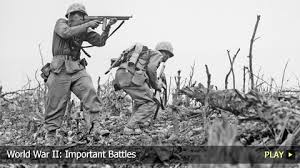
World War II (1939-45): Resulted due to the unjust Treaty of Versailles as both Germany and Italy were dissatisfied with it; rise of fascist forces, such as Nazis in Germany; imperialism of England and France; and Japan’s expansionist ambitions; warring factions; Germany, Italy and Japan (Axis Powers) against Britain, France, Russia, USA, Poland etc. (Allied Powers); Result: Allied Powers emerged victorious; Germany divided, emergence of Russia as a big Power.

Algerian War of Independence (1947-62): The war was fought against French with which Algeria had been politically unified.

Six-Day War (1967): Israel defeated the combined powers of Egypt, Syria and Jordan and occupied Gaza Strip, Syria’s Golan Heights and the West Bank.

Iran-Iraq War (1980-88): Occurred due to boundary disputes between two countries; heavy losses on both sides; a ceasefire in August 1988.

Falklands War (1982): The war was fought between the British and Argentine forces over the claim on the Falklands Islands in the South Atlantic Ocean; British regained control of the Islands.

Gulf War (1991): Followed the Iraqi invasion of Kuwait; a coalition of about 40 countries, including the UK and the USA, defeated Iraq

Don’t Miss: 

Important Battles Fought In India

Important Battles in the Indian History

Battle of Berlin

Chanakya

1
Chanakya
Chanakya

Chanakya (350-283 BCE) was an adviser and a prime minister to the first Maurya Emperor Chandragupta (c. 340-293 BCE), and architect of his rise to power.

Chanakya, also known as Kautilya or Vishnugupta, was born in Pataliputra, Magadha (modern Bihar), and later moved to Taxila, in Gandhara province(now in Pakistan). He was a professor (acharya) of political science at the Takshashila University and later the Prime Minister of the Emperor Chandragupta Maurya. He is widely believed to be responsible for the creation of Mauryan empire, the first of its kind on the Indian subcontinent.

He is regarded as one of the earliest known political thinkers, economists, and king-makers. He was the man to envision the first Indian empire by the unification of the then numerous kingdoms in the Indian sub-continent and provide the impetus for fights against the Greek conqueror Alexander. In Jawaharlal Nehru’s Discovery of India, Chanakya has been called the Indian Machiavelli.

Read Also: Centralized Administration of Mauryan Empire

His famous work called Arthashastra is a classic example of statecraft and politics and is read in Europe even today. It is arguably the first systematic book on economics. It discusses monetary and fiscal policies, welfare, international relations and war strategies in detail. It basically consists of the principles of politics and how the state works.

Arthashastra is a serious manual on statecraft, on how to run a state, informed by a higher purpose, clear and precise in its prescriptions, the result of the practical experience of running a state. It is not just a normative text but a realist description of the art of running a state. An able ruler has to be a ruthless leader to make sure that the state works smoothly and efficiently. He believed in four ways Enticement, Sowing decision, Punishment or war. He was the master of the shrewd act of diplomacy.

Another book attributed to Chanakya was Nitishastra which is also known as Chanakya Niti. Many of his Nitis or policies have been compiled under this book. Nitishastra is a treatise on the ideal way of life and shows Chanakya’s in-depth study of the Indian way of life. The legends associated with Chanakya are very interesting and provide a testimony of his greatness.

The diplomatic enclave in New Delhi is named Chanakyapuri in honor of Chanakya. Institutes named after him include Training Ship Chanakya, Chanakya National Law University and Chanakya Institute of Public Leadership. Chanakya circle in Mysore has been named after him.

Must Read: Top Universities in India

Legends:

  • When Chanakya was born he had a full set of teeth, which is a sign that he would become a king or an emperor. But since he was born in a Brahmin family, it was considered inappropriate. Thus, his teeth were broken and it was predicted that he would make another person a king and rule through him.
  • Even as a child, Chanakya had the qualities of a born leader. His level of knowledge was beyond children of his age.
  • Chanakya was thrown out of the court of King Nanda as he was a blunt man and spoke his mind clearly. Chanakya swore he would take revenge.
  • Chanakya comes across Chandragupta as a young child. Even at that age, he was a born leader and showed the qualities of an able Emperor. He was the guiding force behind Chandragupta and the vital person who made him an able Emperor.
  • Chanakya adds poison in little amounts daily in Chandragupta’s food in order to make him immune to poison, lest some enemy tries to poison him.
  • However, Chandragupta was unaware about this and once gave a little food to his wife who was in the ninth month of pregnancy. She didn’t survive but Chanakya cut open her belly and took out the baby.
  • This baby grew up to become an able emperor named Bindusara. He had a minister named Subandhu who did not like Chanakya. He told Bindusara that Chanakya had killed his mother.
  • Without assessing facts, Bindusara confronted Chanakya. On knowing the whole story, he felt ashamed at his hasty actions and begged for forgiveness. He asked Subandhu to go and apologize and make Chanakya come back.
  • Subandhu was very cunning and on the pretext of going to apologize to Chanakya, he killed him. Thus, ended the life of a great person like Chanakya just because of political rivalry.

His main philosophy was “A debt should be paid off till the last penny; An enemy should be destroyed without a trace”. He seemed to have lived – and died – by his philosophy.

Also, Read:

Timeline of Maurya Empire

Social Conditions in the Era of Mauryan Imperialism


The Delhi Sultanate (1206-1526)

11
delhi sultanate

Until the beginning of the 12th century, there was no mention of the kingdom with Delhi as the capital city. Moreover, Al-Biruni who came to India during the reign of Mahmud of Ghazni wrote about the city of Delhi. In his work Kita-ul-Hind, he mentioned some other cities like Kanauj, Mathura etc. His work, written in Arabic provides an important resource to the historians.

Delhi became an important city only when it became the capital of Rajput rulers. In the middle of the 12th century, it developed as an important commercial center. With the establishment of Delhi Sultanate in the 13th century, it was transformed into a capital city covering a vast area of the subcontinent. The sultans of Delhi built monuments in this area. Delhi Sultanate comprised of five dynasties. These dynasties ruled from 1206 to 1526 A.D.

These are:

  1. Slave dynasty (1206 – 1290 A.D.)
  2. Khilji dynasty (1290 – 1320 A.D.)
  3. Tughluq dynasty (1320 – 1414 A.D.)
  4. Sayyid dynasty (1414 – 1451 A.D.)
  5. Lodi dynasty (1451 – 1526 A.D.)

The word ‘Sultanate’ means strength and authority. Later, t came to be used as the title by certain Muslim rulers, who claimed full sovereign power.

The Slave Dynasty (1206 – 1290 A.D.)

After the death of Muhammad Ghori in 1206 A.D. his slave Qutub-ud-din Aibak founded this dynasty. He extended the Muslim empire in many parts of the northern India. Due to his generosity, he came to be known as lakh-baksh – giver of lakhs. After his death Iltutmish became his successor. Delhi Sultanate was established during the reign of Iltutmish. He made Delhi as his capital. He made many conquests and ruled over whole of the northern India.

On his deathbed, he nominated his daughter Razia Sultana as successor. She was followed by Bahram Shah, Ala-ud-din Masud Shah, Naisr-ud-din Muhammad. Although Nasir-ud-din Muhammad ruled for twenty years but the main power remained in the hands of Ghiyas-ud-din Balban – one of the slaves of Iltutmish his original name was Baha-ud-din. Balban defended his empire from Mangol invation. After the death of Balban, all his successors became inefficient and weak hence, the Slave dynasty came to an end.

Rulers of Slave dynasty:

  1. Qutub-ud-din Aibak (1206 – 1210 A.D.)
  2. Iltutmish (1210 – 1236 A.D.)
  3. Rukh-ud-din Firoz Shah along with his mother (for six months after the death of Iltutmish against his last wish)
  4. Raziya Sultana (1236 – 1240 A.D.)
  5. Bahram Shah (1240 – 1242 A.D.)
  6. Ala-ud-din Masud Shah (1242 – 1246 A.D.)
  7. Nasir-ud-din Muhammad (1246 – 1266 A.D.)
  8. Ghiyas-ud-din Balban (1266 – 1287 A.D.)

The Khilji Dynasty (1290 – 1320 A.D.)

Jalal-ud-din Khilji was the founder of the Khilji dynasty, his nephew Ala-ud-din Khilji murdered him and ascended the throne of Delhi. Expansion of empire during Ala-ud-din Khilji includes successful campaigns in Gujarat, Malwa, Ranghambhore, Chittor etc. After his death, his successor proved inefficient and weak. Hence, Khilji dynasty came to an end.

Rulers of the Khilji dynasty:

  1. Jalal-ud-din Khilji (1290 – 1296 A.D.)
  2. Ala-ud-din Khilji (1296 – 1316 A.D.)

The Tughluq Dynasty (1320 – 1414 A.D.)

The Tughluq Dynasty was founded by Giyas-ud-din Tughluq in 1320, is original name was Ghazi Malik. After his death in an accident in 1324 A.D., he was succeeded by his son Muhammad-bin-Tughluq. Muhammad-bin-Tughluq was a brilliant scholar and a great patron of learning. Ibn Batuta, a traveler came to India during his rule. He has provided a detailed account of his reign. Muhammad-bin-Tughluq was succeeded by Firoz Shah Tughluq, he was an able ruler therefore made an attempt to consolidate Delhi sultanate. He followed the policy of appeasement to please the nobles, army and the ulemas. He imposed jaziya. He died in 1388. Amir Timur, the Mangol leader of central Asia, attached India in 1398. He ordered general massacre in Delhi and robbed people mercilessly. The invasion of Timur gave abig jolt to Tughluq dynasty. Due to weak successors of Tughluq dynasty, it came to an end in 1414.

Rulers of the Tughluq dynasty:

  1. Giyas-ud-din Tughluq (1320 – 1324 A.D.)
  2. Muhammad-bin-Tughluq (1324 – 1351 A.D.)
  3. Firoz Shah Tughluq (1351 – 1388 A.D.)

The Sayyid Dynasty (1414 – 1451 A.D.)

This dynasty existed for a very short period. It was founded by Khizr Khan (1414 – 21 A.D.). He helped Timur in his invasion. His successors namely, Mubarak Shah, Muhammad Shah, and Ala-ud-din Alam Shah were weak rulers.

Rulers of Sayyid dynasty:

  1. Khizr Khan (1414 – 1421 A.D.)
  2. Mubarak Shah (1421 – 1433 A.D.)
  3. Muhammad Shah (1434 – 1443 A.D.)
  4. Ala-ud-din Alam Shah (1443 – 1451 A.D.)

The Lodi Dynasty (1451 – 1526 A.D.)

Bahlol Lodi was the founder of this dynasty. He was one of the Afghan generals of Sayyids. He regained Sind and Mewar by bringing peace and order in the country. Bahlol Lodi was succeeded by his son Sikandar Lodi. He was a good administrator. He annexed Jaunpur, Bihar, parts of Bengal and Ganga valley. He founded the city of Agra and made it his capital. His successor was Ibrahim Lodi. He was the last ruler of the dynasty. In 1526 A.D., Babur defeated Ibrahim Lodi at the first battle of Panipat. Thus, the Delhi Sultanate came to an end.

Rulers of the Lodi dynasty:

  1. Bahlol Lodi (1451 – 1489 A.D.)
  2. Sikandar Lodi (1489 – 1517 A.D.)
  3. Ibrahim Lodi (1517 – 1526 A.D.)

Timeline of Maurya Empire

3
Maurya Empire

The Maurya Empire (322 BCE – 185 BCE) was an Iron Age power in ancient India ruled by the Maurya Dynasty. With its origins in the Magadha kingdom, it was one of the world’s largest empires in its time and the largest ever in the Indian subcontinent. The Maurya Empire was known for a consistent and effective system of administration and finance that allowed for a thriving economy.

Timeline of Maurya Empire

Chandragupta Maurya seizes the Nanda Empire.(c. 322 BCE)

Though his reasoning is unclear, Chanakya, a Brahmin teacher, decides to destroy the Nanda Dynasty and guides a young man named Chandragupta Maurya in leading a guerilla campaign against the rulers. They spark a civil war, eventually forcing the current ruler into exile. The Nanda’s prime minister transfers power to Chandragupta, thereby beginning the Maurya Dynasty.

Read Also: Social Conditions in the Era of Mauryan Imperialism

Chandragupta defeats Seleucus.(c. 305 BCE)

The Macedonians, under Seleucus I Nicator, attempt to expand their empire into India. Chandragupta defeats them and claims a large swath of their territory in the peace negotiations, thereby expanding his empire westward.

The Maurya expand into the Deccan Plateau.(c. 300 BCE)

Led by Chandragupta’s son, Bindusara, the Maurya expand east into the Deccan Plateau.

Bindusara inherits the throne.(298 BCE)

At just 22 years old, Bindusara inherits rule over the empire. He expands the empire southward, conquering sixteen states and nearly all of the Indian peninsula. Only four kingdoms resist him, including the Kalinga Kingdom.

Asoka the Great inherits the throne.(273 BCE)

Asoka, Bindusara’s son, inherits the throne following the death of his father. He proves himself to be a brilliant military commander and quickly crushes multiple revolts against his rule.

Asoka completes his conquest of Kalinga.(262 BCE)

Asoka goes on to defeat the Kalinga kingdom. Although successful, over 100,000 soldiers and civilians are killed in the conquest, including many of Asoka’s own forces. Asoka personally witnesses the consequences of his aggression and decides to renounce war. He converts to Buddhism and sends missionaries to spread Buddhism throughout Asia.

Must Read: Centralized Administration of Mauryan Empire

The Edicts of Asoka spread.(c. 260 BCE)

The Edicts of Asoka are spread throughout the empire. They outline the moral teachings of the emperor, including banning slavery, equal punishment under the law, and the fair treatment of animals.

The Lion Capital of Asoka is built.(c. 250 BCE)

Asoka builds the Lion Capital of Asoka, a sculpture of four Indian lions back to back, at the important Buddhist site of Sarnath. This eventually becomes the emblem of India.

Dasaratha Maurya inherits the throne.(232 BCE)

Due a misunderstanding, Asoka disinherits and blinds his original heir, his son, Kunal. Asoka eventually realizes the manipulation and has Kunal restored to court. However, upon his death, rule instead passes to Kunal’s grandson, Dasaratha Maurya. Under Dasaratha’s rule, much of Asoka’s territory is lost to the empire.

Samprati inherits the throne.(c. 224 BCE)

Samprati succeeds Dasaratha, though sources are unclear as to whether he is Dasaratha’s son or brother. He is known for spreading Jainism and sponsoring Jain scholars.

Don’t Miss: Who were the Mauryas?

Salisuka inherits the throne.(215 BCE)

Salisuka succeeds Samprati and is known as a quarrelsome, unrighteous ruler.

Satadhanvan inherits the throne.(195 BCE)

Satadhanvan succeeds Salisuka, and, under his rule, the empire continues to lose territory to outside invaders.

Brihadratha Maurya comes to power.(c. 187 BCE)

Brihadratha Maurya comes to power in the Maurya Empire, but by this point, the empire’s territory has greatly been reduced. He is still loyal to Buddhism.

Brihadratha is assassinated.(c. 185 BCE)

During a military parade, Brihadratha is assassinated by the commander-in-chief of his guard, a Brahmin general. The general takes over the throne and starts the Sunga Dynasty. Under his leadership, he brings about a wave of religious persecution against Buddhists and a resurgence of Hinduism. This marks the end of the Maurya Empire.

The Indo-Greek Kingdom is established.(c. 180 BCE)

The fall of the Maurya Empire leaves the strategic Khyber Pass vulnerable, which allows Demetrius, a Greek king, to conquer parts of Afghanistan and northwestern India. Demetrius forms the Indo-Greek Kingdom.

Have a look at: Administrative Structure under the Mughals


Important Battles in the Indian History

6
Important Battles in the Indian History

Important Battles in the Indian History


1. 1st battle of Tarain–1191– Prithviraj Chauhan defeated Mohammed Ghori
2. 2nd battle of Tarain–1192–Mohammad Ghori defeated Prithviraj Chauhan
3. 1st battle of Panipat–1526–Babar defeated Ibrahim Lodi
4. Battle of Khanwa–1527– Babur defeated Rana Sunga further strengthening his foothold in India.
5. Battle of Ghaghra–1529–Babur defeated Mahmud Lodi and Sultan Nusrat Shah thus establishing Mughal rule in India.
6. 2nd battle of Panipat–1556–Akbar defeated Hemu
7. 3rd battle of Panipat–1761 Ahmed Shah Abdali defeated the Marathas
8. Battle of Talikota–1565–Deccan Sultanates defeated the glorious Vijayanagar empire
9. Battle of Haldighati–1576–The Undecisive battle between Raja Man Singh of Mughal Army and Rana Pratap of Mewar.
10. Battle of Plassey–1757–British defeated Siraj-ud-duala with the help of Mir Zafar. This battle laid the foundation of British empire in India.
11. Battle of Wandiwash–1760–British decisively defeated the French in India. The Seven years war (1756 – 1763) between the British and the French in Europe ran parallel to this war. 3 Carnatic wars were fought between the British and the French and this battle was a part of the 3rd Carnatic War.
12. Battle of Buxar–1764–British defeated the combined forces of Mir Qasim, Shuja-ud-duala (Nawab of Oudh) and Shah Alam II(Mughal emperor). This completed the work began by the battle of Plassey.
13. Battle of Samugarh–1658–Aurangzeb defeated Dara Shikoh.
14. Battle of Karnal–1739–Nadir Shah defeated Mughal Emperor Muhammad Shah.

Must Read: