
Home Blog Page 347

The Collapse of the Soviet Union

4
collapse of the Soviet Union

The collapse of the Soviet Union started in the late 1980s and was complete when the country broke up into 15 independent states on December 25, 1991. This signaled the end of the Cold War between the Soviet Union and the United States.

Mikhail Gorbachev Becomes General Secretary

Mikhail Gorbachev was elected General Secretary of the Soviet Union in 1985. When he took over the Union economy was in bad shape and his idea was to reform the economy and modernize the political situation in the country.

Must Read: The Chinese Revolution

Glasnost and Perestroika

There were two main platforms of Gorbachev’s reform. The first he called Glasnost. Glasnost allowed more freedom of speech and openness in government. Government officials would be held accountable to the people for their actions. Although Glasnost was a good thing for the people, it also allowed people to protest and the media to report on issues for the first time. Many of the outlying states used this new found freedom to express their desire for independence.

The other major reform was called Perestroika. Perestroika meant “restructuring”. Gorbachev meant to restructure the Soviet economy to work more efficiently. He allowed some private ownership and released some of the tight control the government had on the economy. However, the people and economy of the Soviet Union were used to the government doing everything. Things got worse before they got better.

Baltic Region

With the new found freedom of Gorbachev’s reforms, some outlying Soviet states began to rebel. The first states to demand their freedom were the Baltic states of Estonia, Lithuania, and Latvia.

Also Read: Art and Literature of Middle Ages

Nationalist Movement Spreads

Soon more states wanted their independence including Armenia, Moldova, Ukraine, and Georgia. The central government of the Soviet Union began to feel the pressure of so many states wanting independence.

Attempted Takeover of the Government

With the communist government on the verge of collapse, Soviet hardliners decided to take action. In August of 1991 they kidnapped Gorbachev and announced to the world that he was too sick to govern. They would be taking over. When the Soviet citizens began to protest, the hardliners called in the military to shut them down. However, the soldiers refused to shoot and arrest their own people. Without the military to back them up, the takeover had failed.

You May Also Read: The European Union (EU)

The Soviet Union Breaks Up

On December 24, 1991 the Soviet Union was dissolved. At the same time Mikhail Gorbachev announced his resignation. The Soviet Union divided up into 15 separate independent countries including:

  • Armenia
  • Azerbaijan
  • Belarus
  • Estonia
  • Georgia
  • Kazakhstan
  • Kyrgyzstan
  • Latvia
  • Lithuania
  • Moldova
  • Russia
  • Tajikistan
  • Turkmenistan
  • Ukraine
  • Uzbekistan

Facts about the Collapse of the Soviet Union

  • By international law, Russia was considered the successor state of the Soviet Union. This meant that it kept the nuclear weapons and the Soviet Union’s seat on the Security Council of the United Nations.
  • Many of the old Soviet Union states still have strong economic ties with each other.
  • Some of the new countries have democratic governments while others are still under authoritarian rule.
  • One of Gorbachev’s reforms was to limit the consumption of alcohol in an effort to reduce alcoholism in the Soviet Union.
  • Boris Yeltsin was the first President of Russia after the break up.

Don’t Miss: Middle Age Feudal System

Kings in Indian History

27
kings of indian history

The top 10 greatest kings in Indian history shaped the path we walk on now.

Maharana Pratap:

He was a Hindu Rajput ruler of Mewar, a region in north-western India in the present day state of Rajasthan. Known for his gallantry and magnanimity, Maharana Pratap opposed the Mughals, particularly Emperor Akbar. Chittor was conquered by the Mughals; Maharana Pratap won back most of his territory except his cherished Chittor. He had pledged to sleep on the floor and live in a hut until he won Chittor back from the Mughals which unfortunately he never accomplished in his life time.

Read Also: Cultural Achievements of Akbar

Chandragupta I:

He was a major king in Indian history and also the founder of the Gupta Dynasty. He is believed to have formed several alliances with powerful houses through marriages into those families. He was the Gupta Emperor from 320–335 CE and called himself Maharajadhiraj which means king of kings to show his superiority over others. He ruled over territories like Prayag (Allahabad), Saket (Oudh) and Magadh (south Bihar).

Samudragupta:

He was the successor of Chandragupta I belonging to the Gupta Dynasty and was the greatest king of that dynasty. Samudragupta is the ruler who is known to have ushered in the Golden Age of India. A great warrior, a connoisseur of art and a generous ruler, Samudragupta was chosen for succession by his father in spite of him not being the eldest of his sons. Another quality that he is remembered for is his tolerance and patronage for other religions.

Ranjit Singh:

Ranjit Singh was the founder of the Sikh Empire based in Punjab in the early half of the 19th century. During his rule he brought the whole of the central Punjab from the Sutlej to the Jhelum under his sway. His empire was based on the foundations of the Khalsa with opportunities for accession to commanding positions not restricted only to the Sikhs. He was a tolerant king and was also known as the “Maharaja of Punjab”.

Must Read: The Sangam Age : Early History of South India

Prithviraj Chauhan:

Prithvi Raj III was a king of the Hindu Chauhan dynasty. He ruled the kingdom of Ajmer and Delhi after succeeding to the throne at the young age of 20 and ruled much of present-day Rajasthan and Haryana. His elopement with the daughter of Jai Chandra Rathod of Kannauj, Samyukta , is a popular romantic tale of Indian history. But he is more importantly, remembered for having defeated Muhammad Ghori in the First Battle of Tarain in 1191 and later killing him during an archery show when blinded and imprisoned by the latter in 1192.

Kanishka:

Kanishka, also known as Kanishka the Great, was an emperor of the Kushan Dynasty. His empire extended from Turfan in the Tarim Basin to Pataliputra on the Gangetic plain. With Pataliputra as his main capital, his reign was famous for its military, political, and spiritual achievements. He also had regional capitals as far as present-day Bagram in Afghanistan. Kanishka was a great patron of Buddhism and is still today considered as one of the greatest Buddhist Kings of India.

Shivaji:

Shivaji Bhosale was the founder and the greatest king of the Maratha Empire. Hailing from the Bhosle Maratha clan, he created an independent Maratha kingdom with Raigad as its capital. He was crowned as Chhatrapati for leading the struggle against the Adilshahi sultanate of Bijapur and the Mughal Empire. He is remembered as a great warrior and a hero who united most of the India against the Mughals. Shivaji is also known for pioneering the guerilla warfare methods using geography, speed, and surprise for attacks against more powerful and larger enemies.

Ashoka:

Ashoka is also known as Samraat Chakravartin. He belonged to the Maurya Dynasty and ruled from ca. 269 BCE to 232 BCE. He reigned over most of the Indian subcontinent from the modern Iranian provinces of Khorasan, Sistan and Balochistan (unpartitioned), through the Hindukush Mountains in Afghanistan, to the Indian state of Assam in the east, and as far south as northern Kerala and Andhra Pradesh. He is attributed to the global spread of Buddhism and the emblem of modern India is derived from the Lion Capital of Ashoka.

Akbar:

Akbar was the Mughal Emperor from 1556 until his death. The third ruler of the Mughal Dynasty, he succeeded Humayun at a very young age. He went on to become one of the greatest rulers in Indian history and the greatest Mughal Emperor, too. His empire included nearly all of the Indian Subcontinent north of the Godavari river and he consolidated the same using marriage alliances and diplomacy. Akbar is known to have been a liberal ruler who believed in cultural integration.

Chandragupta Maurya:

Chandragupta Maurya was the founder of the Mauryan Empire and believed to be the first Emperor to have united India into one state. The Mauryan Empire under Chandragupta Maurya was the largest empire in Indian history up until that time. With his chief advisor Chanakya, he built a strong central administration and economy. He is undoubtedly one of the greatest rulers in Indian history known to have conquered Alexander the Great’s easternmost satrapies. He has been considered as the greatest among all kings in Indian History.

There were many other great kings and their greatness is not comparable, so we can not compare it. Considered parameters included higher weightage to defence and expansionist policy and establishment of empire while also took population, kingdoms, contemporary popularity and area under rule.

The List will definitely remain incomplete if we don’t include great names such as Pulakeshin II, Krishnadevaraya, Rajaraja Chola. 

Don’t Miss:

Modern History of India

The Vijayanagar Empire: Social life and Economic condition

The Middle Age – Feudal System

0
Middle Age Feudal System

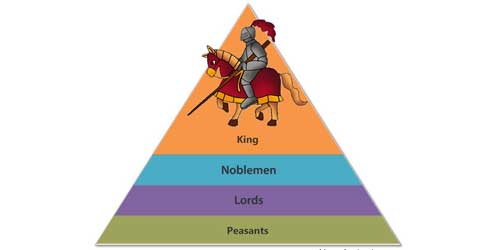
The basic government and society in Europe during the middle ages was based around the feudal system. Small communities were formed around the local lord and the manor. The lord owned the land and everything in it. He would keep the peasants safe in return for their service. The lord, in return, would provide the king with soldiers or taxes.

Service for Land

Under the feudal system land was granted to people for service. It started at the top with the king granting his land to a baron for soldiers all the way down to a peasant getting land to grow crops.

Read Also: Federalism in India

The Manor

The center of life in the Middle Ages was the manor. The manor was run by the local lord. He lived in a large house or castle where people would gather for celebrations or for protection if they were attacked. A small village would form around the castle which would include the local church. Farms would then spread out from there which would be worked by the peasants.

Hierarchy of Rulers

King – The top leader in the land was the king. The king could not control all of the land by himself, so he divided it up among the Barons. In return, the Barons pledged their loyalty and soldiers to the king. When a king died, his firstborn son would inherit the throne. When one family stayed in power for a long time, this was called a dynasty.

Bishop – The Bishop was the top church leader in the kingdom and managed an area called a diocese. The Catholic Church was very powerful in most parts of Medieval Europe and this made the Bishop powerful as well. Not only that, but the church received a tithe of 10 percent from all the people. This made some Bishops very rich.

Baron – Barons ruled large areas of land called fiefs. They reported directly to the king and were very powerful. They divided up their land among Lords who ran individual manors. Their job was to maintain an army that was at the king’s service. If they did not have an army, sometimes they would pay the king a tax instead. This tax was called shield money.

Lord – The lords ran the local manors. They also were the knights and could be called into battle at any moment by their Baron. The lords owned everything on their land including the peasants, crops, and village.

Must Read: Establishment of Turkish Rule in North India

Peasants or Serfs

Most of the people living in the Middle Ages were peasants. They had a hard rough life. Some peasants were considered free and could own their own businesses like carpenters, bakers, and blacksmiths. Others were more like slaves. They owned nothing and were pledged to their local lord. They worked long days, 6 days a week, and often barely had enough food to survive.

Fun Facts about the Middle Age Feudal System

  • Around 90 percent of the people worked the land as peasants.
  • Peasants worked hard and died young. Most were dead before they reached 30 years old.
  • The kings believed they were given the right to rule by God. This was called “divine right”.
  • Lords and Barons swore oaths of homage and fealty to their kings.
  • The Lord held absolute power over the fief or manor including holding court and deciding punishments for crimes.

Don’t Miss: Story of United Kingdom History in nutshell

Padma Awardees 2021 Full List

0
padma awardees list 2021

Padma Awards – one of the highest civilian Awards of the country, are conferred in three categories, namely, Padma Vibhushan, Padma Bhushan and Padma Shri. The Awards are given in various disciplines/ fields of activities, viz.- art, social work, public affairs, science and engineering, trade and industry, medicine, literature and education, sports, civil service, etc. ‘Padma Vibhushan’ is awarded for exceptional and distinguished service; ‘Padma Bhushan’ for distinguished service of high order and ‘Padma Shri’ for distinguished service in any field. The awards are announced on the occasion of Republic Day every year.

These awards are conferred by the President of India at ceremonial functions which are held at Rashtrapati Bhawan usually around March/ April every year. This year the President has approved conferment of 119 Padma Awards including 1 duo case (in a duo case, the Award is counted as one) as per list below. The list comprises 7 Padma Vibhushan, 10 Padma Bhushan and 102 Padma Shri Awards.  29 of the awardees are women and the list also includes 10 persons from the category of Foreigners/NRI/PIO/OCI, 16 Posthumous awardees and 1 transgender awardee.

Padma Vibhushan (7)

NameFieldState/Country
Shri Shinzo AbePublic AffairsJapan
Shri S P Balasubramaniam(Posthumous)ArtTamil Nadu
Dr. Belle Monappa HegdeMedicineKarnataka
Shri Narinder Singh Kapany(Posthumous)Science and EngineeringUnited States of America
Maulana Wahiduddin KhanOthers- SpiritualismDelhi
Shri B. B. LalOthers- ArchaeologyDelhi
Shri Sudarshan SahooArtOdisha

Padma Bhushan (10)

Ms. Krishnan Nair Shantakumari ChithraArtKerala
Shri Tarun Gogoi(Posthumous)Public AffairsAssam
Shri Chandrashekhar KambaraLiterature and EducationKarnataka
Ms. Sumitra MahajanPublic AffairsMadhya Pradesh
Shri Nripendra MisraCivil ServiceUttar Pradesh
Shri Ram Vilas Paswan(Posthumous)Public AffairsBihar
Shri Keshubhai Patel(Posthumous)Public AffairsGujarat
Shri Kalbe Sadiq(Posthumous)Others-SpiritualismUttar Pradesh
Shri Rajnikant Devidas ShroffTrade and IndustryMaharashtra
Shri Tarlochan SinghPublic AffairsHaryana

Padma Shri (102)

Shri Gulfam AhmedArtUttar Pradesh
Ms. P. AnithaSportsTamil Nadu
Shri Rama Swamy AnnavarapuArtAndhra Pradesh
Shri Subbu ArumugamArtTamil Nadu
Shri Prakasarao AsavadiLiterature and EducationAndhra Pradesh
Ms. Bhuri BaiArtMadhya Pradesh
Shri Radhe Shyam BarleArtChhattisgarh
Shri Dharma Narayan BarmaLiterature and EducationWest Bengal
Ms. Lakhimi BaruahSocial WorkAssam
Shri Biren Kumar BasakArtWest Bengal
Ms. Rajni BectorTrade and IndustryPunjab
Shri Peter Brook ArtUnited Kingdom
Ms. Sangkhumi BualchhuakSocial WorkMizoram
Shri Gopiram Bargayn BurabhakatArtAssam
Ms. Bijoya ChakravartyPublic AffairsAssam
Shri Sujit ChattopadhyayLiterature and EducationWest Bengal
Shri Jagdish Chaudhary (Posthumous)Social WorkUttar Pradesh
Shri Tsultrim ChonjorSocial WorkLadakh
Ms. Mouma DasSportsWest Bengal
Shri Srikant DatarLiterature and EducationUnited States of America
Shri Narayan DebnathArtWest Bengal
Ms. Chutni DeviSocial WorkJharkhand
Ms. Dulari DeviArtBihar
Ms. Radhe DeviArtManipur
Ms. Shanti DeviSocial WorkOdisha
Shri Wayan DibiaArtIndonesia
Shri Dadudan GadhaviLiterature & EducationGujarat
Shri Parshuram Atmaram GangavaneArtMaharashtra
Shri Jai Bhagwan GoyalLiterature and EducationHaryana
Shri Jagadish Chandra HalderLiterature and EducationWest Bengal
Shri Mangal Singh HazowaryLiterature and EducationAssam
Ms. Anshu JamsenpaSportsArunachal Pradesh
Ms. Purnamasi JaniArtOdisha
Matha B. Manjamma JogatiArtKarnataka
Shri Damodaran KaithapramArtKerala
Shri Namdeo C KambleLiterature and EducationMaharashtra
Shri Maheshbhai & Shri Nareshbhai Kanodia (Duo) *(Posthumous)ArtGujarat
Shri Rajat Kumar KarLiterature and EducationOdisha
Shri Rangasami Lakshminarayana KashyapLiterature and EducationKarnataka
Ms. Prakash KaurSocial WorkPunjab
Shri Nicholas KazanasLiterature and EducationGreece
Shri K Kesavasamy ArtPuducherry
Shri Ghulam Rasool KhanArtJammu and Kashmir
Shri Lakha KhanArtRajasthan
Ms. Sanjida KhatunArtBangladesh
Shri Vinayak Vishnu KhedekarArtGoa
Ms. Niru KumarSocial WorkDelhi
Ms. Lajwanti ArtPunjab
Shri Rattan LalScience and EngineeringUnited States of America
Shri Ali ManikfanOthers-Grassroots InnovationLakshadweep
Shri Ramachandra ManjhiArtBihar
Shri Dulal MankiArtAssam
Shri Nanadro B MarakOthers- AgricultureMeghalaya
Shri Rewben MashangvaArtManipur
Shri Chandrakant MehtaLiterature and EducationGujarat
Dr. Rattan Lal MittalMedicinePunjab
Shri Madhavan NambiarSportsKerala
Shri Shyam Sundar PaliwalSocial WorkRajasthan
Dr. Chandrakant Sambhaji PandavMedicineDelhi
Dr. J N Pande(Posthumous)MedicineDelhi
Shri Solomon PappaiahLiterature and Education- JournalismTamil Nadu
Ms. PappammalOthers- AgricultureTamil Nadu
Dr. Krishna Mohan PathiMedicineOdisha
Ms. Jaswantiben Jamnadas PopatTrade and IndustryMaharashtra
Shri Girish PrabhuneSocial WorkMaharashtra
Shri Nanda PrustyLiterature and EducationOdisha
Shri K K Ramachandra PulavarArtKerala
Shri Balan PutheriLiterature and EducationKerala
Ms. Birubala RabhaSocial WorkAssam
Shri Kanaka RajuArtTelangana
Ms. Bombay Jayashri RamnathArtTamil Nadu
Shri Satyaram ReangArtTripura
Dr. Dhananjay DiwakarSagdeoMedicineKerala
Shri Ashok Kumar SahuMedicineUttar Pradesh
Dr. Bhupendra Kumar Singh SanjayMedicineUttarakhand
Ms. Sindhutai SapkalSocial WorkMaharashtra
Shri Chaman Lal Sapru(Posthumous)Literature and EducationJammu and Kashmir
Shri Roman SarmahLiterature and Education- JournalismAssam
Shri Imran ShahLiterature and EducationAssam
Shri Prem Chand SharmaOthers- Agriculture Uttarakhand
Shri Arjun Singh ShekhawatLiterature and EducationRajasthan
Shri Ram Yatna ShuklaLiterature and EducationUttar Pradesh
Shri Jitender Singh ShuntySocial WorkDelhi
Shri Kartar Paras Ram SinghArtHimachal Pradesh
Shri Kartar SinghArtPunjab
Dr. Dilip Kumar SinghMedicineBihar
Shri Chandra Shekhar SinghOthers-AgricultureUttar Pradesh
Ms. Sudha Hari Narayan SinghSportsUttar Pradesh
Shri Virender SinghSportsHaryana
Ms. Mridula Sinha(Posthumous)Literature and EducationBihar
Shri K C Sivasankar(Posthumous)ArtTamil Nadu
Guru Maa Kamali SorenSocial WorkWest Bengal
Shri Marachi SubburamanSocial WorkTamil Nadu
Shri P Subramanian(Posthumous)Trade and IndustryTamil Nadu
Ms. Nidumolu Sumathi ArtAndhra Pradesh
Shri Kapil TiwariLiterature and EducationMadhya Pradesh
Father Vallés(Posthumous)Literature and EducationSpain
Dr. Thiruvengadam Veeraraghavan(Posthumous)MedicineTamil Nadu
Shri Sridhar VembuTrade and IndustryTamil Nadu
Shri K Y Venkatesh SportsKarnataka
Ms. Usha YadavLiterature and EducationUttar Pradesh
Col Quazi Sajjad Ali ZahirPublic AffairsBangladesh

Note:  * In duo case, the award is counted as one

The Crusades

0
crusades
crusades

The Crusades were a series of wars during the Middle Ages where the Christians of Europe tried to retake control of Jerusalem and the Holy Land from the Muslims.

Jerusalem

Jerusalem was important to a number of religions during the Middle Ages. It was important to Jewish people as it was the site of the original temple to God built by King Solomon. It was important to the Muslims because it was where they believe Muhammad ascended to heaven. It was important to Christians as it is where Christ was crucified and rose again.

Read Also: Marco Polo  An Italian Travelled China and the Far East

Who fought in the Crusades?

The Crusades were between the armies of the Europe, mostly the Holy Roman Empire, and the Arabs that had control of Jerusalem. In the first Crusade, this was the Seljuk Turks.

There were around 30,000 soldiers from Europe in the first Crusade, they were made up of Knights, peasants, and other commoners. Some saw the army as a way to get rich and try out their fighting skills, while others saw it as a way into heaven.

How they got started

The initial Crusade began when the Seljuk Turks took control of the Holy Land. Prior to this, the Arabs had been in control of the land. However, the Arabs had allowed Christians to pilgrimage and visit the city of Jerusalem. In 1070, when the Turks took control, they began to refuse Christian pilgrims into the area.

Byzantine Emperor Alexius I called for help from the Pope with defending his empire from the Turks and to help push them out of the Holy Land. The Pope helped to gather an army, primarily with the help of the Franks and the Holy Roman Empire.

Also Read: Byzantine, Ottoman, Incas and Aztecs, North American Indians

Timeline of the Crusades

There were a number of Crusades that took place over the course of 200 years starting in 1095:

  • The First Crusade (1095-1099): The First Crusade was the most successful. Armies from Europe drove out the Turks and took control of Jerusalem.
  • The Second Crusade (1147-1149): In 1146 the city of Edessa was conquered by the Turks. The entire population was killed or sold into slavery. Then a second Crusade was launched but was unsuccessful.
  • The Third Crusade (1187-1192): In 1187 Saladin, the sultan of Egypt, recaptured the city of Jerusalem from the Christians. A third Crusade was launched led by Emperor Barbarossa of Germany, King Philip Augustus of France, and King Richard the Lionheart of England. Richard the Lionheart fought Saladin for several years. In the end, he could not conquer Jerusalem, but he did win the right for pilgrims to visit the holy city once again.
  • The Fourth Crusade (1202-1204): The Fourth Crusade was formed by Pope Innocent III with the hope of taking back the Holy Land. However, the Crusaders got sidetracked and greedy and ended up conquering and plundering Constantinople instead.
  • Children’s Crusade (1212): Started by a French child named Stephen of Cloyes and a German kid named Nicholas, tens of thousands of children gathered to march to the Holy Land. This ended in total disaster. None of the children made it to the Holy Land and many were never seen again. They were likely sold into slavery.
  • Crusades Five through Nine (1217 – 1272): Over the next several years there would be 5 more Crusades. None of them would be very successful in terms of gaining control of the Holy Land.

Must Read: Ambedkar : The Crusader Against Caste System

Interesting Facts about the Crusades

  • “Deus vult!”, meaning “God wills it” was the battle cry of the Crusaders. It came from a speech the Pope gave while gathering support for the First Crusade.
  • The symbol of the Crusaders was a red cross. Soldiers wore it on their clothing and armor. It was also used on flags and banners.
  • Between the second and the third Crusades, the Teutonic Knights and the Templars were formed to help defend Christendom. These were famous groups of Holy Knights.

Also, Read:

The Revolt 1857: the First War of Independence

Revolt of 1857 Its Impact and Cause of Failure