
Home Blog Page 191

Quantum Repeater Architectures: Bridging Long-Distance Quantum Communication

0
quantum repeater architecture

Table of Contents

  1. Introduction
  2. Why Quantum Repeaters Are Necessary
  3. Challenges in Long-Distance Quantum Communication
  4. Basic Structure of a Quantum Repeater
  5. First-Generation Repeaters: Entanglement Purification + Swapping
  6. Second-Generation Repeaters: Error Correction-Assisted
  7. Third-Generation Repeaters: Fully Error-Corrected Repeater Chains
  8. Core Components of a Quantum Repeater
  9. Quantum Memory and Buffering
  10. Entanglement Generation and Heralding
  11. Bell-State Measurement and Entanglement Swapping
  12. Entanglement Purification Protocols
  13. Quantum Error Correction in Repeaters
  14. Repeater Rate and Latency Considerations
  15. Physical Platforms for Quantum Repeaters
  16. Hybrid Repeaters (Optical + Matter Qubits)
  17. Multiplexing Techniques in Repeaters
  18. Quantum Repeater Networks and Topologies
  19. Experimental Demonstrations
  20. Conclusion

1. Introduction

Quantum repeaters are specialized devices that enable long-distance entanglement distribution across quantum networks. They overcome the limitations imposed by loss and decoherence in optical fibers or free-space channels.

2. Why Quantum Repeaters Are Necessary

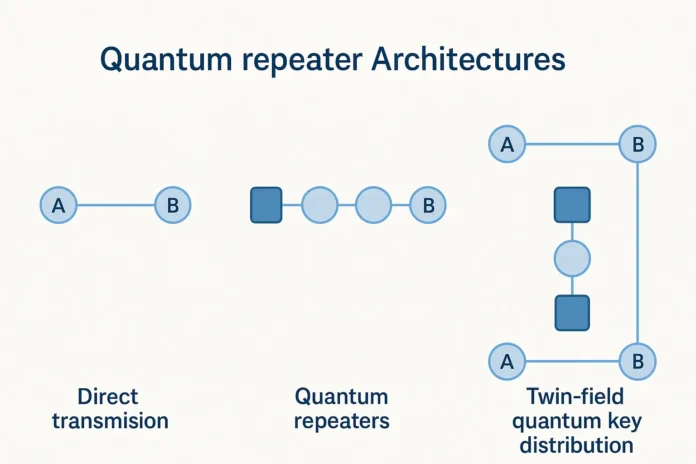
Without repeaters, quantum signals degrade exponentially with distance due to photon loss. Direct transmission beyond ~100 km becomes impractical even with the best single-photon detectors.

3. Challenges in Long-Distance Quantum Communication

  • Exponential loss in fiber (e.g., ~0.2 dB/km at 1550 nm)
  • No-cloning theorem prevents signal amplification
  • Decoherence and timing synchronization over large scales

4. Basic Structure of a Quantum Repeater

Typically includes:

  • Entangled photon source
  • Quantum memory at nodes
  • Bell-state measurement unit
  • Classical communication and control hardware

5. First-Generation Repeaters: Entanglement Purification + Swapping

  • Use probabilistic entanglement generation and heralding
  • Employ purification protocols to enhance fidelity
  • Require two-way classical communication, limiting speed

6. Second-Generation Repeaters: Error Correction-Assisted

  • Replace purification with quantum error detection/correction
  • Allow one-way classical communication
  • Achieve faster entanglement distribution at modest resource cost

7. Third-Generation Repeaters: Fully Error-Corrected Repeater Chains

  • Use logical qubits encoded with fault-tolerant codes
  • Capable of continuous operation with no heralding
  • Scalable to continent-level distances

8. Core Components of a Quantum Repeater

  • Quantum memory with long coherence time
  • Efficient photon-matter interface
  • Bell-state measurement (BSM) capability
  • Timing and synchronization unit

9. Quantum Memory and Buffering

Required to store entangled states until a successful entanglement swap:

  • Types: atomic ensembles, rare-earth-doped crystals, NV centers
  • Must support long storage time and high retrieval efficiency

10. Entanglement Generation and Heralding

  • Performed via spontaneous parametric down-conversion (SPDC) or quantum dots
  • Heralded by detecting one photon of a pair to confirm entanglement

11. Bell-State Measurement and Entanglement Swapping

  • Entanglement swapping connects two shorter links into one longer entangled pair
  • Requires precise interference and high-efficiency photon detection

12. Entanglement Purification Protocols

  • Improve fidelity of entangled states using local operations and classical communication (LOCC)
  • Sacrifice multiple low-fidelity pairs to obtain fewer high-fidelity ones

13. Quantum Error Correction in Repeaters

  • Codes like surface code or Bacon-Shor used
  • Correct both bit-flip and phase-flip errors
  • Trade-off between code overhead and repeater rate

14. Repeater Rate and Latency Considerations

  • First-gen limited by classical round-trip time
  • Second/third-gen can operate with minimal latency
  • Latency critical for quantum key distribution (QKD)

15. Physical Platforms for Quantum Repeaters

  • Trapped ions
  • NV centers in diamond
  • Rare-earth doped crystals
  • Atomic ensembles
  • Superconducting qubits with photonic interfaces

16. Hybrid Repeaters (Optical + Matter Qubits)

  • Combine benefits of fast photonic transmission with stable matter qubits
  • Allow for modular, flexible repeater nodes

17. Multiplexing Techniques in Repeaters

  • Temporal multiplexing: parallel trials over time
  • Spectral multiplexing: use multiple frequency channels
  • Spatial multiplexing: use parallel spatial paths

18. Quantum Repeater Networks and Topologies

  • Linear chains for direct links
  • Star or mesh networks for scalable entanglement distribution
  • Hierarchical repeaters for global-scale networks

19. Experimental Demonstrations

  • Entanglement swapping over 100+ km
  • Memory-assisted repeaters with cold atoms and solid-state systems
  • QKD networks incorporating repeater nodes under development

20. Conclusion

Quantum repeaters are the backbone of future quantum networks, enabling global entanglement and secure communication. Continued progress in memory, photonics, and error correction will unlock high-speed, fault-tolerant quantum repeater networks.
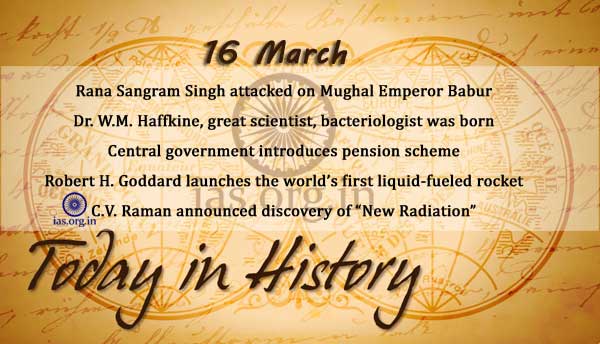
Today in History – 16 March

1
today in history 16 march

today in history 16 march

1527

Rana Sangram Singh, King of Mewad, attacked on Mughal Emperor Babur near Kanwa at Agra.

1751

On this day in 1751, James Madison, drafter of the Constitution, recorder of the Constitutional Convention, author of the Federalist Papers and fourth president of the United States, is born on a plantation in Virginia.

1860

Dr. W.M. Haffkine, great scientist, bacteriologist and professor, was born at Odessa in Russia.

1910

Iftikhar Ali Khan Pataudi, cricketer (Nawab of Pataudi sr, England & India), was born in Pataudi, Punjab.

1912

Gandhiji commends Gokhale’s attempts for abolition of indenture system.

1924

Bhupendranath Basu, great freedom fighter, President of Congress and fluent orator, passed away.

1926

The first man to give hope to dreams of space travel is American Robert H. Goddard, who successfully launches the world’s first liquid-fueled rocket at Auburn, Massachusetts. The rocket traveled for 2.5 seconds at a speed of about 60 mph, reaching an altitude of 41 feet and landing 184 feet away. The rocket was 10 feet tall, constructed out of thin pipes, and was fueled by liquid oxygen and gasoline.

1928

C.V. Raman announced his discovery of ”new radiation” to an assembly of scientists at Bangalore.

1939

Subroto Mukherjee became the first Indian Officer to command a squadron when he took over No.1.

1946

India calls Attlee’s independence offer contradictory, ‘a propaganda move’.

1986

Internationally wanted criminal Charles Sobharaj and 6 other prisoners escape from Tihar Jail.

1992

Satyajit Ray, veteran film producer and director, was presented the honorary Oscar by a three-member Oscar committee at a Calcutta nursing home.

1993

Central government introduces pension scheme for 170 million EPF subscribers.

1997

The first batch of three Russian-made Sukhoi-30 combat aircraft reaches India.

1998

Sonia Gandhi is elected chairperson of the Congress(I) Parliamentary Party.

1999

The Shiromani Akali Dal creates a record by unanimously electing Bibi Jagir Kaur Begowal as the first woman president of the SGPC.

All About Earth

1
all about earth
The earth is an oblate spheroid and not a true sphere because it is flattened at the poles and bulges out at the equator. Its circumference is 25,000 miles.

Earth in Motion

The axis of the earth is the imaginary line on which the earth rotates.

Poles

They are the end of the axis. One end is called the North Pole and other the South Pole.

The Solar System

It is the name given to the group of nine major planets (Mercury, Venus, Earth, Mars, Jupiter, Saturn, Uranus, Neptune, Pluto) and their satellites, asteroids and hundreds of meteorites which revolve around the sun. They are kept in position on account of the pull of the sun on the planets. The Solar System originated from the huge gaseous mass called Nebulae.
The six most abundant elements in the earth’s crust are:(1)Oxygen 49.85% (2)Silicon 26.03% (3)Aluminium 7.28% (4)Iron 4.12% (5)Calcium 3.18% (6)Sodium 2.33%.

Motion of the Earth

Rotation of the Earth

It turns round its own axis once in 24 hours,from West to East.

Revolution of the Earth

It revolves around the sun in about 365 days.

The Boundaries of the Zones

The Torrid Zone

It lies between the Tropic of Cancer and Tropic of Capricorn,i.e 23 and a half degree North and South on either of Equator side.
Must Read: Climate of India

The Frigid Zone

The coldest zone which the sun’s rays are excluded entirely at least for one whole day in a year.

The Temperate Zone

It is between the Torrid and Frigid Zone 66 and a half degree North and South on either side of the Equator.

Latitude and Longitude

Lines of Latitude and Longitude are drawn on a map to locate the position of the place on the surface of the earth.
The equator is an imaginary circle on the surface of the earth, midway between poles. Latitude is the angular distance measuring North to South of the Equator from the plane of the Equator.

Meridian

Meridian means “Midway Line”. It is the imaginary line joining North and South Poles that, when any place comes directly below the sun, has its midday everywhere on it.

Prime Meridian

It is the meridian, that passes through Greenwich, that is placed near London.It is the zero degree longitude.

Local Time

Local Time or Sun Time of the place is the time which is reckoned according to the time when the sun’s altitude is the highest at that place. At this time, the shadow of a vertical rod fixed in the ground is the shortest.

Standard Time

If every place were to use its own local time that Standard Time of India is the local time of a place near Allahabad situated at 82 and a half degree E longitude.

Delta

It is a triangular-shaped land between the distributaries of a river.

Tide

Tide is the periodic rise and fall of sea water twice in about 25 hours.

Causes of Tide

Two forces are acting on the earth:(a) the moon’s attraction, (b) the centrifugal force. Although these two forces are equal and opposite to each other at the centre of the earth yet that is not the case everywhere on the earth. Tide is caused by the difference in these two forces.

Types of Tides

Spring Tide, Neap Tide, Eclipses, Lunar Eclipses, Solar Eclipse, Currents, Contours.

Natural Regions

The Hot Belt, Savanna or Sudan Type, Desert Type, The Monsoon Type, The Mediterranean Type, Steppe Type, China Type, British Type, Siberian Type, EasternType, Tundra Type.
Read Also:

Kyoto Protocol – Detailed Analysis

6
kyoto protocol

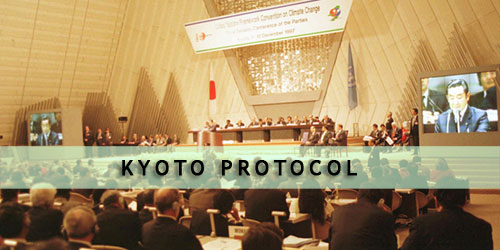
Kyoto Protocol is considered as a milestone in the field of climate change negotiations. It came into existence in third Conference of Parties held in Japan in 1997. The Kyoto Protocol has completed its term and now world is moving forward to a more strong resolution in Paris Meet last year. Before discussing Paris meet let’s have an analysis on few important meets of UNFCCC (CoP).

What is UNFCCC and CoP?

The first multilateral legal instrument on climate change was adopted, by consensus among 195 parties, in a UN Summit Conference on Environment and Development (UNCED). This instrument was named UNFCCC (The UN Framework Convention on Conference of the Parties). All institutions, particularly the Conference of the Parties (COP), the subsidiary bodies (advisor of the cop), and the COP bureau, engaged in the international climate charge negotiations are supported well by the UNFCCC secretariat. COP Bureau deals mainly with organizational and procedural issue emerging from the COP and also has some technical function. All the multilateral negotiation are based on the principle and objectives spelled art by the UNFCCC, which were to cooperatively consider what they could do to check average global temperature increase and the resulting climate charge.

Also Read: Earth Summit 1992 an Post-Rio Progress

KYOTO PROTOCOL: COP-3       

On 11 December 1997, the Kyoto Protocol was adopted, in order to strengthen the global response to climate change in Kyoto, Japan. However, due to a complicated ratification process it entered into force on 16 February 2005.

The Kyoto Protocol commits industrialised nation to stabilise greenhouse gas emission based on the principles and objectives of the convention. Therefore, it can be said that the Kyoto Protocol “operationalized” the convention.

The major difference between the convention and the Protocol is -the convention encourages industrialized nations to stabilize GHG emission, the Protocol commits them to do it.

Targets:              

In its first commitment period, KP fixed binding targets for 37 industrialized countries and the European countries. It was acknowledged by KP that developed countries were mainly responsible for the current high level of GHG emissions in the atmosphere owing to their 150 years of industrial activities. so it  only restricted the developed countries.

Under its central principle of common but differentiates responsibility. KP placed a heavier burden on developed counties. these targets on the whole added up to an average five per cent emissions reduction compared to 1990 levels over the five-year period from 2008 to 2012.

Also Read: Understanding Global Warming

The Famework of Kyoto Protocol regime                           

The essential framework of the Kyoto Protocol has been constructed and shaped over almost two decoded of experience, political will and hard work. The most important features on which Kyoto Protocol was made up of:-

  1. Procedures of reporting and verification,
  2. Flexible market-based mechanisms which had in turn their own procedures of governance and,
  3. A system of compliance. So it can be claimed that two things made KP function efficiently


  1. Commitments to emission reduction

The restricted emission reduction commitments for developed parties, the first one, clearly indicated that space to pollute was limited. Carbon dioxide became new commodity as it was prevalent in greenhouse gas emissions. Kyoto Protocol then started to internalise what was then acknowledged as unpriced externalities.

  1. Mechanism of flexible Markets

The mechanisms of flexible markets, the second one, of the KP were based on the trade of emissions permits. The countries bound to targets had to meet them mainly through domestic action-for example, in the developing countries.

Mechanisms of the Kyoto Flexible Market Protocol:

  • JI (joint Implementation)
  • CDM (The clean Development Mechanism)
  • Emission Trading.

Also Read: Ecology and Environment

The objectives of Kyoto mechanisms:

Its objective is to promote, facilitate and enforce compliance with commitment listed in the protocol.

Its objectives are:

  • to help parties to meet their targets by removing carbon from the atmosphere in other countries in a cost-effective way.
  • to encourage sustainable development through investment and technology transfer.
  • to urge the developing countries and the private sector to contribute to the efforts in emission reduction .

Joint Implementation:

This mechanism permitted a country under the Kyoto Protocol (Annex. B Party- develop nation) to earn emission reduction units (ERUs) from an emission removal project in another Annex B Party, each being equivalent to one tonne of CO2 which could be counted towards meeting its Kyoto target.

In this mechanism the host party benefited from foreign investment and technology transfer. Although projects starting from the year 2000 might be eligible as JI projects, ERU issued from 2008.

Clean Development Mechanism     

The clean Development Mechanism (CDM), being the first global, environmental investment and credit scheme of its kind, allowed a party under the Kyoto Protocol (Annex B Party) to implement an emission reduction project in developing countries.

This scheme provided standardized emission offset instrument – CERs. The projects under this scheme could earn certified emission reduction (CER) credits, each equivalent to one tonne of Carbon dioxide that could be counted in meeting Kyoto targets.


Carbon Trading:

The exchange of emission permits that – is carbon trading – may take place within the economy or may take the form of international transaction.

There are two types of carbon trading;

  1. Emission trading, and
  2. Offset trading

1. Emission trading/ ‘Cap-and-trade’

Emission permit is another name for carbon credit. The protocol had assigned a fixed amount of carbon emission for each Annex 1 country in the agreement. This amount was in fact the amount  of emission that was to be reduced by the concerned country, implying that the country was permitted to exit the remaining amount. This allowance was in fact kind of carbon credit.

The total amount of allowance was then subdivides into certain units which were expressed in terms of carbon equivalent. Each unit granted the owner the right to exit one metric tonne of greenhouse gods.

  1. Offset trading/Carbon project/’Baseline-and-credit’ trading:

A country can earn another variant of carbon credit by investing some amount of money in carbon projects which exit lesser amount of greenhouse gas in the atmosphere. The Word Bank’s carbon finance unit estimated that the volume of carbon trade through emission trading route alone had indicated a 240 per cent increase in 2005 over the previous year.

Benefits of flexible market mechanism

It has the analogous benefits or encouraging green investment in developing countries and embracing the private sector in this effort to cut and hold steady GHG emission at save level. It also makes “leap- frogging” more economical by creating the possibility to terminate older, dirtier technology for newer, cleaner infrastructure and systems to get long term benefits.

The Kyoto Protocol compliance mechanism was aimed to strengthen its environmental integrity, support the credibility of carbon market and ensure transparency of accounting by parties.

Non-Compliance of Kyoto Protocol and Penalties

kyoto protocol-The country that does not fulfil the requirements for measurements and reporting loses the privilege of getting credit through joint implementation projects.

– The country that crosses its emission cap, and does not try to bridge the difference by using any of the available mechanisms, must make up the difference plus and an additional thirty per cent during the next period. The country could also face a ban from participating in the “cap and trade” programme.

Also Read: The United Nations Environment Programme (UNEP)

Central Vigilance Commission (CVC)

2
Central Vigilance Commission

Establishment

Central Vigilance Commission (CVC), a top Indian Governmental body, was formed in February 1964 to address the rampant corruption in government departments. Central Vigilance Commission was set up on the recommendations of the Committee on Prevention of Corruption headed by K.Santhanam.  Its main function was to guide and advise Central Government agencies in the area of vigilance.

The Sanathanam Committee, before finalizing its report, presented its interim recommendations to the government in two parts. In the first part it recommended the formation of the Central Vigilance Commission. In the part second the committee suggested granting powers to the commission. The committee advocated that the powers had to be similar to those under Sections 4 and 5 of the Commission of Enquiry Act, 1952, so that the Central Vigilance Commission could embark on an inquiry into transactions where public servants were suspected of having acted in a corrupt manner. It is important here to mention that CVC, as autonomous body, is free of control of any other executive authority. It has got the power to monitor all vigilance activities that fall under the Central Government of India, and advise various authorities in Union Government organizations in planning, executing, reviewing and reforming their vigilance works.

Must Read: Social Conditions Under Gupta Period

Composition of Central Vigilance Commission

The Central Vigilance Commission comprises of a Central Vigilance Commissioner called the chairperson; and it has not more than two members who are called Vigilance Commissioners.

Mr. Nittoor Srinivasa Rao was made the first Chief Vigilance Commissioner of India. Mr. K. V. Chowdary is the current Central Vigilance  Commissioner; prior to this appointment, he was the Chairman of the Central Board of Direct Taxes. The other two members, the Vigilance Commissioners, are Shri T M Bhasin and Mr. Sarad Kumar.

Appointment and Oath

The President of India after receiving the recommendations of a committee appoints the Central Vigilance Commissioner and the Vigilance Commissioners. The Committee consists of the Prime Minister who functions as the Chairperson; the minister of the Home Affairs; and the leader of the second largest party in the Lok Sabha or majority group leader in the parliament.

According to the Schedule of the Central Vigilance Commission Act, 2003, the Central Vigilance Commissioner or a Vigilance Commissioner, before he enters upon his office, is required to make and subscribe to an oath or affirmation before the President of India.

Also Read: Indian Renaissance – The Socio-Cultural Awakening

Removal of Central Vigilance Commissioner

Only the president has got the power to remove The Central Vigilance Commissioner or any Vigilance Commissioner on the ground of proven misbehavior or incapacity in The Supreme Court. The President, following the due process of law, at first refers the matter to the Supreme Court to inquire into. If the Supreme Court, after inquiry, reports to the President that the Central Vigilance Commissioner or any Vigilance Commissioner, as the case may be, should be removed then the President,  using his constitutional power, orders the removal.

During the inquiry of the Supreme Court, the Central Vigilance Commissioner or any Vigilance Commissioner may be suspended from the office by the President till he gets the report of the Supreme Court on his reference.

The Commissioner can be removed if he: engages in any paid employment outside the duties of his office; or has developed such financial or other interests as is likely to affect his functions as a Central Vigilance Commissioner or a Vigilance Commissioner; or has been convicted of an offence which, in the opinion of the Union Government, includes moral turpitude; or is, in the opinion of the President, unfit to continue in office by reason of infirmity of mind or body.

Role and Limitations of CVC

As the Central Vigilance Commission is not an investigating agency, the only investigating it can accomplish is that of examining Civil Works of the Government that is done through the Chief Technical Officer. The investigations against corrupt officials can be initiated only after obtaining the permission of the Government. The CVC publishes a list of cases where permissions are pending.

Department s of the Central Government are not bonded to accept Central Vigilance Commission’s advice in corruption cases as it is an advisory body. It does not have enough resources to entertain all complaints that it receives as it is a very small set up with a sanctioned staff of 299.It is important here to mention in this context that CVC is supposed to restrain corruption in more than 1500 Central Government departments and ministers.Central Vigilance Commission has not got the powers to register criminal case. It can deal only with Vigilance or disciplinary cases. Although it has got supervisory powers over CBI, Central Vigilance Commission can not demand any file from CBI or direct CBI investigate any case in a particular manner.

Don’t Miss: Money Bill and Finance Bill