
Home Blog Page 190

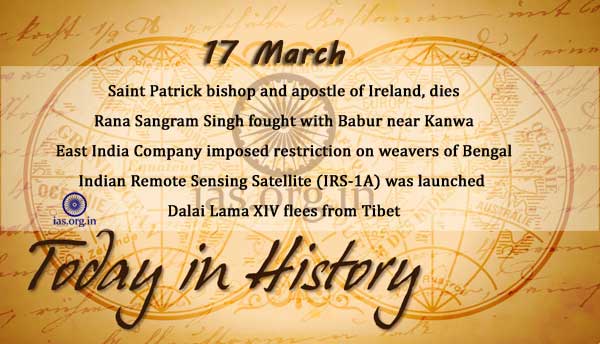
Today in History – 17 March

0
today in history 17 march

today in history 17 march

461 AD

Saint Patrick, Christian missionary, bishop and apostle of Ireland, dies at Saul, Downpatrick, Ireland.

1527

Rana Sangram Singh, King of Mewad, fought Babur near Kanwa at Agra and lost the battle and died thereafter. He had vowed not to enter Chittogarh without a victory.

1769

To establish the business of English Mill’s Cloth, East Indiian Company had imposed various restriction on weavers of Bengal to destroy the Muslim and textile industry in Bengal , which was meant to destroy the Indian cloth and ‘malmal’ industry.

1782

Salby Teaty was singed between Anderson (British) and Scindia for the Maratha and East India Company.

1798

Rani Shiromani anounced to attack the British Army.

1906

A powerful earthquake and a full day of aftershocks rock Taiwan on this day in 1906, killing over 1,200 people. This terrifying day of tremors destroyed several towns and caused millions of dollars in damages.

1943

Indian troops retreat from Rathedaung to Buthidaung in the face of a renewed Japanese offensive on the Arakan front in Burma.

1955

Indian Standard’s Institute started working to control the quality of Indian products and the ISI mark was issued to quality products.

1959

Dalai Lama XIV flees from Tibet after Chinese military occupied Tibet.

1967

4th Parliament (Lok Sabha) was formed.

1988

First operational Indian Remote Sensing Satellite (IRS-1A) launched by a Russian Vostok. IRS system under National Natural Resources Management System (NNRMS) coordinated at national level by the Planning Committee of NNRMS (PC-NNRMS) and the data from IRS satellites is processed by the National Remote Sensing Agency, Hyderabad. SI, a US Company, also receives and markets IRS data worldwide under a commercial contract with Antrix Corporation of the Department of Space.

1991

The first Indian Remote Sensing Satellite IRS-IA completes three years of successful operation.

1997

Cochin Stock Exchange goes online.

1999

An international seminar on UN Peacekeeping was co-jointly hosted by Ministry of External affairs and Ministry of Defence at New Delhi from 17 to 19 March 1999. The seminar was conducted by HQ Army Training Command, Shimla on behalf of the Indian Army. A total of 126 foreign delegates from 71 countries participated in the seminar.

Related Articles:
Today in History – 16 March

Today in History – 15 March

Today in History – 14 March

Today in History – 12 March

Pollution

1
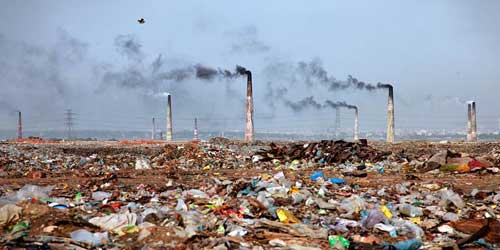
The addition of constituents to water, air or land, which adversely alter the natural quality of our environment is known as Pollution. Pollution may also be defined as an undesirable variation in the physical, chemical or biological characteristics of our water, air and land that may or will harmfully affect human life or that of desirable species, our industrial processes, living conditions and cultural assets, or that may or will waste or deteriorate our raw material resources.

Global Aspect of Pollution

Entire world can be considered as a single vast ecosystem of the universe consisting of two parts:
 
(I) Biotic Community (or Living Part) 
That is the Biosphere in which life exists. The lack of living creatures and dis-balance in their life balance gives rise to the crises in the biological community.
 
(II) Abiotic Community (or Non-Living Part of Physical Environment) 
The abiotic or physical environment of all organism existing on the earth exists in three zones: Atmosphere, Lithosphere, and Hydrosphere.

Causes of Environmental Pollution

The root cause of environmental pollution has been men’s behave with the nature. Albeit, there are several reasons for environmental pollution, for example:

A. Harmful Gases in the Atmosphere

The concentration of harmful gases is increasing day by day in the atmosphere. Increasing Carbon dioxide content will warm up the earth atmosphere to such an extent that it will melt the polar ice and will cause a subsequent rise in sea level. Thus low line areas will be submerged, carbon dioxide is harmful to our health. Carbon mono-oxide, Sulpur dioxide, Hydrogen sulphide, Nitrogen oxide, Ozone etc also constitute the other harmful pollutant.

B. Industrial Waste (Effluents)

Discharge of untreated industrial effluents (for example Breweries, Tanneries, Dying, Textile and Paper can cause very serious pollution indeed.

C. Swage and Domestic Wastes

Dumping of tonnes of sewage, dead humans and animals and domestic wastes from cities into the water reservoirs are one of the major causer of water pollution. Discharge of untreated or partially treated sewage may cause: (a) depletion of oxygen content caused by biological oxidation of organic matter; and (b) stimulation of algae growth.
The above effects affects the diverse uses of water.

D. Insecticides and Pesticides

Insecticides used to kill insects which destroys (damages) our corps, spread several diseases in man, after spraying are washed off to the rivers and lakes and become a part fish body and other animal there. In the same way pollution of food grains by insecticides and pesticides and the various diseases caused by such food grains are also well known.
Must Read: Types of Polution

E. Automobile/Factory Exhausts

The air becomes foul by the exhaust from the internal combustion engines of automobiles used for personal conveyance, transport of goods and passenger traffic in the modern world. This polluted air is unhealthy for human and animal. Carbon monoxide is a deadly poisonous gas discharged from the automiles and factories is a serious problem in big cities of the world. It causes headaches, loss of vision, nausea, pain, convulsions, asthmatic spasm etc.

F. Fertilizers and Detergents

Fertilizers applied in the fields are also washed off into streams, rivers and the seas. Here they increase the growth of algae (algae is a microscopic green plan). This algae consumes the oxygen of water much more then they returned to water in dissolved state (during photosynthesis). In short supply of oxygen the animal living in water become suffocated.
Detergents also cause a serious problem to the fresh water resources. Major ingredients of most detergents are phosphates. When discharged into the water they support the luxuriant growth of algae.

Different types of pollution

Pollution can be classified mainly on the basis of (i) Environmental (water, soil, and air etc.); and (ii) Pollutants (lead, carbon-dioxide, solid waste etc.). On the basis of these two ways pollution may be classified as:
  1. Air
  2. Mercury Pollution
  3. Noise
  4. Pesticide and Herbicide Pollution
  5. Radioactive
  6. Soil
  7. Thermal Pollution
  8. Water Pollution

Must Read:

Most Polluted Cities in India

Indian Industry: Rules, Policies, and Types

Solid Waste Management (SWM) : Growing for Solutions

Earth Summit 1992 an Post-Rio Progress

0
The principles and objectives laid down by the Stockholm Resolution were confirmed by the Rio de Janeiro Summit on June 14, 1992 (also known as the Earth Summit) which adopted a now famous Rio Declaration and its Plan of Action popularly known as Agenda 21 and the Declaration on Principles of Forests. The Heads of Governments who attended the Earth Summit proclaimed that “there shall be sustainable development, and the environmental issues are best handled with the participation of all concerned citizens, at the relevant levels”. The post-Rio program was reviewed in the World Summit on Sustainable Development (WSSD) held on Johannesburg in 2002.
A close examination of Earth Summit performance reveals that it remained far from becoming an earth-friendly convention, which it was originally intended. This failure can be explained mainly in terms of non-performance of many treaties and conventions signed in its aftermath, which again, was due to the conflict of interests between the rich industrial countries of the North and natural resources rich environment, which have reversed the direction of ‘reforms’ towards ‘ecological globalization’. In other words, the best intentions as outlined in these treaties and conventions were defeated by the defiant USA and the other rich countries taking shelter behind it in order to safeguard their industrial elites.
The most important environmental concern relates to the dangerously increasing phenomenon of global warming. Burning of fossil fuels (e.g. coal) has been the driving force of industrialization; it also has been the major source of emissions of carbon dioxide, which along with other gases like chlorofluorocarbons (CFCs) trap the sunrays in the atmosphere and heat up the earth like a ‘greenhouse’. These GHGs (Greenhouse gases) with carbon dioxide component close to half of the total are main fuel for global warming. If these emissions are not topped, there is a fear that (a) there will be several incidents of droughts and floods; and (b) the sea level will rise and submerge a good part of low-lying countries like the Maldives, Bangladesh etc. In order to meet this danger, a UN Framework Convention on Climate Change was signed by 154 countries at the Earth Summit in 1992. After protracted negotiations, industrialized countries agreed to reduce their emissions in the period 2008-12 period by 5.2 per cent compared to 1990 levels. This is the famous Kyoto Protocol which has been signed by the majority of countries but not by the USA and Australia (prominently).
The similar fate fell to the Convention on Biological Diversity (CBD) which President (Senior) George Bush refused to sign at the 1992 Earth Summit. The CBD recognizes the rights of countries on their genetic resources and insists on the fair and equitable return for the use of these resources mostly by the pharmaceutical companies of the North. Recognition of the rights of ownership of these genetic resources for the indigenous communities is a major feature of CBD which has been ratified by more than 175 countries today.
Eighty per cent of the world’s biological resources exists in the forests in the South (i.e. the developing countries). The North (industrially rich countries) wants unrestricted access to these forests for raw material for their drugs production, which is approximately US$ 43 billion a year. Tropical deforestation is fast increasing owing to large scale felling of trees for logs. Forest of southare preying grounds for the multinationals of the north which want a convention to protect its timber trade interests but not because they are the lifeline for people inhabiting those lands. The struggle is still going to have an international convention on sustainable forestry. Though Rio Summit had called for it as a part of its global sustainable development goal.
Similarly, the UN convention to combat desertification which was adopted by the Reo Summit in 1992 is similarly faced with problems as the northern countries are willing to accept “desertification” as anything more than a local problem caused by population pressure. Desertification affects 41 per cent of the total land area on the earth and affects livelihoods of more than 1 billion people (mostly in Africa) in more than 110 countries. The northern countries are willing to provide any assistance to the southern countries in this matter.
This is however not the case with the environmental concern affecting northern hemisphere. Whether it is the hole in the ozone layer which was found to cause cancer particularly to the white skin or the problem of Persistent Organic Pollutants (POPs) travelling to the Arctic, the governing Montreal Protocol and the negotiations on POPs respectively, have been administered both in time and with full force. However, treaties on biological diversity and desertification which deal mostly with the problem in developing country have been stalled. This is symptomatic of ‘ecological globalization’ which the governments of the world are promoting through the drive on the part of the rich and passive indifference on the part of countries of the south. One of the leading actors of India “The Center for Science and Environment” has identified these challenges ahead of us.
Don’t Miss:

Pradhan Mantri Gram Sadak Yojana (PMGSY)

2
Pradhan Mantri Gram Sadak Yojana

PMGSY- an Introduction

The Pradhan Mantri Gram Sadak Yojana was launched on 25 December, 2000 by the then NDA Government led by the Prime Minister Atal Bihari Vajpayee. The programme was introduced with an aim to cater all-weather road connectivity to every rural abode with a mimimum population of 500 in the plains and 250-plus in hill states, tribal districs and desert areas. PMGSY, a fully centrally sponsered schemem, covered a total of 1,78,184 abodes.

The road built under Pradhan Mantri Gram Sadak Yojana are required to fulfil the technical specification and geometric design standards in the rural Road Manuals, specially brought out by the Indian Road Congress in 2002. all roads, falling under PMGSY, are protected by a five year maintainance contract. According to a standard Bidding Document this maintenance contract, that is in addition to the construction contract, has to be entered with the same contractor.

Must Read: Pradhan Mantri MUDRA Yojna (PMMY)

Acheivements of Pradhan Mantri Gram Sadak Yojana

The fact that a total of 1,14,540 (64 per cent) out of targeted 1,78,184 abodes actually have roads today can be considered a reasonable acheivement. It is imperative here to mention that projects are being cleared for another 30,501.

Pradhan Mantri Gram Sadak Yojana , since its commencement, has catered connectivity of over 4,66,044 km, that includes upgradation of 1,67,977 km of existing roads, at an aggregate cost of Rs 1,41,822 crore as on January 2016. The most important thing to note, in order to highlight the acheivement of Pradhan Mantri Gram Sadak Yojana in real terms, is to know not how much but where these roads have been built.

Under this scheme, the States that have recorded the highest road construction are the ones that were the least connected at the beginning of this century. The construction of Roads in terms of km in these States is proof in itself: Madhya Pradesh (63,548 km), Rajasthan (35,510 km),and Orissa (35,019 km). Bihar alone had 34,637 abodes, originally eligible under PMGSY, out of which 15,048 now have road connectivity with work on another 12,136 abodes getting clearances. In this context even more impressive is the connectivity for MP – 14,085 out of 18,404; Rajasthan – 13,587 out of 16,694; UP – 11,228 out of 13,984; Chhattisgarh – 8,592 out of 10,191; and West Bengal – 12,141 out of 18,641.

Also Read: Smart Cities Mission and its Objectives

Impact of Pradhan Mantri Gram Sadak Yojana

It has been rightly assesed that Pradhan Mantri Gram Sadak Yojana , a rare public programme, qualifies as a success in terms of accomplishing both equity and efficiency objectives.

The biggest impact has been on productivity. It is only due to Pradhan Mantri Gram Sadak Yojana that producers of perishable produce such as vegetables, milk and fish have become able to sell these to a wider base of consumers. This wider base of consumers has been created by the enhanced connectivity between the villages. It has also empowered companies to distribute their products through rural retail stores.

The most important factors behind the success of PMGSY is that it did not have to undergo lack of funding for most of the time. In the beginning it was financed extensively through a 50-paise-per-litre cess on diesely, that was increased to 75 paise in the 2003-04 Budget. It is important here to mention that the UPA which formed the Governmen a year later, did not undemine Pradhan Mantri Gram Sadak Yojana . On the contrary, it enhanced the allocation that eventually made the programme a real success. Expenditures and road construction reached a peak in 2009-10 that witnessed 60,117 km of rural road construction.

It was only from 2011-12, the programme suffered drawbacks in terms of allocation of funds. The current NDA Governmen, under the leadership of Prime Minister Narendra Modi, has allocated Rs. 19,000 crore under Pradhan Mantri Gram Sadak Yojana to put it back on the rails. The Government has also announced that it will connect remaining 65, eligible abodes by 2019.

Read Also: Poverty Alleviation Programs in India

Mughal Architecture

9
mughal-architecture

ARCHITECTURE OF THE MUGHAL PERIOD

Most of the monuments of India that are recognised as the world heritage sites belong to the Mughal period. These are known especially for their architectural brilliance. The Mughal architecture was inspired from the Persian style of building. With the amalgamation of Indian techniques to this style a new style called INDO-ISLAMIC style of architecture emerged.

CHARACTERISTICS OF MUGHAL ARCHITECTURE:

The main characteristics of the Mughal architecture are facades with four-centred arches and semi-doomed roofs, vaults of intersecting arches, domes with inverted lotus tops, ornaments in marble carvings, PIETRA DURA (a technique used to create images with coloured stones) and so on.

All the monuments of the Mughal period possess the above characteristics. Even in the countries of Pakistan and Afghanistan, Nepal and Bangladesh also you can find the same features.

mughal-architecture

Read Also: The Later Mughals of the (Mighty) Mughal Empire

FAMOUS ARCHITECTURAL WORKS:

The pioneer of the Mughal rule, Babur and his son Humayun had spent all their time in establishing the Mughal rule in India and thus didn’t contributed to the Mughal architecture. It was from the reign of Akbar that the Mughal architecture flourished like anything.

AKBAR’S PERIOD:

It was during the reign of Akbar that the Mughal architecture took a concrete form. Akbar was an enlightened patron of architecture. He encouraged the style of architecture with a mix of Indian and foreign styles. The main works of his time are:

HUMAYUN’S TOMB: This was the first monument built in the real Mughal style which was constructed in 1569 in Delhi. Standing on a high platform with typical Timurid design and Mughal scheme of Tomb gardens, the design of the tomb is of central Asian and Persian style.

AGRA FORT:It was the first major building project of Akbar’s time. The fort is an irregular semi-circle in a plan, with the massive wall built by huge blocks of RED SANDSTONE. The Hindu influence is strong in the style of building.

FATEHPUR SIKRI:The most remarkable architectural project of Akbar was the creation of the city FATEHPURSIKRI near AGRA, to commemorate the birth of his first son JAHANGIR. The buildings in the city are mostly built of Red Sand Stone.

The most important buildings are PANCH MAHAL (a five-storeyed structure), PALACE OF JODHABHAI (with rich interiors), DIWAN-I-KHAS (official court with over hanging galleries and central pillar), JAMA MASJID (Islamic in design but Hindu style also employed).

The other important architectural monuments of Akbar’s time are BULAND DARWAZA, TOMB OF SHAIKH SALIM CHISTI and so on.

Must Read: The Administrative System under Delhi Sultanate

JAHANGIR’S PERIOD:

The architecture of Jahangir’s period is more like a continuation of Akbar’s architecture. The important works are

AKBAR’S TOMB: It was constructed in Sikandra near Agra. The marble trellis work with raised platforms, tiles decorated with golden painting and the garden of char bagh design are the main notable works. The design is similar to Buddhist viharas.

The other architectural works of this period are TOMB OF ITIMADUD-DAUL, TOMB OF ABDUL RAHIM KHAN and so on.

SHAHJAHAN’S PERIOD:

In the Shah Jahan’s period, there was a transition in the architecture from robust style to pretty and elegant style. We can say that the ShahJahan’s period was an age of marble buildings. The style of PIETRADURA was the important characteristic of this period.

RED-FORT: The RED-FORT, which was constructed in Delhi was similar to that of the AGRA FORT. But, the pleasing style of Shahjahan reflects in every architectural work ranging from Pietra dura paintings and domed kiosks to massive walls and marble water canals.

JAMA MASJID: This Masjid which was built in 1656 in Delhi is one of the most impressive mosques in the world with an amalgamation of RED SAND STONE and WHITE MARBLE.

TAJMAHAL: TAJMAHAL, the crown of all palaces, was built by Shah Jahan in Agra in the memory of his late beloved wife MUMTAZ BEGUM. It took nearly 14 years to complete this stupendous architectural piece. The White marble used is of the best quality. The Pietra dura ornamentation, arabesques and scroll works of floral forms are the major architectural works. The ornamental gardens, with long rows of water courses and fountains, add to the beauty.

The Mughal architecture declined after Shahjahan as his successor, AURANGZEB paid no attention to the fine arts.

CONCLUSION:

The architecture of the monuments of the Mughal period is a visual splendour, enhancing our cultural heritage.

Don’t Miss:

The Revenue System under Mughal Administration

The Mughal Empire