
Home Blog Page 403

RAKESH BALWAL IPS

3


Q : When and how did the inspiration and idea of joining civil service come in your mind?

Rakesh Balwal : I always had a childhood dream of becoming an civil servant. But somehow I did mechanical engg, but I didn’t found myself doing justice with mech. engg any time. The immediate trigger for preparations was my job in Railways as Sr. Section engineer. I was doing my job satisfactorily. But there was something i found missing in my life. Which I soon discovered was my passion to directly contribute to society which is possible through civil service. I Believe one should decide about career based on our Personality & our nature; be it civil services, Banking, working in MNC’s, Engg, Entrepreneurship etc . All these sectors require motivated youths for India’s growth. I decided to go full-on about civil services. I started in Jan 2009

Q : Tell something about yourself?

Rakesh Balwal : I am from a small town udhampur (J&K). I am the 1st and only one to make it to IAS/IPS from my district. But it is our dedication to the cause and goal that matters more than anything else. It was my dedication and continuous sincerity towards a dream which kept me moving in spite of my initial failures. Even though I failed many times but I always believed I would do it one day, something which ultimately happened

Q: What is your view about new prelims pattern esp CSAT?

Rakesh Balwal : I think it has brought all aspirants on equal footing. Now we have Two papers of 200 marks each. Paper 1(GS) has become much more current affairs oriented. Also Paper 2 (CSAT) is positive change and genuine aspirants will find it much relevant to aptitude needed in civil services. Decision making Section is very interesting and scoring part in CSAT. For G.S One should be aware of all happening in India & the world and basics must be clear.Also One should also solve lot of objective type problems especially in preceding 20-25 days of prelims exam

Q : What factors did you consider before selecting your optionals? What were they?

Rakesh Balwal : I had political science & Anthropology. Very rare combination in civils. For me the most important thing is your interest in subject rather than opting subjects which are common & perceived as scoring. Civil services preparation is a long struggle. It our interest in a subject which can sustain our preparation. Past results, graduation subjects, Availability of good study material are also deciding factors. But for all new aspirants, 2013 is perhaps last tym we will have optional in civils. So in 2013 choose optionals which remain relevant in new pattern without optional as well like Pub ad, sociology, pol.science, economics etc. I think one should go through syllabus of shortlisted optional before finalising them

Q : Being a engineer, u selected non science sub. So it was difficult for u to set ur hand in these subjects?

Rakesh Balwal : As said earlier it’s about interest thing. I felt comfortable with these optionals than I would have been with Mech engg. I had interest in Indian political scene and world politics, so Pol science was natural choice Plus pol science helps a lot in G.S & Essay as well. For 2nd optional I finalized sociology, anthropology and geography. I started with all three but in 2 weeks time came to conclusion that Anthropology is my subject. I was comfortable with these two all through these 3 years of my Ordeal.

Q : How did you sustain the study-momentum throughout the year?

Rakesh Balwal : Its all about your motivation & Focus. You should be strongly motivated towards your goal. There are times when you feel down. But only those who stand up & keep moving succeed in the End. Whenever i was down I would watch motivational videos of IAS/IPS toppers on YOU TUBE, I also used to read ‘You can win’ by Shiv khera it helped me a lot. A constant sustained motivation throughout one’s preparation is very very important.

Q : How many hours did you study per day? How many months did it take you to complete the core syllabus of GS and optional subjects?

Rakesh Balwal : I was in full time job in a railway workshop with 9 AM to 5 PM timings. I used to study from 6 PM to 2 AM with an hour’s dinner break. So about 6- 7 hours of intensive study. A month before mains exam this increased to 10-12 hrs daily. I started in Jan 2009. By 6 months i was ready with basics of optionals and G.S conventional part. I think 7-8 months are enough to be ready for the kill.

Q: Did u used the internet is it was effective

Rakesh Balwal : Very effective i would say. I kept myself updated via internet. I use to visit sites of various govt ministries, Jagranjosh, Gktoday, Upscportal etc. Internet supplements our study. But this cannot be at the cost of study from books and newspapers etc as internet can be a distraction as well. Like most people will simultaneously log-in to their facebook accounts and waste precious time in chatting etc. Which happened with me too. But this is where self control and our Focus is tested, to resist the temptation of such deviations is most important

Q: Which newspapers & magazines you went through?

Rakesh Balwal : I regularly gave 2 hours to THE HINDU, making daily notes from HINDU was part of my routine, it is a must. In magazines Civil Services Chronicle/Wizard & FRONTLINE (for mains)

Q : How did you prepare yourself for the essay?

Rakesh Balwal : I didn’t prepared specially for essay. I have reading habit so it helped. Plus political science as an optional helped a lot. A few quotations i had memorized which enriched my essay. We must have enough knowledge reserves to write down an 1500-1700 word Essay. I had prepared a strategy forwriting essay which helped me.

Q : Which Essay did you write in Mains-2011?

Rakesh Balwal : I wrote on ‘creation of small states and its consequent administrative, economic and developmental Implications’. It was a good one forme as it was connected with Indian polity. I got good marks in essay, 113 out of 200. Most people do not take essay seriously which is a wrong strategy. The range in essay marks is from 30 to 130. So it should be taken seriously.

Q : Do u took coaching?

Rakesh Balwal : As I was in a full time job. So did not go for coaching. But for those who are starters & have time coaching at times helps in giving right direction, But coaching is not something compulsory for success in civils. For personality test I gave a few mock interviews which helped me in final interview

Q : What is your advice to all aspirants,,,as ur success came with ur job nd also without coacHing….

What was ur success mantra?

Rakesh Balwal : I would say it is not our conditions in life that determine our success. But it’s our will power and strong motivation which matters. Half hearted efforts lead to nowhere really. Only when we are motivated strongly about our goal we succeed. One should Make a time table and stick to that no matter what happens & also a revision schedule should be made for retention of all that we read.

Q: What about Interview in civil services? Which Board you had got?

Rakesh Balwal : It is very rightly called as personality test. As our knowledge has been checked in prelims and mains. So we are judged on basis of our personality traits. We have 20-25 minutes to bring out best in us and project that too in front of the interview panel. These 300 marks determine which service we will get or whether we will be there in final list.
I got Alka sirohi mam’s panel for my interview. It went for about 30 minutes. Even though i was severely grilled about mechanical engineering about which i am poor & really could not answer much. But still my composure and coolness ensured me 168/300 marks & IPS as service. So more than our answers overall impact matters

Q : What message you want to give to all aspirants?

Rakesh Balwal : Being a real genuine aspirant is just the start. One should be dead serious about clearing civils and getting into IAS/IPS etc. Everything is possible in world if you have sincerity towards your purpose. I lived in a village, was an average student, got marks in 60’s & 70’s in school n college, Didn’t studied in top class institutes, Didn’t spoke convent-accent english, was working full tym in worst factory conditions. So If I could do it anyone else can also do the same.
The Civil Service Examination (CSE) is a test of our perseverance & hard work and not of intelligence, cramming ability,academic records etc. My message is simply to stand up and keeping moving positively till you succeed in your set-goal .
Forest Service exam topper 2009

1

Forest Service exam topper 2009: “No coaching for me”

Sangram Keshari Behera, IFS topper, believes wildlife and forest conservation would affect the country’s future progress.

SANGRAM had no other ambition but to be in the Civil Services. This dream was given to him by his father, a barber. The 24-year-old gold medallist in MSc (Zoology) from Behrampur University, topped the IFS exam without any coaching; he says that it was God’s mercy. Sangram talked to us from Gopalpur beach where he was celebrating with his friends.

Q. Were you expecting to top?
A. No, not really. But yes, I was confident that I would be among the Top 5. It was God’s mercy and my parents’ relentless efforts in giving me the resources to achieve this dream.

Q. Were you a little nervous before the interview?
A. In fact, no, I wasn’t nervous. Well, for one, this was the second time I was facing the interview board. I had appeared for the Civil Services in 2008, where I cleared the finals and made it to the interview stage but couldn’t qualify, eventually. So the earlier experience helped this time round. Besides, the panellists made me feel comfortable by asking me questions about my research and hobbies.

Q. So tell us about your research and hobbies.
A. My research, though, in preliminary stages is on Aedes mosquito. In fact, I am especially interested in the regeneration of antlers in spotted deer. As for my hobbies, (laughs), I like to write poems in Oriya. If you ask me if I have a favourite writer, I would say I have many, but what stays with me is their poetry not their names.

Q. What attracted you to the Indian Forest Services since it is an unusual choice?
A. In times to come, India’s ecological future is going to be of utmost importance. Even now many species are on the verge of extinction; both wildlife and forest conservation would affect the country’s future progress. At home, we – my two sisters and I – were always told of the importance of contributing to society. And for me, there cannot be a better way than to protect India’s rich forests and precious wildlife.

Q. So, would you be a good officer just as you have been a good student?
A. Guidance is key to one’s progress. Although I went to a municipal school with little infrastructure, I have been lucky to have good teachers. Even in the university I had very supportive teachers. Thanks to them I got through without any coaching or outside help. But yes, even my friends are waiting for me to prove myself as an officer. What I can tell you is that I promise to do my very best.

Q. Tell us, how did you prepare for the exam without any coaching?
A. For me, it has never been about the number of hours that one puts in, but the quality of the time spent in preparation. I get up at six in the morning and I am in bed by nine no matter what. When you have limited means and resources you learn to manage time and make the most of what you have. Poverty sharpens intelligence. My father’s earnings were meagre but I found a way out: I would spend many hours in the library. And my teachers helped me with books and notes.

Q. What if you hadn’t made it this time; did you have a back-up plan?
A. There was no back-up plan. I would have appeared for the exam once again. This was my second attempt at IFS. The first time I appeared for it was in 2007 and I didn’t do well in the written. So, I examined my score and tried to rectify my mistakes. And the reason I would have tried again is because of my mother who once had to sell her silver anklets to meet my education expenses (I am a bit emotional now). She hasn’t bought them yet. She’s waiting for me to buy them for her with my first salary as an IFS officer.

Q. Mr Behera, what’s your message to future aspirants?
A. Faint hearts have never won fair ladies. If you want to, you have to be a braveheart!

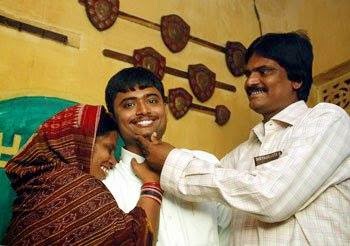
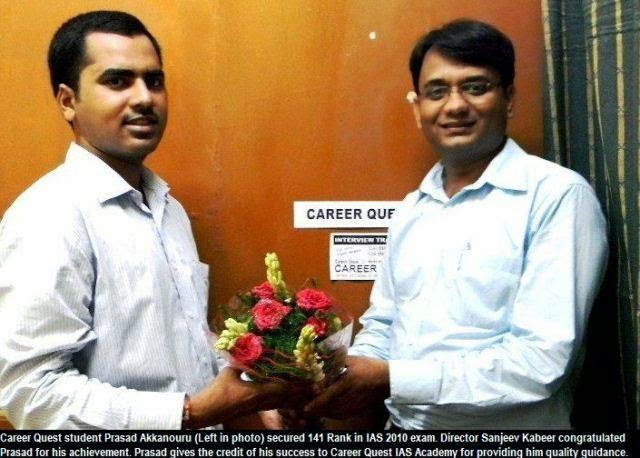
Prasad Akkanouru achieved his dream of becoming a Civil Servant

2

Against all the odds Prasad Akkanouru achieved his dream of becoming a Civil Servant

In this year’s IAS merit list Prasad Akkanouru is probably the only aspirant, who passed this coveted exam despite many difficulties.

– After completing 10th class from Latur, he did ITI Electrician course for secure future. It was his parents wish.

– His family members wanted him to become a teacher by doing a D.Ed. Course after 12th. But Prasad wanted to become a officer through civil services exam.

– He left home to fulfill his dream of IAS officer.

– He boarded the train to Nagpur, the city, which was unknown to him.

– After reaching in Nagpur, he went to many unknown people for job. Here he got his first job of a waiter in a small roadside hotel.

– He took admission in a school in 11th class by selling a gold chain, his only asset.

– After a work of 10 hours, he used to study hard in the night. He did that for two years.

– His strong determination and perseverance paid him off. He secured 12th class merit list.

– Media in Maharashtra took notice of Prasad’s achievement. His photos published in the newspapers and flashed on news TV channels.

– Because of this media attention, his family members came to know about his location. Till then there was no contact with the family for two years.

– At that time he told media that his dream is to become an IAS officer.

– Pune based NGO took responsibility of providing him facilities in Pune to complete his graduation.

– During the graduation, he started IAS preparation. He completed graduation with distinction.

– After graduation, he was willing to go Delhi for guidance. The financial condition was the big hurdle for him.

– He went to many people for financial help. After continuous efforts of several months, some people extended their helping hand for Prasad. With that help, he came to Delhi.

– In Delhi, he faced many problems due to insufficient money. But he managed all the problems with great determination and focused hard work.

– In Delhi, he joined ‘Career Quest’. Here he got timely guidance and motivation. According to Prasad, ‘Interview (Personality Test) plays very crucial role in one’s selection in Civil Services exam. I realized this during my third attempt. Guidance provided by Sanjeev Kabeer, Director, Career Quest IAS Academy was instrumental in my success in this exam.’

– Prasad said ‘I was feeling a great pressure because of two unsuccessful attempts. Many people started telling me that one cannot pass this exam without paying a bribe! I never give attention towards the rubbish things like this. During this time, self-motivation was the key for me. On 11th of May 2011, a good news came to me! I passed this coveted exam with such an unexpected rank! It was a feeling of conquering the world. Now I can say that any one can pass this exam with determination and continuous hard work. Timely & right guidance is the key to IAS exam. ‘Nothing is impossible’ is my mantra.’

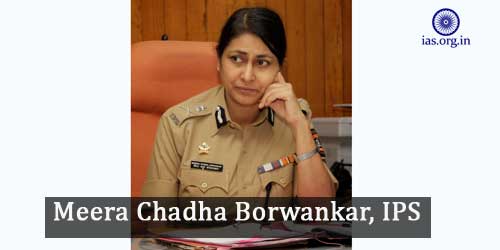
Meera Chadha Borwankar : First female IPS Officer in Maharashtra Cadre from Fazilka

8
Meera Chadha Borwankar
Meera Chadha Borwankar : First female IPS Officer in Maharashtra Cadre from Fazilka.
 Meera Chadha Borwankar

Another reason to feel proud for the entire community of this India’s smallest big town Fazilka. Daughter of Fazilka, Meera Chadha Borwankar, for becoming the first ever woman to be posted as Commissioner of Mumbai Crime Branch in its 150-year-long history. To be a woman police officer in a force that has barely one or two per cent women is unique in itself; but to head an investigative force of 300 police officers is definitely a first. At present Meera Chadha Borwankar is working as Special Inspector General of Police, CID State Crime Branch, stationed at Pune.

Must Read: Career Path of an IPS Officer

Mumbai’s Crime Branch is known as the premier department of the city’s police force, handling the investigation of organized and white-collar crime, and law enforcement in the mega-polis. While it didn’t exactly cover itself with glory during the Mumbai riots in the early 1990s, it has had to deal with the operations of rival underworld gangs remote controlled by Dawood Ibrahim, Chhota Rajan and even the don-turned-politician Arun Gawli. It has had to grapple with criminal cases against big film financiers like Bharat Shah, the ignominious Prevention of Terrorist Act (POTA) case against Mohammad Afroz and myriad encounters against gangsters by trigger-happy cops who call themselves ‘encounter specialists’.

Educational Background of Meera Chadha Borwankar

Born and brought up in Fazilka, Meera Chadha Borwankar studies till matriculation from D.C Model School Fazilka. Her father, Mr. O P Chadha, was with the Border Security Force and Posted in Fazilka region till 1971 war. Later she completed her Master’s in English Literature from Lyallpur Khalsa College and did her post-graduation from DAV College in Jalandhar, Punjab.Meera Chadha Borwankar was, by all accounts, a very good student and became head girl of her college. Later, she also studied Policy Analysis in Law Enforcement at the University of Minnesota, USA, was awarded the President’s Medal for meritorious service in 1997, apart from the police medal and the Director General’s insignia for meritorious service and Hubert Humphrey Fellowship (2001-2) in three decades of her policing career. During her stint with the state Crime Investigation Department from 1993-95, one of the important cases she investigated was the Jalgaon sex scandalWhile answering to a question about choosing IPS as her career, Meera Chadha Borwankar said “I was good at studies too, participating in plays, debates, etc. I was also in the Punjab Cricket Team”. So, in general I grew up with no future thoughts, but I was sure I did not want my life to end with marriage. When I was in college, during ’71-’72, Kiran Bedi had just joined the IPS and was creating waves. That is when, one day, my teachers called me and told me that they saw within me the potential for the IPS and that I should consider it as a career option. I completed my M.A. In English Literature, cleared my UPSC examinations and did my basic police training at SVP National Police Academy, Hyderabad. Meera Chadha Borwankar asserts that women are much more patient, resourceful and capable than men. All they need to do is throw away the yoke of selfdoubt and their own insecurities

In 1981, Meera Chadha Borwankar became an IPS officer of the Maharashtra cadre, served as Deputy Commissioner of Police at Mumbai between 1987-91, held independent charge of Aurangabad as District Superintendent of Police (and later of Satara in 1996-99) and was posted at the state CID crime branch in 1993-95. She worked with the Economic Offences Wing of the Central Bureau of Investigation (CBI) in Mumbai and was DIG of the Anti-Corruption Bureau of the CBI in New Delhi.

Also Read: Role of Civil Servants (IAS, IPS, IRS, IFS and IES)

She is married to Mr. Abhay Borwankar, who quit the Indian Administrative Service to start a food-processing business. She has two children and they presently live in Pune with family.Her immediate ongoing tasks are the extradition case of gangsters like Abu Salem and his partner Monica Bedi from Portugal, Iqbal Mirchi and Tariq Parvin from Dubai and Sharmila Shanbhag from Germany.

Entire Fazilka is proud on her achievements. It is wonderful to have such police officers in our country. We wish Fazilite Meera a bright and further satisfying career ahead. She would be a source of motivation to thousands of young girls in the country. We all know this upright and down-to earth and no-nonsense officer will achieve greater heights and fulfill her mission for the good of the nation! May God Bless Her in All Her Endeavors and Godspeed!

Don’t Miss: Meet Atul Vikas Kulkarni, IPS – Inspirational Story

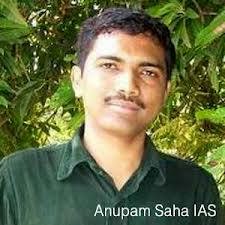
IAS Topper’s Corner | Anupam Saha, Exam: CSE, Year: 2011, Rank 35

3
ANUPAM SAHA
IAS Topper Rank: 35
Exam: Civil Services Examination
IAS Topper Year: 2011
Marks Obtained


Total Marks Marks Obtained
Essay 200 118
General Studies 600 248 (111 + 137)
Geography 600 376 (201 + 175)
Public Administration 600 303 (144 + 159)
Total (Written) 2000 1045
Interview 300 180
Total 2300 122553.26 %
Optional Subjects
Geography, Public Administration
Success Plan

I had once been to my district headquarter and was influenced by the personality of District Collector during my college days. That was a deciding moment.

While I was in job (TCS) after my graduation I decided to prepare for the exam seriously and I quit the job.

Success story of Bijay ketan Upadhyaya (AIR 5, CSE 2008) and Anay Dwivedi (AIR 5, CSE 2009) influenced me a lot.

It was a trial and error case for me. I learnt from my mistakes. But sometimes I used to consult my friends who are already selected like Smarak Swain (IRS), Harish (IRS).

Number of attempts
This was my 3rd attempt. In my 1st attempt I couldn’t clear even Preliminary Examination. I misjudged the demand of examination. I was bookish and never used to study newspaper properly.

From then onwards I started reading newspaper (The Hindu) very thoroughly. I used to make notes from it. That was really helpful. In my 2nd attempt I wrote mains but it was a half hearted one. So I missed interview call for few marks.

In this attempt things started falling in place in due course of time and I succeeded.

‘Time Management’
Yes, time management is very vital. For mains number of questions have increased for every optional. So one should divide the time according to the marks allotted.

Secret of success
Single minded devotion with intelligent hard work.

Optional Subjects

‘Interest’ in the optional should be given highest priority. Next is availability of material and guidance. One need not necessarily go for so called popular optional subjects.

Optional Subject 1- Geography
Optional Subject 2- Public Administration

I have inherent interest in Geography since my school days. It helps a lot in General Studies and Essay too.

Public Administration has Short and concise syllabus. It’s contemporary in nature and helpful for General Studies and Essay. It’ll be useful in my career too.

I kept the same optional subjects in all attempts.

Prelims

Repeated revision for paper I and practice for paper II are the keys. Newspaper plays a vital role too. There was no water tight division of time for both the papers. I used to do what I feel is required to be done.

Extensive use of internet is useful for Preliminary Examination. UPSC asks questions from Government reports. So I used to download them from internet and read. One should browse MOEF’s website for ecology, environment preparation.

Paper II (Aptitude Test)
Practice is the key to Paper II in Prelims. I used to solve few passages daily and tried to improve in the accuracy level there. I solved some practice sets for quantitative aptitude.

‘Negative Marking’
For GS conceptual clarity helps to tackle negative marking.. But UPSC now-a-days is asking more and more statement based questions with close answers. So, it is difficult to avoid negative marking.

One has to take chance in 75:25, 50:50 cases judiciously. For CSAT practice will reduce the negative marking

Mains
The shift in strategy was only from extensive preparation in Preliminary Examination to intensive for Main Examination.
Essay

I didn’t prepare anything separately for essay. I wrote one essay before mains and got it evaluated from teachers and my friends. I got very good feedback and tried to improve on them.

I chose the Essay topic “Creation of smaller states and the consequent administrative, economic and developmental implications” because I was most confident on it and was having sufficient points to write.
My Public Administration knowledge came handy. At that time Telengana and GJM movement was in news and I had read several articles on them. That helped a lot.

Interview

I prepared my Bio-data very well particularly home state and district.

I faced Alka Sirohi madam’s board. It lasted for around 25 minutes. It went well. The board was cooperative.

Interview Questions
Questions asked were mostly generic in nature.
Advice

Always do the SWOT (Strength-weakness-Opportunity-Threat) analysis.

Have confidence on your abilities. Be on track and keep doing till you reach your goal.