Home Blog Page 220

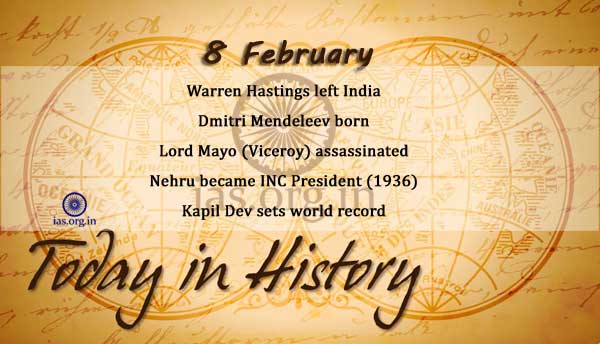
Today in History – 8 February

0

1785

Warren Hastings, British Viceroy, left India.

1834

Dmitri Mendeleev, a Russian chemist and inventor. He formulated the Periodic Law, created a farsighted version of the periodic table of elements, and used it to correct the properties of some already discovered elements and also to predict the properties of eight elements yet to be discovered was born on this day.

1872

Lord Mayo, Viceroy of India, was assassinated by prisoner Sher Ali during his visit to Andaman Islands.

1936

Jawaharlal Nehru elected president of Indian National Congress.

1943

Subhashchandra Bose started his journey to Japan from Kiel along with his secretary Major Abid Hassan in a submarine.

1994

Kapil Dev sets world record for Test Cricket wickets with 432.

Right to Strike in India

3
right to strike

The Supreme Court of India in its judgment in the case of T.K. Rangarajan Vs. Government of Tamil Nadu and Others (the case of the dismissal of over 170,000 striking Tamil Nadu Government employees and teachers) ruled on August 7, 2003 that the government employees do not have either a Fundamental or Statutory or equitable, moral right to strike, whatever the cause, just or unjust.

The Division Bench of Supreme Court comprises of Justice M.B. Shah and Justice A.R. Lakshmanan observed that apart from statutory rights. Government employees cannot claim that they can take society at ransom by going on strike.

The Supreme Court in 1961 in the case of Kameshwar Prasad Vs. State of Bihar had held that even a very liberal interpretation of Article 19(l)(C) of the Indian Constitution could not bad to the conclusion that the trade unions have a guaranteed Fundamental Right to strike.

In stating that the Government employees have no legal, moral or equitable right to strike the Court has evolved a new industrial jurisprudence unthought of earlier.

Though earlier decisions of the courts have rejected the right to strike as a Fundamental Right but not as a legal, moral or equitable right.

The question of strike not being a statutory right or legal right has never been considered in the court.


The decision of Rangarajan Case has ignored the statutory provisions in the Industrial Disputes Act, 1947 and the Trade Unions Act, 1926, and an equal number of case laws laid down by larger benches that have recognised the right to strike.

It also fails to consider International Covenants that pave the way for this right as a basic tenet of international labour standards.

In Kameshwar Prasad’s Case, the apex court had settled that the right to strike is not a Fundamental Right.

But time and again the court has also settled that the right to strike is a legal right, one that is recognised by most democratic countries of the world.

The Supreme Court evidently carried away by the fact that nearly two lakh government employees went on strike in the instant case and the Government machinery came to a standstill, also 90% of the state revenue of the state is spent on salaries of the government servants.

It is true that the Government employees everywhere are paid better salaries and enjoy more privileges and amenities than other employees. The public sympathy is generally against the Government employees who go on strike. But that is no justification for the Supreme Court to say that the Government employees have no moral justification to go on strike in every case.

Optomechanics at the Quantum Limit: Coupling Light and Motion

0

Table of Contents

  1. Introduction
  2. What Is Cavity Optomechanics?
  3. Radiation Pressure Coupling
  4. Quantum Description of Optomechanical Interaction
  5. Optomechanical Hamiltonian
  6. Sideband Cooling to Ground State
  7. Strong Coupling Regime
  8. Quantum Backaction and Measurement Limits
  9. Optomechanical Crystals and Devices
  10. Mechanical Oscillator Types
  11. Optical Cavities and Resonators
  12. Displacement Sensing at the Standard Quantum Limit
  13. Squeezing and Quantum Noise Reduction
  14. Entanglement Between Light and Mechanics
  15. Quantum State Transfer and Interfaces
  16. Nonclassical Mechanical States
  17. Applications in Force and Mass Sensing
  18. Hybrid Systems and Quantum Networks
  19. Challenges and Future Directions
  20. Conclusion

1. Introduction

Quantum optomechanics explores the interaction between optical fields and mechanical motion at the quantum level. It provides a platform for precision measurements, quantum control of macroscopic systems, and quantum information applications.

2. What Is Cavity Optomechanics?

Cavity optomechanics studies systems where a mechanical oscillator (mirror, membrane, etc.) modulates the resonance of an optical cavity, enabling bidirectional energy and information transfer.

3. Radiation Pressure Coupling

Light exerts radiation pressure on a movable mirror. The momentum transfer leads to a mechanical displacement, altering the cavity length and thus its resonance condition.

4. Quantum Description of Optomechanical Interaction

In quantum terms, the optical and mechanical modes are quantized as bosonic fields. The photon number affects the mechanical position, and the mechanical motion modulates the cavity frequency.

5. Optomechanical Hamiltonian

The linearized interaction Hamiltonian is:
\[
H = \hbar \omega_c a^\dagger a + \hbar \omega_m b^\dagger b – \hbar g_0 a^\dagger a (b + b^\dagger)
\]
where \( a \) and \( b \) are the photon and phonon annihilation operators, \( g_0 \) is the single-photon coupling strength.

6. Sideband Cooling to Ground State

Applying a red-detuned laser to the cavity enables sideband cooling, analogous to laser cooling of atoms. This technique reduces the thermal occupation of the mechanical mode to the quantum ground state.

7. Strong Coupling Regime

In the strong coupling regime, the optomechanical interaction rate exceeds dissipation rates:
\[
g > \kappa, \gamma_m
\]
This enables coherent energy exchange and normal mode splitting (optomechanically induced transparency).

8. Quantum Backaction and Measurement Limits

Measurement of a mechanical position is limited by quantum backaction: the act of measurement perturbs the system. This leads to the Standard Quantum Limit (SQL) for continuous position readout.

9. Optomechanical Crystals and Devices

Nanofabricated optomechanical crystals confine both light and sound in the same structure, maximizing coupling. These are used in:

  • Quantum state control
  • Delay lines
  • Frequency converters

10. Mechanical Oscillator Types

Common mechanical elements include:

  • Suspended mirrors
  • SiN membranes
  • Nanobeams
  • Optomechanical drumheads

11. Optical Cavities and Resonators

High-finesse Fabry–Pérot cavities, whispering gallery resonators, and photonic crystal cavities provide high-Q optical modes for strong optomechanical interaction.

12. Displacement Sensing at the Standard Quantum Limit

Optomechanical systems serve as ultra-sensitive sensors, detecting displacement with precision limited only by the quantum vacuum fluctuations of light.

13. Squeezing and Quantum Noise Reduction

By engineering quantum correlations between light and mechanics, optical squeezing and backaction evasion can surpass classical noise limits in measurements.

14. Entanglement Between Light and Mechanics

Entangled states between photons and phonons can be created via optomechanical interaction, offering routes to test quantum mechanics at large scales and realize quantum networking components.

15. Quantum State Transfer and Interfaces

Optomechanical devices can transfer quantum states between different platforms (e.g., microwave ↔ optical) by acting as mediators in hybrid quantum systems.

16. Nonclassical Mechanical States

Mechanical oscillators can be prepared in:

  • Fock states
  • Schrödinger cat states
  • Squeezed phonon states
    These enable quantum-enhanced metrology and fundamental tests.

17. Applications in Force and Mass Sensing

Mechanical systems are ideal for measuring ultraweak forces (e.g., Casimir, gravitational) and detecting single molecules or masses with zeptogram sensitivity.

18. Hybrid Systems and Quantum Networks

Optomechanics connects disparate quantum systems (ions, superconducting circuits, spins), providing interfaces for quantum transduction and entanglement distribution.

19. Challenges and Future Directions

  • Increasing single-photon coupling rates
  • Reducing decoherence
  • Realizing room-temperature operation
  • Scaling up optomechanical networks

20. Conclusion

Optomechanics at the quantum limit provides a gateway to controlling motion at the single-quantum level. From quantum sensing to hybrid systems, it bridges photonics, mechanics, and quantum information science.

.

Today in History – 7 February

0

1687

Mughal army won the Gowalkonda fort. Kutubshahi came to end.

1795

Dutch Prince William V accepts British occupation of Dutch Indies.

1856

Wajid Ali Shah, ruler of Oudh, was asked to abdicate by the British Resident on grounds of chronic misrule.

1983

Eastern News Agency was established in Calcutta.

1992

Shalki’, the first submarine designed in India, joined Indian Navy.

1993

Medium-range surface to surface missile, ‘Prithvi‘ successfully launched for the 10th time.

1997

Bal Thackeray, Shiv Sena supremo, found guilty of contempt of court and sentenced to simple imprisonment of one week and a fine of Rs. 2000 by Nagpur bench of Mumbai HC for his statement that ”a judge had demanded a bribe of Rs. 35 lakhs for favouring a litigant”.

1999

Indian leg-spinner Anil Kumble became the second only bowler in Test history after J.C. Laker (England) to take all ten wickets in an innings against Pakistan in the second Test in Delhi.

Arbitration and Conciliation

0
Arbitration and Conciliation

Arbitration and Conciliation Act 1996

The laws pertaining to Arbitration and Conciliation can be found in Arbitration and Conciliation Act, 1996. The Act applies throughout the country, except for the state of Jammu and Kashmir.

Arbitration

Definition of Arbitration:

Arbitration is the mode of settlement of the dispute between the parties, by means of a nominated person (called as arbitrator) without going to the court of law.

Read Also: Fundamental Duties Incorporated in Constitution of India

Arbitration Agreement

When the parties involved in a dispute make an agreement, that instead of going to court, they would settle the dispute through arbitration, the agreement is called as Arbitration agreement.
Once when the Arbitration agreement is made, no party can take up any matter pertaining to the dispute to the court of law.
Any person capable of entering into a contract can enter into Arbitration agreement.

Advantages of Arbitration:

1) Less costly in comparison to the court of law.
2) Less time taking and simple
3) Dispute is not publicized
4) Award is final (except in rare instances)

Disputes of Arbitration:

Disputes arising out of the legal relationship between the parties (present or future state) can be referred to arbitration.
However, following disputes cannot be referred to arbitration:
1) Proceedings of insolvency
2) Proceedings of lunacy
3) Proceedings for the appointment of guardian to a minor
4) Matter of criminal nature
5) Matter pertaining to Public Charitable Trust

Appointment of Arbitrator

Qualification of an Arbitrator:

There is no hard and fast rule defined for the qualification of an arbitrator. And the parties can select any person as an arbitrator. However, it is in the interest of parties to select an intelligent, rational, impartial person as their arbitrator. An arbitrator can be disqualified if he has a personal interest in the matter pertaining to the dispute

Must Read: Fundamental Rights (Articles, Writs)

Number of Arbitrators:

The number of Arbitrator should be of odd number (i.e. 1,3,5,7 etc.)

Nationality of an Arbitrator:

An Arbitrator can be of any nationality unless otherwise agreed by the parties. However, in the case of an international dispute, the Chief Justice of India may appoint an arbitrator other than the nationality of parties.

Appointment of Arbitrator by Agreement:

If there is an agreement regarding the procedure for appointment of the director, the parties must appoint the director in accordance with the agreement. The agreement may provide for:
• Number of arbitrators
• Qualification of arbitrators
• Procedure for appointment of arbitrators
• Procedure for termination of arbitrators
• Place, the language of arbitration etc.

Appointment of Arbitrator by Chief Justice of India:

The Chief Justice of Indian may appoint arbitrators in the following cases:
1) When the parties fail to agree upon a sole arbitrator within 30 days.
2) When a party fails to appoint an arbitrator within 30 days.
3) When the two appointed arbitrators fail to agree upon the third arbitrator within 30 days of appointment.
4) When the party (or parties) or arbitrators fail to act in accordance with the agreement.

Termination of Arbitrator:

An arbitrator can be terminated on following ground:
1) When the arbitrator becomes unable to perform his function (either by law or in fact).
2) When the arbitrator fails to act within the specified time period
3) When the arbitrator withdraws from his office.
4) When the parties agree for termination.

Don’t Miss: LGBT & Supreme Court refers Curative Petition to Constitution Bench

Arbitral Award

At the end of the arbitral proceeding, an Arbitral Award is to be made in writing, duly signed by all the members of Arbitral Tribunal. The Arbitral Tribunal should also mention the date and place of Arbitration. A copy of award is to be given to each of the parties.
The Arbitral shall be final and binding upon the parties.

An Arbitral Proceeding is terminated when:

1) The Arbitral award is made
2) The continuity of proceeding becomes unnecessary or impossible.
3) The parties agree on the termination.
4) The claimant withdraws his claim, and the respondent does not object to it

The Arbitral Award becomes enforceable to the parties, normally after 3 months from the date it has been received by the parties. However, any of the parties can appeal to the court for setting aside the award before this period (3 months).
The court can set aside the Arbitration award on following grounds:
1) Incapacity of a party.
2) Invalid arbitration agreement.
3) Invalid arbitral tribunal or its proceedings.
4) The subject matter of dispute cannot be settled through arbitration.
5) The Arbitration award is in conflict with the public policy of India.

Conciliation

Definition of Conciliation:

Conciliation is the mode of friendly settlement of the dispute between the parties, with the assistance of a nominated person (called as conciliator) without going to the court of law.
Although both in Arbitration and Conciliation the dispute is settled outside the court, there is a fundamental difference between two. While, in the case of Arbitration, an award is given by the arbitrator, at the end of the tribunal; in the case of Conciliation, the two parties arrive at mutually agreed decision with the help of the conciliator.

Notice of conciliation:

A party initiating conciliation will send a written invitation to the other party. If the other party accepts the invitation, the conciliation proceeding will start from that point.
However, if the party initiating conciliation does not receive the reply within 30 days of from the date of invitation, the invitation is treated as the rejection.

Also, Read: US Amendment to Provide NATO Ally Status to India

Appointment of conciliator:

Unless otherwise agreed, there shall only be one conciliator. However, the parties on mutual consent can even select more conciliator.

Settlement Agreement:

If the conciliator feels that a settlement is possible for the dispute, he will formulate a possible settlement and submit a copy to the parties for observation. If the parties feel satisfied with the solution given by the conciliator, they may give approval to it by signing to it. The settlement agreement thus reached will be binding and final to both the parties.

Read Also:

Constitutional Development in India & From Regulating Act 1773 to Govt. of India Act 1935

Important Constitutional Amendments in India

Fast facts about United State & Constitution Day