

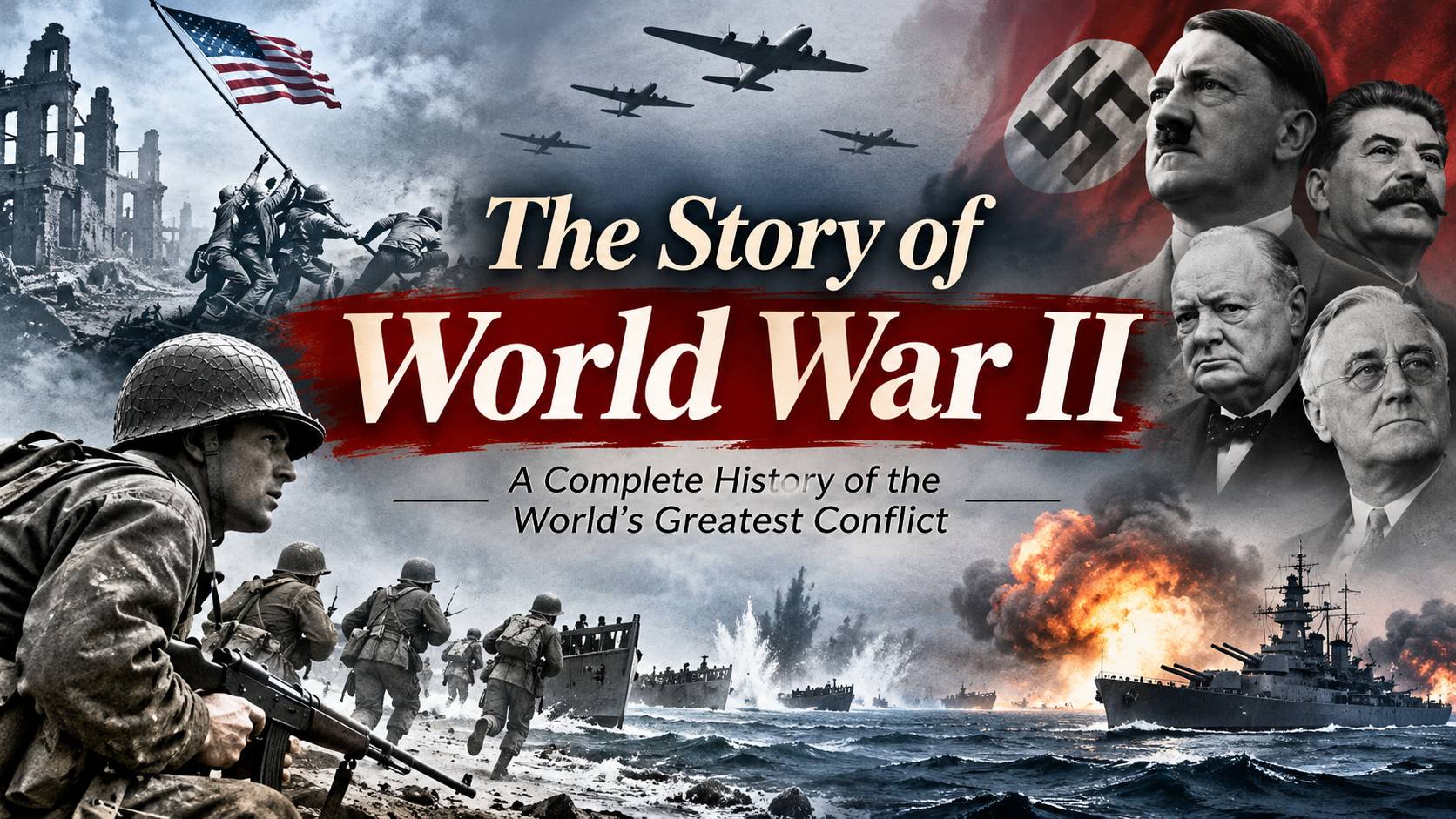


, including its causes, major events, battles, world leaders, Holocaust, India's contribution and consequences.)
Introduction: The War That Changed the World
World War II (1939–1945), also known as the Second World War, was the largest and deadliest military conflict in human history. It involved more than 30 countries and directly or indirectly affected almost every part of the world. The war was fought between two major military alliances: the Allied Powers and the Axis Powers.
Beginning in September 1939 with Germany’s invasion of Poland, the conflict rapidly expanded across Europe, Asia, Africa and the Pacific. It eventually brought together some of the most powerful nations of the twentieth century, including Germany, Italy, Japan, Britain, France, the Soviet Union, the United States and China.
The war was driven by several interconnected factors, including aggressive nationalism, territorial expansion, economic instability, militarism, the rise of dictatorships and the failure of international diplomacy. The unresolved tensions following World War I also played a significant role in creating the conditions for another global conflict.
World War II witnessed extraordinary military campaigns, devastating aerial bombardments, the Holocaust, the use of atomic weapons and the deaths of an estimated 70–85 million people, including military personnel and civilians.
Its conclusion in 1945 fundamentally transformed international politics. Germany and Japan were defeated, the United Nations was established, colonial empires began to weaken, and the United States and Soviet Union emerged as rival superpowers, setting the stage for the Cold War.
Understanding the story of World War II is essential to understanding the modern world.
Table of Contents
- What Was World War II?
- Background: The World After World War I
- Major Causes of World War II
- Rise of Dictatorships in Europe and Asia
- Axis Powers and Allied Powers
- World War II Begins: Germany Invades Poland
- The Major Phases of World War II
- Major Battles and Military Campaigns
- The Role of Adolf Hitler and Nazi Germany
- The Holocaust: One of History’s Greatest Atrocities
- Japan’s Expansion and the War in the Pacific
- The United States Enters World War II
- India’s Role in World War II
- Important World War II Leaders
- Major Technological and Military Developments
- The End of World War II
- Atomic Bombings of Hiroshima and Nagasaki
- Consequences of World War II
- Formation of the United Nations
- World War II Timeline (1939–1945)
- Interesting Facts About World War II
- Frequently Asked Questions
1. What Was World War II?
World War II was a global armed conflict fought between 1939 and 1945, although the war in Asia had already begun several years earlier with Japan’s invasion of China in 1937.
The conflict involved two principal alliances:
- Allied Powers: Primarily Britain, France, the Soviet Union, the United States and China.
- Axis Powers: Primarily Germany, Italy and Japan.
Numerous other countries participated, either as combatants, occupied territories, colonial forces or supporting nations.
The war was fought across several major geographical theatres:
- European Theatre: Battles between Germany, Italy, the Soviet Union, Britain and other European countries.
- Eastern Front: The massive military conflict between Nazi Germany and the Soviet Union.
- North African Campaign: Battles between Allied forces and Axis forces across North Africa.
- Pacific Theatre: The war between Japan and the Allied Powers, particularly the United States.
- Asian Theatre: Japanese expansion and military operations across China, Southeast Asia and other parts of Asia.
- Atlantic Theatre: Naval and submarine warfare between Germany and Allied shipping.
World War II ended in 1945 with the surrender of Germany in May and Japan in September.
How Many People Died in World War II?
World War II caused approximately 70–85 million deaths, making it the deadliest conflict in recorded history.
The casualties included soldiers, prisoners of war, civilians, victims of genocide, people killed during aerial bombardments and those who died from starvation and disease.
The Soviet Union, China, Germany, Poland and Japan were among the countries that suffered enormous human losses.
The scale of destruction was unprecedented, with entire cities destroyed, economies devastated and millions of people displaced.
2. Background: The World After World War I
To understand why World War II happened, it is necessary to examine the political and economic situation following World War I (1914–1918).
World War I ended with the defeat of Germany and its allies. The victorious Allied nations imposed a series of political, military and economic conditions on the defeated countries.
The most significant development was the signing of the Treaty of Versailles on 28 June 1919.
The Treaty of Versailles (1919)
The Treaty of Versailles was the peace agreement between Germany and the Allied Powers following World War I.
It imposed severe conditions on Germany, including:
- Germany was required to accept responsibility for the war under Article 231, commonly known as the War Guilt Clause.
- Germany had to pay substantial war reparations.
- Germany lost territories in Europe.
- Germany lost all its overseas colonies.
- Its military forces were severely restricted.
- The German army was limited to 100,000 soldiers.
- Germany was prohibited from maintaining an air force.
- The Rhineland was demilitarised.
The treaty created widespread resentment among the German population.
Many Germans believed that the agreement was humiliating and unjust. Adolf Hitler and the Nazi Party later exploited this dissatisfaction to gain political support.
The Great Depression (1929)
Another important factor was the Great Depression, which began with the Wall Street Crash in October 1929.
The economic crisis spread across the world, resulting in:
- Mass unemployment.
- Industrial decline.
- Banking failures.
- Falling international trade.
- Political instability.
- Growing public dissatisfaction with democratic governments.
Germany was particularly vulnerable because its economy depended heavily on international loans, especially American financial assistance.
As unemployment and poverty increased, extremist political movements gained popularity.
The Nazi Party promised economic recovery, national revival and the restoration of German power.
Failure of the League of Nations
The League of Nations was established after World War I to maintain international peace and prevent future conflicts.
However, it lacked an effective military force and depended on cooperation among member states.
It failed to stop major acts of aggression during the 1930s, including:
- Japan’s invasion of Manchuria in 1931.
- Italy’s invasion of Ethiopia in 1935.
- Germany’s military expansion.
- Germany’s occupation of Austria in 1938.
- Germany’s expansion into Czechoslovakia.
The failure of the League of Nations demonstrated the weakness of the international system created after World War I.
3. Major Causes of World War II
World War II did not begin because of a single event. It resulted from several political, economic and ideological developments that gradually destabilised international relations.
3.1 Harsh Conditions of the Treaty of Versailles
The Treaty of Versailles created deep resentment in Germany.
The loss of territory, military restrictions and economic reparations weakened Germany and encouraged the growth of nationalist and extremist movements.
Hitler promised to overturn the treaty and restore Germany’s position as a major European power.
3.2 Rise of Fascism and Nazism
During the interwar period, authoritarian and extremist political movements gained influence in several countries.
In Germany, Adolf Hitler established a totalitarian Nazi regime based on extreme nationalism, racial ideology, antisemitism and territorial expansion.
In Italy, Benito Mussolini established a Fascist dictatorship.
In Japan, military leaders and expansionist nationalists gained considerable influence over government policy.
These regimes promoted militarism, aggressive nationalism and territorial expansion.
3.3 German Expansionism
Adolf Hitler wanted to reverse the territorial restrictions imposed by the Treaty of Versailles.
He pursued a policy of territorial expansion, known as Lebensraum, or living space, particularly towards Eastern Europe.
Germany began rearming, remilitarising the Rhineland and annexing neighbouring territories.
3.4 Japanese Militarism and Expansion
Japan sought natural resources, strategic territories and greater influence in Asia.
Its expansionist policies led to the occupation of Manchuria in 1931 and a full-scale war against China beginning in 1937.
Japanese military expansion eventually brought it into direct conflict with the United States and European colonial powers in Asia.
3.5 Italian Fascist Expansion
Under Benito Mussolini, Italy pursued an aggressive foreign policy.
Italy invaded Ethiopia in October 1935 and occupied Albania in April 1939.
Mussolini wanted to establish a new Italian empire and restore the prestige of ancient Rome.
3.6 Failure of Appeasement
Britain and France initially followed a policy of appeasement towards Hitler.
Appeasement involved making concessions to Germany in the hope of avoiding another European war.
The most notable example was the Munich Agreement of September 1938.
Under this agreement, Britain and France accepted Germany’s annexation of the Sudetenland, a region of Czechoslovakia with a substantial ethnic German population.
However, Hitler occupied the remaining Czech lands in March 1939.
This demonstrated that his territorial ambitions extended far beyond the Sudetenland.
3.7 Nazi-Soviet Non-Aggression Pact (1939)
On 23 August 1939, Germany and the Soviet Union signed the Molotov–Ribbentrop Pact, also known as the Nazi-Soviet Non-Aggression Pact.
The agreement publicly committed both countries to avoiding war against each other.
A secret protocol divided parts of Eastern Europe into German and Soviet spheres of influence, including provisions concerning the partition of Poland.
The agreement enabled Hitler to invade Poland without immediately facing a Soviet military response.
3.8 Immediate Cause: Germany Invades Poland
On 1 September 1939, Germany invaded Poland.
German forces used a military strategy known as Blitzkrieg, or lightning warfare, involving coordinated attacks by aircraft, tanks and infantry.
On 17 September 1939, the Soviet Union invaded eastern Poland in accordance with the secret arrangements of the Nazi-Soviet Pact.
On 3 September 1939, Britain and France declared war on Germany after its invasion of Poland.
This marked the beginning of World War II in Europe.
4. Rise of Dictatorships in Europe and Asia
The rise of authoritarian leaders was one of the defining characteristics of the period between the two world wars.
Adolf Hitler – Germany
Adolf Hitler became Chancellor of Germany on 30 January 1933.
He transformed Germany into a totalitarian dictatorship, eliminated political opposition and established the Nazi Party as the dominant political organisation.
His government pursued racial persecution, militarisation and territorial expansion.
Hitler’s aggressive foreign policy ultimately triggered World War II in Europe.
Benito Mussolini – Italy
Benito Mussolini founded the Fascist movement in Italy and became Prime Minister in October 1922.
He established an authoritarian regime and pursued territorial expansion in Africa and Europe.
Italy joined Germany in the Axis alliance and declared war on Britain and France in June 1940.
Hideki Tojo and Japanese Military Leadership
Japan’s expansionist military leadership played a major role in the outbreak of war in Asia and the Pacific.
Hideki Tojo became Prime Minister of Japan in October 1941.
He supported Japan’s military expansion and was a leading political figure during the attack on Pearl Harbor.
Japan’s imperial expansion was, however, a broader process involving military leaders, political institutions and successive governments.
Joseph Stalin – Soviet Union
Joseph Stalin led the Soviet Union during World War II.
Initially, the Soviet Union signed a non-aggression agreement with Germany in 1939.
However, Germany invaded the Soviet Union in June 1941.
Stalin subsequently became one of the principal leaders of the Allied Powers and directed the Soviet war effort against Nazi Germany.
5. Axis Powers and Allied Powers
The two principal alliances in World War II were the Axis Powers and the Allied Powers.
Axis Powers
The Axis Powers were primarily composed of Germany, Italy and Japan.
| Country | Leader during major wartime period |
|---|---|
| Germany | Adolf Hitler |
| Italy | Benito Mussolini |
| Japan | Emperor Hirohito; Hideki Tojo was Prime Minister during the Pearl Harbor attack |
The Axis Powers sought territorial expansion and greater political and military influence.
Germany concentrated on conquering Europe, Italy pursued expansion in Africa and the Mediterranean, and Japan attempted to establish dominance in East Asia and the Pacific.
Allied Powers
The Allied Powers included several major countries:
| Country | Important wartime leader |
|---|---|
| United Kingdom | Winston Churchill |
| United States | Franklin D. Roosevelt |
| Soviet Union | Joseph Stalin |
| China | Chiang Kai-shek |
| France | Charles de Gaulle led Free France |
| Canada | William Lyon Mackenzie King |
| Australia | John Curtin |
| New Zealand | Peter Fraser |
Other nations, governments-in-exile, resistance movements and colonial forces also contributed to the Allied war effort.
The alliance was based primarily on the common objective of defeating the Axis Powers, despite significant political and ideological differences among its members.
6. World War II Begins: Germany Invades Poland
On 1 September 1939, German forces invaded Poland from multiple directions.
The German military used Blitzkrieg tactics, combining air power, tanks, artillery and fast-moving infantry units.
The strategy aimed to overwhelm the enemy before it could organise an effective defence.
Poland faced a powerful military assault and was unable to withstand the combined German and Soviet invasions.
On 17 September 1939, Soviet troops entered eastern Poland.
Poland was divided between Germany and the Soviet Union.
Britain and France had previously guaranteed support for Poland. They declared war on Germany on 3 September 1939.
The conflict that followed rapidly developed into a worldwide war.
7. The Major Phases of World War II
Historians often divide World War II into different phases to understand how the conflict developed.
Phase 1: German Expansion and Early Axis Victories (1939–1941)
During the initial years, Germany achieved a series of major military victories in Europe.
After invading Poland in September 1939, Germany turned its attention towards Western Europe.
In April 1940, German forces invaded Denmark and Norway.
In May 1940, Germany launched an offensive against Belgium, the Netherlands, Luxembourg and France.
The German advance was extremely rapid.
France surrendered in June 1940, and Germany occupied much of the country.
The British Expeditionary Force and other Allied troops were evacuated from Dunkirk between 26 May and 4 June 1940.
This evacuation, known as Operation Dynamo, saved more than 338,000 Allied soldiers.
Battle of Britain (1940)
After the fall of France, Germany attempted to gain air superiority over Britain.
The German Luftwaffe launched sustained air attacks against British airfields, military installations and cities.
The Royal Air Force (RAF) resisted these attacks.
The Battle of Britain took place primarily between July and October 1940.
Britain’s successful defence prevented Germany from achieving the air superiority necessary for a planned invasion.
Operation Sea Lion, the proposed German invasion of Britain, was postponed indefinitely.
The Battle of Britain was a major turning point in the early stages of the war.
The Blitz
Following its failure to defeat the RAF, Germany intensified bombing attacks against British cities.
This campaign became known as the Blitz.
London, Coventry, Birmingham, Liverpool and other cities suffered extensive destruction.
Thousands of civilians were killed, but Britain continued fighting.
Phase 2: Expansion of the War (1941)
The year 1941 transformed the European and Asian conflicts into an even larger global war.
Two major events were particularly important:
- Germany invaded the Soviet Union.
- Japan attacked Pearl Harbor, bringing the United States into the war.
Operation Barbarossa (22 June 1941)
On 22 June 1941, Germany launched Operation Barbarossa, its massive invasion of the Soviet Union.
It was one of the largest military operations in history.
Millions of German and allied troops advanced into Soviet territory.
The initial German offensive achieved substantial territorial gains.
However, the Soviet Union resisted fiercely.
The German military faced several challenges:
- Extremely long supply lines.
- Severe weather conditions.
- Soviet resistance.
- Shortages of fuel and equipment.
- Difficulties in maintaining logistical support.
The German advance eventually slowed, and the Soviet Union began to organise a major counteroffensive.
Attack on Pearl Harbor (7 December 1941)
On 7 December 1941, Japanese forces launched a surprise attack on the American naval base at Pearl Harbor in Hawaii.
The attack destroyed or damaged numerous American ships and aircraft and killed more than 2,400 Americans.
The objective was to weaken American naval power and create an opportunity for Japanese expansion across the Pacific.
The following day, 8 December 1941, the United States declared war on Japan.
Germany and Italy subsequently declared war on the United States on 11 December 1941.
The conflict had now become a truly global war involving the world’s major industrial and military powers.
Phase 3: Turning Points in the War (1942–1943)
The period between 1942 and 1943 witnessed several decisive Allied victories.
The Axis Powers began losing their military advantage.
Three important developments changed the direction of the war:
- The Battle of Midway in the Pacific.
- The Battle of El Alamein in North Africa.
- The Battle of Stalingrad on the Eastern Front.
Battle of Midway (June 1942)
The Battle of Midway was fought between the United States and Japan from 4 to 7 June 1942.
It was a decisive naval battle in the Pacific Theatre.
American forces intercepted Japanese communications and prepared an ambush against the Japanese fleet.
The United States destroyed four Japanese aircraft carriers, significantly weakening Japan’s naval aviation capabilities.
The victory shifted the strategic balance in the Pacific and marked a major turning point against Japanese expansion.
Second Battle of El Alamein (October–November 1942)
The Second Battle of El Alamein was fought in Egypt between British-led Allied forces and the German-Italian Axis armies.
British forces under General Bernard Montgomery defeated the Axis forces commanded by Erwin Rommel’s Afrika Korps and their Italian allies.
The victory prevented Axis forces from advancing towards Egypt and the strategically important Suez Canal.
It marked the beginning of the Axis retreat in North Africa.
Battle of Stalingrad (1942–1943)
The Battle of Stalingrad was one of the bloodiest battles in human history.
It was fought between Germany and the Soviet Union from August 1942 to February 1943.
Germany wanted to capture Stalingrad, an important industrial and transportation centre on the Volga River.
The Soviet Red Army defended the city through intense urban warfare.
German forces became increasingly isolated as Soviet troops launched Operation Uranus in November 1942.
The German Sixth Army was encircled and eventually surrendered in February 1943.
The defeat was a catastrophic blow to Nazi Germany.
Stalingrad became one of the most important turning points of World War II.
Phase 4: Allied Offensive and Liberation of Europe (1944)
By 1944, the Allied Powers had gained a significant military advantage.
The Soviet Union advanced westward, while Britain and the United States prepared a major invasion of Western Europe.
D-Day: Normandy Landings (6 June 1944)
D-Day refers to 6 June 1944, when Allied forces launched Operation Overlord, the invasion of Nazi-occupied France.
It was the largest seaborne invasion in history.
The operation involved forces from the United States, Britain, Canada and several other Allied nations.
The landings took place across five Normandy beaches:
- Utah Beach.
- Omaha Beach.
- Gold Beach.
- Juno Beach.
- Sword Beach.
Despite heavy casualties, especially at Omaha Beach, Allied forces successfully established a foothold in France.
The invasion opened a major Western Front against Germany.
Paris was liberated on 25 August 1944.
Operation Bagration (June–August 1944)
The Soviet Union launched Operation Bagration on 22 June 1944 against German forces in Belarus.
The offensive destroyed much of Germany’s Army Group Centre and inflicted a devastating defeat on the German military.
It was one of the largest and most successful Soviet military operations of the war.
The operation significantly weakened Germany’s position on the Eastern Front.
Phase 5: Defeat of Nazi Germany (1945)
By early 1945, Allied forces were advancing into Germany from both the east and the west.
Soviet troops approached Berlin while American, British and other Allied forces crossed into German territory from the west.
Battle of Berlin (April–May 1945)
The Battle of Berlin was the final major offensive against Nazi Germany.
Soviet forces surrounded and attacked the German capital.
On 30 April 1945, Adolf Hitler committed suicide in his underground bunker.
German forces continued resisting for a short period.
On 7 May 1945, Germany signed an unconditional surrender at Reims, France. A further surrender ceremony took place in Berlin on 8 May.
Victory in Europe Day, commonly known as VE Day, was celebrated on 8 May 1945 in Western Europe and North America.
The Soviet Union commemorates Victory Day on 9 May because of the difference in local time.
The European war had ended, but the conflict in Asia and the Pacific continued.
Phase 6: Defeat of Japan (1945)
Following Germany’s surrender, Japan remained at war against the Allied Powers.
American forces continued their advance across the Pacific.
Major battles such as Iwo Jima and Okinawa demonstrated the enormous human cost of defeating Japanese forces.
In August 1945, the United States dropped atomic bombs on Hiroshima and Nagasaki.
The Soviet Union also entered the war against Japan and launched an offensive in Manchuria.
Japan announced its surrender on 15 August 1945.
The formal surrender was signed on 2 September 1945 aboard the USS Missouri in Tokyo Bay.
This marked the end of World War II.
8. Major Battles and Military Campaigns of World War II
World War II witnessed numerous battles that changed the course of military history.
The following table highlights some of the most important battles and operations.
| Battle or Campaign | Date | Significance |
|---|---|---|
| Invasion of Poland | September 1939 | Beginning of World War II in Europe |
| Battle of France | May–June 1940 | German victory and occupation of France |
| Dunkirk Evacuation | May–June 1940 | Evacuation of more than 338,000 Allied troops |
| Battle of Britain | July–October 1940 | Germany failed to gain air superiority |
| Operation Barbarossa | June 1941 | German invasion of the Soviet Union |
| Pearl Harbor | December 1941 | Brought the United States into the war |
| Battle of Midway | June 1942 | Major American victory in the Pacific |
| Second Battle of El Alamein | October–November 1942 | Major Allied victory in North Africa |
| Battle of Stalingrad | August 1942–February 1943 | Major turning point on the Eastern Front |
| Battle of Kursk | July–August 1943 | Major Soviet victory against Germany |
| Normandy Landings | June 1944 | Opening of the Western Front in France |
| Operation Bagration | June–August 1944 | Destruction of much of Germany’s Army Group Centre |
| Battle of the Bulge | December 1944–January 1945 | Germany’s final major offensive in the West |
| Battle of Berlin | April–May 1945 | Fall of Nazi Germany |
| Battle of Iwo Jima | February–March 1945 | Important American victory in the Pacific |
| Battle of Okinawa | April–June 1945 | One of the bloodiest Pacific campaigns |
| Hiroshima and Nagasaki | August 1945 | Atomic bombings preceding Japan’s surrender |
9. The Role of Adolf Hitler and Nazi Germany
Adolf Hitler was the central political figure responsible for Nazi Germany’s aggressive expansion and the outbreak of World War II in Europe.
Born on 20 April 1889 in Austria-Hungary, Hitler served in the German Army during World War I.
Following Germany’s defeat, he became involved in extremist nationalist politics.
In 1920, the German Workers’ Party was renamed the National Socialist German Workers’ Party, commonly known as the Nazi Party.
Hitler became its dominant leader.
Hitler’s Rise to Power
Hitler attempted to seize power through the Beer Hall Putsch in November 1923, but the coup failed.
He was imprisoned and wrote much of Mein Kampf, in which he presented his political ideology and expansionist ambitions.
The economic crisis of the Great Depression helped the Nazi Party gain popularity.
Hitler was appointed Chancellor of Germany on 30 January 1933.
He quickly dismantled democratic institutions and established a dictatorship.
Hitler’s Foreign Policy
Hitler pursued several aggressive policies:
- Rebuilding the German armed forces.
- Reintroducing conscription.
- Remilitarising the Rhineland.
- Annexing Austria in the Anschluss of 1938.
- Acquiring the Sudetenland.
- Occupying the remaining Czech lands in 1939.
- Invading Poland in September 1939.
- Invading the Soviet Union in June 1941.
His expansionist ambitions brought Germany into conflict with much of the world.
Hitler’s Death
By April 1945, Soviet troops had surrounded Berlin.
Hitler remained in his underground bunker as the German military collapsed.
On 30 April 1945, Hitler died by suicide along with his wife, Eva Braun, whom he had married the previous day.
His death marked the final collapse of the Nazi leadership.
10. The Holocaust: One of History’s Greatest Atrocities
The Holocaust was the systematic, state-sponsored persecution and murder of approximately six million European Jews by Nazi Germany and its collaborators.
It was one of the most horrific genocides in human history.
The Nazi regime considered Jews racially inferior and responsible for Germany’s supposed social and economic problems.
This ideology was rooted in antisemitism and racist pseudoscience.
Persecution of Jews
After coming to power in 1933, the Nazis introduced discriminatory laws and policies against Jewish people.
The Nuremberg Laws of 1935 stripped German Jews of important citizenship rights and prohibited marriages between Jews and people classified as German or related blood.
Jewish businesses were boycotted, property was confiscated and Jewish people were increasingly excluded from public life.
Kristallnacht (1938)
Kristallnacht, also known as the Night of Broken Glass, took place on 9–10 November 1938.
Nazi-organised violence targeted Jewish communities throughout Germany and Austria.
Synagogues were burned, Jewish businesses were destroyed and thousands of Jewish men were arrested.
The event marked a major escalation in Nazi persecution.
Concentration and Extermination Camps
During the war, Nazi Germany established an extensive network of concentration camps, forced labour camps and extermination centres.
Major camps included:
- Auschwitz-Birkenau.
- Treblinka.
- Sobibor.
- Belzec.
- Chelmno.
- Majdanek.
- Dachau.
- Bergen-Belsen.
Not all these camps served the same purpose. Some were primarily concentration camps, while others were established as extermination centres.
Auschwitz-Birkenau became the largest Nazi concentration and extermination complex.
The Final Solution
The Nazi leadership implemented the so-called Final Solution, a coordinated plan to systematically murder Europe’s Jewish population.
Mass shootings, deportations, starvation, forced labour and gas chambers were used to carry out genocide.
Approximately six million Jews were murdered.
Millions of other people were also persecuted and killed by the Nazi regime, including Roma and Sinti people, people with disabilities, Soviet prisoners of war, Polish civilians, political opponents and others targeted by Nazi ideology and policies.
Liberation of Concentration Camps
As Allied forces advanced into Germany and occupied Europe, they liberated numerous concentration camps.
The liberation of these camps exposed the full scale of Nazi crimes to the world.
The Holocaust remains an enduring reminder of the consequences of racism, antisemitism, authoritarianism and systematic dehumanisation.
11. Japan’s Expansion and the War in the Pacific
Japan played a central role in the outbreak and development of World War II in Asia.
Its military expansion had begun before the European war.
Japanese Invasion of Manchuria (1931)
In September 1931, Japan invaded Manchuria in northeastern China.
It subsequently established the puppet state of Manchukuo in 1932.
The invasion demonstrated the growing influence of the Japanese military and the weakness of international efforts to prevent aggression.
Second Sino-Japanese War (1937)
In July 1937, a full-scale war began between Japan and China following the Marco Polo Bridge Incident.
Japan occupied large areas of Chinese territory.
One of the most notorious events was the Nanjing Massacre, which began after Japanese forces captured Nanjing in December 1937.
Japanese troops committed mass killings, sexual violence and other atrocities against civilians and prisoners of war.
The precise death toll remains a subject of historical discussion, but the massacre is recognised as a major war crime.
Attack on Pearl Harbor
Japan attacked the American naval base at Pearl Harbor on 7 December 1941.
The attack was intended to weaken American military power in the Pacific.
However, it brought the United States directly into World War II.
Japanese Expansion in Southeast Asia
Following Pearl Harbor, Japan launched military operations across the Pacific and Southeast Asia.
Japanese forces occupied or attacked territories including:
- The Philippines.
- Malaya.
- Singapore.
- Burma.
- Indonesia.
- Hong Kong.
- Thailand.
The capture of Singapore in February 1942 was a major defeat for British forces.
Japan also occupied Burma, bringing its forces closer to British India.
Turning Point in the Pacific
The Battle of Midway in June 1942 marked a major turning point.
The United States began gradually pushing Japanese forces back across the Pacific.
The Allied strategy involved capturing strategically important islands and establishing bases for further operations.
This approach became known as island hopping.
By 1945, American forces had reached the Japanese home islands.
The battles of Iwo Jima and Okinawa demonstrated the intensity of the final stages of the Pacific war.
12. The United States Enters World War II
Initially, the United States maintained a policy of neutrality in the European conflict.
However, President Franklin D. Roosevelt increasingly supported Britain and other Allied nations through economic and military assistance.
Lend-Lease Act (1941)
The Lend-Lease Act was passed by the United States Congress in March 1941.
It allowed the American government to provide military equipment, food and other supplies to countries considered important to American security.
Britain, the Soviet Union, China and other Allied nations benefited from this assistance.
Attack on Pearl Harbor
Japan’s attack on Pearl Harbor on 7 December 1941 changed American foreign policy dramatically.
The United States declared war on Japan on 8 December 1941.
Germany and Italy declared war on the United States on 11 December 1941.
America became one of the principal military and industrial powers supporting the Allied war effort.
American Contribution
The United States contributed significantly to the Allied victory through:
- Large-scale industrial production.
- Naval and air power.
- Military operations in Europe and the Pacific.
- Economic assistance to Allied nations.
- Development of advanced military technology.
- The Manhattan Project, which developed the first atomic weapons.
American participation significantly altered the balance of power in the war.
13. India’s Role in World War II
India played a major role in World War II despite being under British colonial rule.
On 3 September 1939, the Viceroy of India, Lord Linlithgow, declared India at war with Germany without consulting Indian political leaders.
This decision created widespread political opposition.
Contribution of the Indian Army
More than 2.5 million Indians volunteered for military service during World War II, making the British Indian Army one of the largest volunteer armies in history.
Indian soldiers served in several important theatres of war, including:
- North Africa.
- East Africa.
- The Middle East.
- Italy.
- Burma.
- Malaya and other parts of Southeast Asia.
Indian troops fought against German, Italian and Japanese forces.
Their contribution was particularly important in the Burma Campaign, where Allied forces resisted Japanese expansion towards India.
Burma Campaign
Japan occupied Burma in 1942, bringing the war close to India’s northeastern frontier.
Indian and Allied forces fought major battles against Japanese troops.
Important campaigns included:
- Battle of Imphal (1944).
- Battle of Kohima (1944).
The Battles of Imphal and Kohima were decisive Allied victories that stopped the Japanese invasion of India.
The fighting was extremely intense and resulted in heavy casualties.
Subhas Chandra Bose and the Indian National Army
Subhas Chandra Bose played a significant role in India’s independence movement during World War II.
He believed that military assistance from Britain’s enemies could help India achieve independence.
He became the leader of the Indian National Army (INA), also known as Azad Hind Fauj, which sought to overthrow British rule in India.
The INA initially developed under Indian nationalists in Southeast Asia and was subsequently reorganised under Bose in 1943.
Bose established the Provisional Government of Free India, or Azad Hind, in October 1943.
The INA fought alongside Japanese forces during the campaigns in Burma and northeastern India.
Although its military campaigns ultimately failed, the INA had a lasting political impact on India’s independence movement.
Quit India Movement (1942)
The Indian National Congress launched the Quit India Movement in August 1942, demanding an immediate end to British rule.
The movement was led by Mahatma Gandhi and other prominent nationalist leaders.
The British government responded with mass arrests and repression.
The movement demonstrated the growing demand for independence during the war.
Bengal Famine (1943)
The Bengal Famine of 1943 was one of the worst humanitarian disasters in modern Indian history.
Millions of people died from starvation, disease and related causes.
The famine resulted from multiple factors, including wartime disruptions, inflation, food shortages, administrative failures and policy decisions.
It remains an important and deeply debated chapter in the history of British India during World War II.
India’s Overall Contribution
India contributed soldiers, labour, industrial production, food supplies and financial resources to the Allied war effort.
Its contribution was enormous, even though the country remained under colonial rule.
World War II also weakened Britain’s economic and political position, contributing to the changing circumstances that eventually led to Indian independence in August 1947.
14. Important World War II Leaders
Several political and military leaders played decisive roles in shaping the course of World War II.
| Leader | Country | Role |
|---|---|---|
| Adolf Hitler | Germany | Nazi dictator and principal instigator of war in Europe |
| Benito Mussolini | Italy | Fascist leader and Axis partner |
| Emperor Hirohito | Japan | Emperor during the war |
| Hideki Tojo | Japan | Prime Minister during the attack on Pearl Harbor |
| Winston Churchill | Britain | British Prime Minister during most of the war |
| Franklin D. Roosevelt | United States | American President from 1933 until April 1945 |
| Harry S. Truman | United States | President during the final months of the war |
| Joseph Stalin | Soviet Union | Soviet leader during the war |
| Chiang Kai-shek | China | Leader of Nationalist China |
| Charles de Gaulle | Free France | Leader of the Free French movement |
| Bernard Montgomery | Britain | Allied field commander in North Africa and Europe |
| Dwight D. Eisenhower | United States | Supreme Allied Commander in Western Europe |
| Georgy Zhukov | Soviet Union | Leading Soviet military commander |
| Douglas MacArthur | United States | Senior Allied commander in the Southwest Pacific |
| Erwin Rommel | Germany | German field marshal known as the Desert Fox |
15. Major Technological and Military Developments
World War II accelerated the development of modern military technology.
The war transformed aviation, naval warfare, communications, medicine, engineering and weapons development.
15.1 Radar
Radar technology became essential for detecting approaching aircraft and ships.
Britain used radar extensively during the Battle of Britain to identify incoming German aircraft.
It helped the RAF organise an effective defence against Luftwaffe attacks.
15.2 Aircraft and Strategic Bombing
Military aviation became increasingly important during World War II.
Major aircraft included:
- Supermarine Spitfire.
- Hawker Hurricane.
- Messerschmitt Bf 109.
- Boeing B-17 Flying Fortress.
- Avro Lancaster.
- Mitsubishi A6M Zero.
- North American P-51 Mustang.
Strategic bombing campaigns targeted industrial facilities, transportation networks and cities.
15.3 Tanks and Armoured Warfare
Tanks played a central role in land warfare.
Some important tanks included:
- German Panzer IV.
- German Tiger I.
- German Panther.
- Soviet T-34.
- American M4 Sherman.
- British Churchill tank.
The Soviet T-34 became one of the most influential tanks of the war.
15.4 Aircraft Carriers
Aircraft carriers became central to naval warfare, particularly in the Pacific.
The Battle of Midway demonstrated that aircraft carriers and naval aviation could determine the outcome of major naval engagements.
15.5 Codebreaking and Computing
Intelligence and codebreaking played a significant role during the war.
British cryptanalysts at Bletchley Park worked to decipher German military communications encrypted using the Enigma machine.
Alan Turing and numerous other mathematicians, engineers and cryptanalysts contributed to this effort.
The development of electronic computing also accelerated during the war.
15.6 Jet Aircraft and Rockets
Germany developed some of the earliest operational jet-powered combat aircraft, including the Messerschmitt Me 262.
The German V-1 flying bomb and V-2 ballistic missile were among the most advanced rocket weapons of the period.
These technologies influenced post-war aerospace and missile development.
15.7 Atomic Weapons
The Manhattan Project was a secret American-led research programme involving scientists and engineers from several countries.
It developed the first nuclear weapons.
The project culminated in the first successful nuclear explosion during the Trinity Test on 16 July 1945.
Atomic bombs were subsequently used against Hiroshima and Nagasaki in August 1945.
16. The End of World War II
World War II ended in two major stages: the surrender of Germany in May 1945 and the surrender of Japan in September 1945.
Germany’s Surrender
By early 1945, Germany was facing defeat on both the Eastern and Western Fronts.
Soviet forces advanced towards Berlin, while American, British and other Allied forces crossed into western Germany.
On 30 April 1945, Adolf Hitler died by suicide.
On 7 May 1945, German representatives signed an unconditional surrender at Reims.
A further formal surrender ceremony took place in Berlin on 8 May 1945.
The date is commemorated as Victory in Europe Day.
Japan’s Surrender
Japan continued fighting after Germany’s defeat.
American forces had captured several strategically important islands and were preparing for a possible invasion of the Japanese home islands.
The United States used atomic weapons against Hiroshima and Nagasaki in August 1945.
The Soviet Union also declared war on Japan on 8 August 1945 and launched a major offensive against Japanese forces in Manchuria beginning on 9 August.
On 15 August 1945, Emperor Hirohito announced Japan’s acceptance of surrender terms.
The formal surrender was signed on 2 September 1945 aboard the USS Missouri.
This date marks the official end of World War II.
17. Atomic Bombings of Hiroshima and Nagasaki
One of the most controversial events in World War II was the American use of atomic weapons against Japan.
The United States dropped two atomic bombs in August 1945.
Hiroshima – 6 August 1945
On 6 August 1945, an American B-29 bomber named Enola Gay dropped an atomic bomb called Little Boy on Hiroshima.
The explosion destroyed a large part of the city.
Tens of thousands of people died immediately, and many more died in the following months due to burns, injuries and radiation exposure.
By the end of 1945, the estimated death toll had reached approximately 140,000, although historical estimates vary.
Nagasaki – 9 August 1945
Three days after Hiroshima, the United States dropped a second atomic bomb, called Fat Man, on Nagasaki.
The bombing caused enormous destruction and killed tens of thousands of people.
The estimated number of deaths by the end of 1945 was approximately 70,000, although estimates vary.
Why Were Atomic Bombs Used?
The American government argued that the atomic bombings would force Japan to surrender and prevent the enormous casualties expected from a full-scale invasion.
However, historians continue to debate the military, diplomatic and strategic reasons behind the decision.
The Soviet Union’s entry into the war against Japan was also a major factor in Japan’s decision to surrender.
Consequences of the Atomic Bombings
The atomic bombings demonstrated the destructive potential of nuclear weapons.
They also marked the beginning of the nuclear age.
The use of atomic weapons remains one of the most debated decisions in modern military and political history.
18. Consequences of World War II
World War II transformed international politics, economics, society and military strategy.
Its consequences continued to influence the world for decades.
18.1 Massive Human Losses
The war caused an estimated 70–85 million deaths.
Millions of people were displaced from their homes.
Entire communities disappeared, and numerous cities were reduced to ruins.
The Soviet Union, China, Poland, Germany and Japan experienced enormous human losses.
18.2 Destruction of Cities and Infrastructure
Many European and Asian cities suffered extensive destruction.
Important industrial centres, transportation networks, bridges, ports, factories and residential areas were damaged or destroyed.
Reconstruction required enormous financial resources.
18.3 Defeat of Germany, Italy and Japan
The Axis Powers suffered complete military defeat.
Germany was occupied and divided into four occupation zones administered by the United States, Britain, France and the Soviet Union.
Italy underwent political transformation following Mussolini’s removal and the collapse of Fascist rule.
Japan was occupied by American-led Allied forces under General Douglas MacArthur.
18.4 Emergence of the United States and Soviet Union as Superpowers
The war weakened traditional European powers and transformed the international balance of power.
The United States emerged as a major economic and military superpower.
The Soviet Union emerged as another major global power.
Their ideological rivalry eventually developed into the Cold War.
18.5 Beginning of the Cold War
The Cold War was a prolonged geopolitical and ideological rivalry between the United States and the Soviet Union.
It involved competition over political influence, military power, technology, economics and ideology.
Although the two countries had cooperated during World War II, their relationship deteriorated after the conflict.
The Cold War shaped international politics from the late 1940s until the dissolution of the Soviet Union in 1991.
18.6 Division of Germany
After the war, Germany was divided into four occupation zones.
Berlin was also divided into four sectors.
In 1949, two separate German states emerged:
- Federal Republic of Germany (West Germany).
- German Democratic Republic (East Germany).
The division symbolised the growing East-West rivalry.
Germany was reunified on 3 October 1990.
18.7 Establishment of the United Nations
The United Nations was established on 24 October 1945 to promote international peace, security, cooperation and human rights.
It replaced the League of Nations, which had failed to prevent World War II.
The United Nations became one of the most important international organisations in the post-war world.
18.8 Beginning of Decolonisation
World War II weakened European colonial powers economically and militarily.
Nationalist movements in Asia and Africa gained strength.
Several countries achieved independence in the years following the war.
Important examples include:
- India and Pakistan in 1947.
- Burma (Myanmar) in 1948.
- Indonesia in 1949, following a struggle against Dutch rule.
- Ghana in 1957.
- Nigeria in 1960.
The process of decolonisation continued throughout the second half of the twentieth century.
18.9 Creation of Israel
The Holocaust intensified international attention towards Jewish persecution and the question of a Jewish homeland.
The United Nations General Assembly adopted Resolution 181 in November 1947, recommending the partition of Mandatory Palestine into separate Jewish and Arab states, with a special international status for Jerusalem.
The State of Israel was established on 14 May 1948.
The development occurred amid an existing conflict over Palestine and led to further regional conflict and displacement.
18.10 War Crimes Trials
Following the war, Allied governments organised trials to prosecute individuals responsible for major war crimes.
The Nuremberg Trials were held between 1945 and 1946.
Senior Nazi officials were prosecuted for:
- Crimes against peace.
- War crimes.
- Crimes against humanity.
The International Military Tribunal at Nuremberg established important principles for international criminal law.
The Tokyo Trials prosecuted major Japanese wartime leaders.
18.11 Economic Reconstruction
The war devastated the economies of many European countries.
The United States introduced the European Recovery Program, popularly known as the Marshall Plan, in 1948.
It provided substantial economic assistance to Western European countries to support reconstruction and economic recovery.
Japan also underwent extensive economic and institutional reconstruction during the American-led occupation.
18.12 Nuclear Arms Race
The development and use of atomic weapons changed international security.
The United States initially possessed a nuclear monopoly, but the Soviet Union successfully tested its first atomic bomb in 1949.
This began an increasingly dangerous nuclear arms race.
19. Formation of the United Nations
One of the most important institutional outcomes of World War II was the creation of the United Nations.
The organisation was established to prevent future global conflicts and provide a platform for international cooperation.
United Nations Charter
The United Nations Charter was signed on 26 June 1945 at the San Francisco Conference.
The organisation officially came into existence on 24 October 1945.
The original founding members numbered 51.
Main Objectives of the United Nations
The principal objectives of the United Nations include:
- Maintaining international peace and security.
- Developing friendly relations among nations.
- Promoting international cooperation.
- Protecting human rights.
- Encouraging economic and social development.
- Providing mechanisms for peaceful conflict resolution.
Five Permanent Members of the UN Security Council
The five permanent members of the United Nations Security Council are:
| Country | Status |
|---|---|
| United States | Permanent Member |
| United Kingdom | Permanent Member |
| France | Permanent Member |
| Russia | Permanent Member |
| China | Permanent Member |
The five permanent members possess veto power over substantive Security Council resolutions.
The permanent membership structure reflects the international power arrangements that emerged after World War II.
20. World War II Timeline (1939–1945)
The following timeline summarises the major events of World War II.
| Date | Event |
|---|---|
| 1 September 1939 | Germany invades Poland |
| 3 September 1939 | Britain and France declare war on Germany |
| 17 September 1939 | Soviet Union invades eastern Poland |
| 9 April 1940 | Germany invades Denmark and Norway |
| 10 May 1940 | Germany launches its Western European offensive |
| 26 May–4 June 1940 | Dunkirk evacuation |
| 10 June 1940 | Italy enters the war against Britain and France |
| 22 June 1940 | France signs an armistice with Germany |
| July–October 1940 | Battle of Britain |
| 22 June 1941 | Germany launches Operation Barbarossa |
| 7 December 1941 | Japan attacks Pearl Harbor |
| 8 December 1941 | United States declares war on Japan |
| 11 December 1941 | Germany and Italy declare war on the United States |
| 4–7 June 1942 | Battle of Midway |
| October–November 1942 | Second Battle of El Alamein |
| February 1943 | German Sixth Army surrenders at Stalingrad |
| July–August 1943 | Battle of Kursk |
| 6 June 1944 | D-Day: Normandy landings |
| 25 August 1944 | Liberation of Paris |
| December 1944–January 1945 | Battle of the Bulge |
| 30 April 1945 | Adolf Hitler dies by suicide |
| 7 May 1945 | Germany signs surrender at Reims |
| 8 May 1945 | Victory in Europe Day |
| 6 August 1945 | Atomic bombing of Hiroshima |
| 8 August 1945 | Soviet Union declares war on Japan |
| 9 August 1945 | Atomic bombing of Nagasaki |
| 15 August 1945 | Japan announces its surrender |
| 2 September 1945 | Japan formally signs surrender |
21. Interesting Facts About World War II
Here are some important and lesser-known facts about World War II.
- World War II lasted from 1939 to 1945, although the war in Asia had begun earlier.
- Germany invaded Poland on 1 September 1939, marking the beginning of World War II in Europe.
- More than 30 countries participated directly in the conflict.
- The Soviet Union suffered the highest total number of deaths of any country during the war.
- More than 2.5 million Indians volunteered for military service during World War II.
- The Battle of Stalingrad was one of the deadliest battles in history.
- The Battle of Midway was a major turning point in the Pacific Theatre.
- D-Day involved the largest seaborne invasion in history.
- The Battle of Britain was the first major military campaign fought primarily by air forces.
- The Holocaust resulted in the murder of approximately six million Jews.
- The United States dropped the first atomic bombs used in warfare on Hiroshima and Nagasaki.
- The first successful nuclear explosion took place during the Trinity Test on 16 July 1945.
- Germany surrendered in May 1945, but the war continued in the Pacific until September.
- The United Nations was established shortly after World War II.
- The Nuremberg Trials established important principles for prosecuting international war crimes.
- Women played major roles in military services, intelligence, industry, medicine and resistance movements.
- The war accelerated developments in radar, aviation, rocketry, medicine and computing.
- The British Indian Army became one of the largest volunteer armies in history.
- Japan’s surrender was formally signed aboard the USS Missouri on 2 September 1945.
- World War II contributed significantly to the decline of European colonial empires.
22. Frequently Asked Questions About World War II
Q1. When did World War II start?
World War II began in Europe on 1 September 1939, when Germany invaded Poland. Britain and France declared war on Germany on 3 September 1939.
However, the conflict in Asia had begun earlier, particularly with Japan’s invasion of Manchuria in 1931 and the full-scale Second Sino-Japanese War in 1937.
Q2. When did World War II end?
World War II ended in September 1945. Germany surrendered in May 1945, while Japan formally surrendered on 2 September 1945.
Q3. What were the main causes of World War II?
The main causes included:
- The Treaty of Versailles.
- The Great Depression.
- The rise of Fascism and Nazism.
- German territorial expansion.
- Japanese militarism and expansion.
- Italian imperial ambitions.
- The failure of the League of Nations.
- The policy of appeasement.
- The Nazi-Soviet Non-Aggression Pact.
Q4. Who were the Axis Powers?
The principal Axis Powers were Germany, Italy and Japan.
Other countries also joined or cooperated with the Axis alliance at different stages.
Q5. Who were the Allied Powers?
The major Allied Powers were Britain, France, the Soviet Union, the United States and China.
Many other countries also contributed to the Allied war effort.
Q6. Who started World War II?
Nazi Germany, under Adolf Hitler, initiated World War II in Europe by invading Poland on 1 September 1939.
Japan’s earlier military aggression in Asia was also an important part of the broader history of the conflict.
Q7. Who was the leader of Germany during World War II?
Adolf Hitler was the dictator of Nazi Germany during most of World War II.
He died by suicide on 30 April 1945, shortly before Germany’s surrender.
Q8. Why did Japan attack Pearl Harbor?
Japan attacked Pearl Harbor on 7 December 1941 to weaken American naval power in the Pacific and reduce the threat to its planned expansion in Southeast Asia and the Pacific.
The attack brought the United States into World War II.
Q9. What was D-Day?
D-Day refers to 6 June 1944, when Allied forces launched Operation Overlord and landed on the beaches of Normandy in German-occupied France.
It marked the opening of a major Western Front against Nazi Germany.
Q10. What was the Holocaust?
The Holocaust was the systematic persecution and murder of approximately six million European Jews by Nazi Germany and its collaborators during World War II.
Millions of other victims were also persecuted and killed by the Nazi regime.
Q11. How many people died in World War II?
An estimated 70–85 million people died during World War II, including soldiers and civilians.
It was the deadliest war in human history.
Q12. What was the role of India in World War II?
India contributed more than 2.5 million volunteer soldiers to the Allied war effort.
Indian troops fought in North Africa, the Middle East, Italy, Burma and other theatres. Indian nationalists also challenged British colonial rule during the war, while Subhas Chandra Bose organised the Indian National Army.
Q13. Who dropped the atomic bombs on Japan?
The United States dropped the atomic bombs on Hiroshima on 6 August 1945 and Nagasaki on 9 August 1945.
Q14. Which countries emerged as superpowers after World War II?
The United States and the Soviet Union emerged as the two principal global superpowers following World War II.
Their rivalry led to the Cold War.
Q15. What was the significance of the Treaty of Versailles?
The Treaty of Versailles was signed in 1919 after World War I.
Its harsh conditions, particularly those imposed on Germany, contributed to political and economic resentment that Adolf Hitler later exploited.
Q16. What was the United Nations’ role after World War II?
The United Nations was established in 1945 to promote international peace, security, cooperation and human rights.
It replaced the League of Nations as the principal global organisation for international cooperation.
Q17. What was Operation Barbarossa?
Operation Barbarossa was Germany’s invasion of the Soviet Union, launched on 22 June 1941.
It became one of the largest military operations in history and eventually resulted in Germany’s catastrophic defeat on the Eastern Front.
Q18. What was the Battle of Stalingrad?
The Battle of Stalingrad was fought between Germany and the Soviet Union from August 1942 to February 1943.
It ended with the surrender of the German Sixth Army and became a major turning point in World War II.
Q19. What is VE Day?
VE Day stands for Victory in Europe Day.
It is commemorated on 8 May 1945 in Western Europe and North America to mark Germany’s surrender and the end of the war in Europe.
Q20. What is VJ Day?
VJ Day stands for Victory over Japan Day.
It commemorates Japan’s surrender in August 1945. The formal surrender was signed on 2 September 1945.
Conclusion: The Lasting Legacy of World War II
World War II was more than a military confrontation between competing nations. It was a defining historical event that transformed political systems, national boundaries, economies, international institutions and societies across the world.
The defeat of Nazi Germany and Imperial Japan brought an end to the Axis Powers’ expansionist ambitions. However, the enormous human suffering caused by the conflict left a lasting mark on humanity.
The Holocaust demonstrated the devastating consequences of racial hatred and systematic persecution. The atomic bombings of Hiroshima and Nagasaki introduced the world to the terrifying destructive potential of nuclear weapons. The formation of the United Nations reflected a renewed commitment to international cooperation and the prevention of future global conflicts.
The war also weakened European colonial powers and accelerated independence movements across Asia and Africa. Countries such as India gained independence in the years that followed, while the United States and Soviet Union emerged as competing superpowers.
The lessons of World War II remain relevant today. It reminds the world of the importance of diplomacy, international cooperation, democratic institutions, human rights and peaceful conflict resolution.
More than eight decades after its conclusion, the story of World War II continues to shape our understanding of international relations, modern warfare and the importance of preserving peace.
World War II changed the course of history, and its consequences continue to influence the world we live in today.