Home Blog Page 291

Today in History – 10 July

0
Today in History 10 July

Today in History 10 July

1609

The Catholic states in Germany set up a league under the leadership of Maximilian of Bavaria.

1890

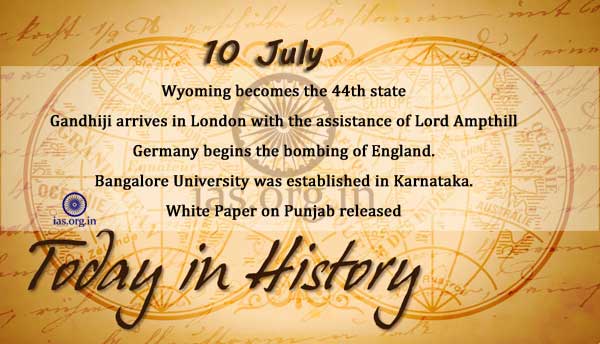
Wyoming becomes the 44th state.

1909

Gandhiji arrives in London with the assistance of Lord Ampthill and works ceaselessly to educate influential British leaders and the public, and also to move Imperial authorities.

1940

Germany begins the bombing of England.

1949

Sunil Manohar Gavaskar, great Indian cricket player (opener, 10,122 Test runs), was born in Bombay. He has received Arjun Award (1975) and Padma Bhushan (1980).

1964

Bangalore University was established in Karnataka.

1965

First NCC (National Cadet Corps) College for training girls started at Gwalior.

1971

Kochin University was established in Kerala.

1977

The Planning Commission decides to introduce Rolling Plan concept.

1978

`Mahatma Phule Backward Class Development Corporation’ (Mahatma Phule Magaswarg Vikas Mahamandal) was established.

1984

White Paper on Punjab released by Union Government.

1993

Kenyan runner Yobes Ondieki becomes the first man to run 10,000 meters in less than 27 minutes.

1997

Malleswari earns India’s first gold medal in Asian weightlifting championship in Beijing.

Also Read:

Today in History- 9 July

Today in History – 8 July

Today in History – 7 July

Today in History -6 July

Today in History – 9 July

0
today in history 9 july

today in history 9 july

1746

French sailor’s fleet reached at the bank of Pondichery in India.

1755

E Braddock, British General, was mortally wounded during French & Indian War.

1777

On this day in 1777, New York elected Brigadier General George Clinton as the first governor of the independent state of New York. Clinton became New York’s longest-serving governor, as well as the longest-serving governor in the United States, holding the post until 1795, and again from 1801 to 1804. In 1805, he was elected vice president of the United States, a position he held under Presidents Thomas Jefferson and James Madison, until his death in 1812.

1850

Zachary Taylor, the 12th president of the United States, died suddenly from an attack of cholera morbus. He was succeeded by Millard Fillmore.

1873

Henry Albert John Gidney, greatest leader and politician, was born in Igatpuri, Maharashtra.

1875

The Bombay Stock Exchange, the first in India, was constructed under the shade of a large banyan tree.

1877

On July 9, 1877, the All England Croquet and Lawn Tennis Club began its first lawn tennis tournament at Wimbledon, then an outer-suburb of London. Twenty-one amateurs showed up to compete in the Gentlemen’s Singles tournament, the only event at the first Wimbledon. The winner was to take home a 25-guinea trophy.

1947

In a ceremony held at the Pentagon in Arlington, Virginia, General Dwight D. Eisenhower appointed Florence Blanchfield to be a lieutenant colonel in the U.S. Army, making her the first woman in U.S. history to hold permanent military rank.

1951

India’s first Five Year Plan was prepared and published. There was the first amendment to the Constitution and the first general elections were held.

1969

India accepted ‘Royal Bengal Tiger’ as its National Animal, as recommended by the Indian Wild life Board. This Tiger is also known as the majestic tiger – panthere tigris (Linnaeus).

1992

The government agreed to set up a Joint Parliamentary Committee to enquire into the security scam.

Related Articles:

Today in History – 8 July

Today in History – 7 July

Today in History – 6 July

Today in History- 5 July

Schrödinger Equation (Time-Independent): The Cornerstone of Quantum Bound States

0
schrodinger equation

Table of Contents

  1. Introduction
  2. The Schrödinger Equation Framework
  3. Time-Dependent vs Time-Independent Equations
  4. Derivation from Separation of Variables
  5. Mathematical Form of the Time-Independent Schrödinger Equation
  6. Physical Interpretation
  7. Boundary Conditions and Normalization
  8. One-Dimensional Potential Wells
  9. Particle in a Box
  10. Quantum Harmonic Oscillator
  11. Finite Square Well
  12. Tunneling and Potential Barriers
  13. Energy Quantization
  14. Eigenstates and Orthogonality
  15. Operators and Commutators in TISE
  16. Higher-Dimensional Systems
  17. Importance in Atomic and Molecular Physics
  18. Conclusion

1. Introduction

The time-independent Schrödinger equation (TISE) lies at the heart of non-relativistic quantum mechanics. It provides a framework for understanding quantum systems in stationary states, such as electrons in atoms and molecules. Solving the TISE yields quantized energy levels and wavefunctions, which form the foundation of our understanding of quantum structure.


2. The Schrödinger Equation Framework

Proposed by Erwin Schrödinger in 1926, the equation governs the wavefunction \( \psi \), a complex-valued function whose modulus squared represents the probability density of finding a particle.


3. Time-Dependent vs Time-Independent Equations

Time-Dependent Schrödinger Equation (TDSE):

\[
i\hbar \frac{\partial}{\partial t} \Psi(x, t) = \hat{H} \Psi(x, t)
\]

Applicable to all quantum systems. Solutions describe full time evolution.

Time-Independent Schrödinger Equation (TISE):

\[
\hat{H} \psi(x) = E \psi(x)
\]

Applies when the potential \( V(x) \) is not explicitly time-dependent. Solutions give stationary states with definite energy.


4. Derivation from Separation of Variables

Assume:

\[
\Psi(x, t) = \psi(x) e^{-iEt/\hbar}
\]

Substitute into TDSE and divide by \( \Psi \):

\[
\hat{H} \psi(x) = E \psi(x)
\]

This gives the time-independent equation.


5. Mathematical Form of the Time-Independent Schrödinger Equation

In one dimension:

\[
\frac{\hbar^2}{2m} \frac{d^2 \psi(x)}{dx^2} + V(x)\psi(x) = E\psi(x)
\]

Where:

  • \( \hbar \) is the reduced Planck constant
  • \( m \) is the mass of the particle
  • \( V(x) \) is the potential energy
  • \( E \) is the total energy of the system

6. Physical Interpretation

  • \( \psi(x) \) is a probability amplitude
  • \( |\psi(x)|^2 \) is the probability density
  • The equation represents a balance between kinetic and potential energy

7. Boundary Conditions and Normalization

Wavefunctions must satisfy:

  • Continuity: \( \psi(x) \) and \( \frac{d\psi}{dx} \) must be continuous
  • Normalization:
    \[
    \int_{-\infty}^{\infty} |\psi(x)|^2 dx = 1
    \]
  • Boundary conditions: depend on potential and geometry

8. One-Dimensional Potential Wells

Potential wells are regions where \( V(x) < E \).

  • Infinite potential well: simplest example
  • Finite well: allows tunneling
  • Harmonic oscillator: parabolic potential

9. Particle in a Box

Infinite square well with \( V(x) = 0 \) for \( 0 < x < L \), \( V = \infty \) elsewhere:

\[
\psi_n(x) = \sqrt{\frac{2}{L}} \sin\left( \frac{n\pi x}{L} \right)
\]

\[
E_n = \frac{n^2 \pi^2 \hbar^2}{2mL^2}
\]

Quantized energies due to boundary conditions.


10. Quantum Harmonic Oscillator

Potential:

\[
V(x) = \frac{1}{2} m \omega^2 x^2
\]

Solutions:

\[
E_n = \hbar \omega \left(n + \frac{1}{2}\right), \quad n = 0, 1, 2, \dots
\]

Wavefunctions involve Hermite polynomials.


11. Finite Square Well

Potential:

\[
V(x) = \begin{cases}
-V_0, & |x| < a \ 0, & |x| > a
\end{cases}
\]

  • Bound states for \( E < 0 \)
  • Discrete number of eigenvalues
  • Tunneling into classically forbidden region

12. Tunneling and Potential Barriers

For a barrier \( V(x) > E \), classical physics predicts no penetration. Quantum mechanics allows tunneling:

  • \( \psi(x) \) decays exponentially in barrier
  • Transmission probability nonzero
  • Crucial in nuclear decay, electronics (tunnel diodes)

13. Energy Quantization

Solving the TISE results in discrete energy eigenvalues:

  • Arises due to boundary conditions and continuity
  • Explains spectral lines and stability of matter

14. Eigenstates and Orthogonality

  • Solutions \( \psi_n(x) \) are eigenfunctions
  • Correspond to eigenvalues \( E_n \)
  • Orthogonality condition:

\[
\int \psi_m^*(x) \psi_n(x) dx = \delta_{mn}
\]


15. Operators and Commutators in TISE

  • Hamiltonian \( \hat{H} = \frac{\hat{p}^2}{2m} + V(\hat{x}) \)
  • Position \( \hat{x} \): multiplication
  • Momentum \( \hat{p} = -i\hbar \frac{d}{dx} \)

Key commutator:

\[
[\hat{x}, \hat{p}] = i\hbar
\]


16. Higher-Dimensional Systems

In 3D:

\[
-\frac{\hbar^2}{2m} \nabla^2 \psi(\vec{r}) + V(\vec{r}) \psi(\vec{r}) = E \psi(\vec{r})
\]

Used in:

  • Atoms (hydrogen)
  • Molecules
  • Solid-state systems

17. Importance in Atomic and Molecular Physics

TISE describes:

  • Atomic orbitals
  • Molecular vibrations and rotations
  • Chemical bonding
  • Energy quantization in nanoparticles and quantum dots

18. Conclusion

The time-independent Schrödinger equation is a cornerstone of quantum mechanics. It captures the essence of stationary quantum systems and introduces quantized energy levels, tunneling, and wavefunction structure. Mastery of the TISE is critical for any deeper study of quantum physics, chemistry, and nanotechnology.


.

Today in History – 8 July

0
today in history 8 july

today in history 8 july

1497

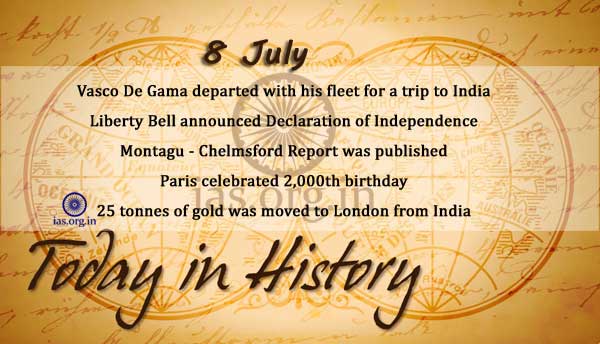
Vasco De Gama departed with his fleet from Lisbon Harbour for a trip to India .

1776

In Philadelphia, the Liberty Bell rang out from the tower of the Pennsylvania State House (known as Independence Hall), summoning citizens to the first public reading of the Declaration of Independence, by Colonel John Nixon. On July 4, the historic document was adopted by delegates to the Continental Congress meeting in the State House. However, the Liberty Bell, which bore the apt biblical quotation, “Proclaim Liberty Throughout All the Land unto All the Inhabitants Thereof,” was not rung until the Declaration of Independence returned from the printer on July 8.

1907

Elphinstone Picture Palace was started by Jamshedji F. Madan at Calcutta.

1918

Montagu – Chelmsford Report was published. This report was prepared to reform the legislature of India. This report was made by Edwin Montagu who was the Secretary of States for India and Lord Chelmsford, who was the Viceroy.

1930

The King opened India House in the Aldwych, appealing for peace in India at London.

1951

On this day in 1951, Paris, the capital city of France, celebrated turning 2,000 years old. In fact, a few more candles would’ve technically been required on the birthday cake, as the City of Lights was most likely founded around 250 B.C.

1954

Jawaharlal Nehru, Prime Minister of India, inaugurated world’s longest Bhakra-Nangal Dam canal at Punjab.

1958

Lord Canning declared that since peace was established, it is better known as end of Indian Mutiny, 1857.

1959

Maj. Dale R. Ruis and Master Sgt. Chester M. Ovnand became the first Americans to be killed in the American phase of the Vietnam War when guerrillas strike a Military Assistance Advisory Group (MAAG) compound in Bien Hoa, 20 miles northeast of Saigon.

1991

25 tonnes of gold was moved to London from India to raise $ 200 million loan.

1996

Mathematical Olympiad was held in Mumbai – the first time in India (from 08-17, 1996).

Related Articles:

Today in History – 7 July

Today in History – 6 July

Today in History – 5 July

Today in History – 4 July

State Vectors and Operators: The Language of Quantum Mechanics

0
state vectors

Table of Contents

  1. Introduction
  2. Quantum States and Hilbert Space
  3. Bra-Ket Notation
  4. Properties of State Vectors
  5. Orthogonality and Completeness
  6. Observables as Operators
  7. Hermitian Operators and Measurement
  8. Eigenvalues and Eigenvectors
  9. Expectation Values and Variance
  10. Operator Algebra
  11. Commutators and Uncertainty
  12. Projection Operators
  13. Unitary and Anti-Hermitian Operators
  14. Examples of Common Operators
  15. Conclusion

1. Introduction

Quantum mechanics is formulated in terms of state vectors and operators. These mathematical objects define how systems evolve, how observables are represented, and how measurements are made. They reside in a Hilbert space, which provides the formal setting for quantum theory.


2. Quantum States and Hilbert Space

A quantum state is described by a vector \( |\psi\rangle \) in a complex Hilbert space \( \mathcal{H} \).

  • The space is complete, linear, and endowed with an inner product
  • Physical information is contained in the state vector, up to a global phase
  • The norm is always 1:
    \[
    \langle \psi | \psi \rangle = 1
    \]

3. Bra-Ket Notation

Introduced by Dirac, bra-ket notation simplifies inner products and operators.

  • Ket: \( |\psi\rangle \): column vector
  • Bra: \( \langle\psi| \): complex conjugate transpose
  • Inner product: \( \langle\phi|\psi\rangle \)
  • Outer product: \( |\phi\rangle\langle\psi| \): operator

4. Properties of State Vectors

  • Linear superposition:
    \[
    |\psi\rangle = \alpha |\phi_1\rangle + \beta |\phi_2\rangle
    \]
  • Normalization:
    \[
    \langle \psi | \psi \rangle = 1
    \]
  • Two states \( |\psi\rangle \) and \( e^{i\theta} |\psi\rangle \) are physically equivalent

5. Orthogonality and Completeness

  • Orthogonal: \( \langle \psi | \phi \rangle = 0 \)
  • Orthonormal basis: \( \langle e_i | e_j \rangle = \delta_{ij} \)
  • Completeness:
    \[
    \sum_i |e_i\rangle \langle e_i| = \hat{I}
    \]

Enables expansion of any state in terms of basis vectors.


6. Observables as Operators

Every observable corresponds to a Hermitian operator \( \hat{A} \).

  • Acts on state vectors to yield eigenvalues
  • Hermitian condition:
    \[
    \hat{A}^\dagger = \hat{A}
    \]

Operators encapsulate measurable physical quantities (e.g., position, momentum, energy).


7. Hermitian Operators and Measurement

  • Measurement outcomes are real eigenvalues
  • Upon measurement of \( \hat{A} \), the system collapses into an eigenstate \( |a\rangle \):
    \[
    \hat{A}|a\rangle = a|a\rangle
    \]

Hermitian operators have:

  • Real spectrum
  • Orthogonal eigenstates
  • Spectral decomposition

8. Eigenvalues and Eigenvectors

If \( \hat{A}|\psi\rangle = a|\psi\rangle \), then:

  • \( |\psi\rangle \) is an eigenvector
  • \( a \) is the eigenvalue

Eigenvectors form the measurement basis.


9. Expectation Values and Variance

The expectation value of an operator \( \hat{A} \) in state \( |\psi\rangle \) is:

\[
\langle \hat{A} \rangle = \langle \psi | \hat{A} | \psi \rangle
\]

Variance (measure of spread):

\[
(\Delta A)^2 = \langle \hat{A}^2 \rangle – \langle \hat{A} \rangle^2
\]


10. Operator Algebra

Operators can be added and multiplied:

  • Linear: \( \hat{C} = \alpha \hat{A} + \beta \hat{B} \)
  • Product: \( \hat{A}\hat{B} \neq \hat{B}\hat{A} \) generally
  • Associative but not commutative

11. Commutators and Uncertainty

Commutator:

\[
[\hat{A}, \hat{B}] = \hat{A}\hat{B} – \hat{B}\hat{A}
\]

Example:

\[
[\hat{x}, \hat{p}] = i\hbar
\]

Leads to Heisenberg uncertainty principle:

\[
\Delta x \Delta p \ge \frac{\hbar}{2}
\]


12. Projection Operators

Project a state onto a basis vector:

\[
\hat{P}_a = |a\rangle\langle a|
\]

Used in measurement theory and quantum logic.


13. Unitary and Anti-Hermitian Operators

  • Unitary: \( \hat{U}^\dagger \hat{U} = \hat{I} \)
  • Preserve inner products
  • Represent time evolution
  • Anti-Hermitian: \( \hat{A}^\dagger = -\hat{A} \)

14. Examples of Common Operators

  • Position: \( \hat{x} \), acts as multiplication
  • Momentum: \( \hat{p} = -i\hbar \frac{d}{dx} \)
  • Hamiltonian: total energy, governs dynamics
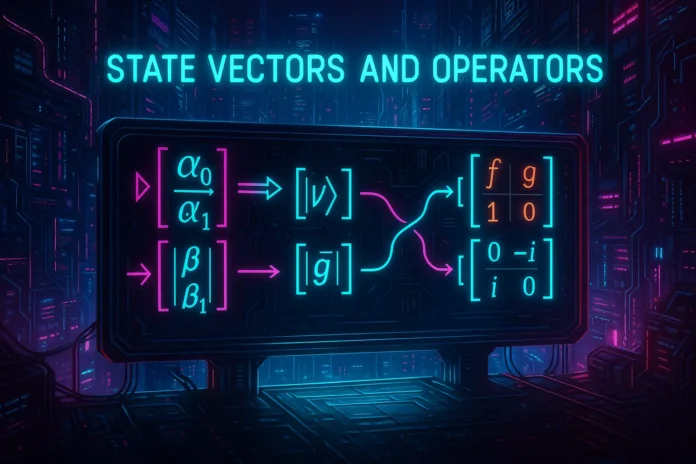
  • Pauli matrices: act on spin-1/2 particles

15. Conclusion

State vectors and operators are the mathematical language of quantum mechanics. They describe the evolution, measurement, and properties of quantum systems. Mastery of these concepts is essential for understanding everything from fundamental quantum theory to quantum computing and field theory.


.