
Home Blog Page 314

History of Scientific Revolutions: Milestones in the Evolution of Physics

0
history of scientific revolutions

Table of Contents

  1. Introduction
  2. What is a Scientific Revolution?
  3. Pre-Scientific Thought: Natural Philosophy
  4. The Copernican Revolution
  5. The Galilean and Newtonian Synthesis
  6. The Chemical and Electromagnetic Revolutions
  7. The Thermodynamic Revolution
  8. The Relativity Revolution
  9. The Quantum Revolution
  10. The Information and Quantum Computing Age
  11. Kuhn’s Theory of Scientific Paradigms
  12. Interplay Between Technology and Scientific Revolutions
  13. Unfinished Revolutions and Open Challenges
  14. Conclusion

1. Introduction

Scientific revolutions are transformative shifts in scientific thinking that redefine how we understand the universe. These revolutions mark turning points that replace outdated paradigms with new theories that more accurately explain and predict natural phenomena. Understanding these milestones is crucial as we journey toward deeper knowledge in quantum physics and beyond.


2. What is a Scientific Revolution?

A scientific revolution involves:

  • The overturning of established paradigms.
  • The birth of new theories.
  • Shifts in methodology, tools, and even philosophical outlooks.

According to Thomas Kuhn in The Structure of Scientific Revolutions (1962), scientific revolutions are non-cumulative and paradigm-shifting events in the history of science.


3. Pre-Scientific Thought: Natural Philosophy

Before formal scientific methods, natural philosophy merged speculative reasoning with rudimentary observations. Thinkers like Aristotle, Ptolemy, and Archimedes laid early foundations that were later challenged during the scientific revolutions.


4. The Copernican Revolution

Nicolaus Copernicus proposed a heliocentric model in De revolutionibus orbium coelestium, where the Sunโ€”not Earthโ€”was the center of the universe. This directly challenged the long-accepted Ptolemaic (geocentric) model.

Johannes Kepler built on Copernicusโ€™ model with three laws of planetary motion, derived from observational data:

  • Kepler’s First Law (Elliptical Orbits):
    The orbit of a planet is an ellipse with the Sun at one of the foci.
  • Kepler’s Second Law (Equal Areas):
    A line joining a planet and the Sun sweeps out equal areas during equal intervals of time.
  • Kepler’s Third Law (Harmonic Law): \( \frac{T^2}{r^3} = \text{constant} \)

This revolution launched modern astronomy and set the stage for Newtonian physics.


5. The Galilean and Newtonian Synthesis

Galileo Galilei

Galileo combined experimentation with mathematical abstraction, laying down the principle of inertia and advocating for heliocentrism through telescope observations.

Isaac Newton

Newtonโ€™s contributions unified celestial and terrestrial mechanics through a set of universal laws.

  • Newtonโ€™s Second Law of Motion: \( F = ma \)
  • Universal Law of Gravitation: \( F = G \frac{m_1 m_2}{r^2} \)

Where:

  • F is the gravitational force,
  • G is the gravitational constant,
  • \( m_1, m_2 \) are the masses,
  • rr is the distance between them.

Newtonโ€™s Principia Mathematica laid down a deterministic framework that dominated physics for over two centuries.


6. The Chemical and Electromagnetic Revolutions

Chemical Revolution

Antoine Lavoisier formulated the Law of Conservation of Mass:

\[ \text{Mass}_{\text{reactants}} = \text{Mass}_{\text{products}} \]

This shifted chemistry from qualitative alchemy to quantitative science.

Electromagnetic Revolution

Michael Faraday discovered electromagnetic induction, while James Clerk Maxwell synthesized electricity and magnetism into a single framework.

Maxwell’s Equations in differential form:

\[ \nabla \cdot \vec{E} = \frac{\rho}{\varepsilon_0} \]

\[ \nabla \cdot \vec{B} = 0 \]

\[ \nabla \times \vec{E} = -\frac{\partial \vec{B}}{\partial t} \]

\[ \nabla \times \vec{B} = \mu_0 \vec{J} + \mu_0 \varepsilon_0 \frac{\partial \vec{E}}{\partial t} \]

These equations predicted the existence of electromagnetic waves, laying the groundwork for radio, radar, and modern communication.


7. The Thermodynamic Revolution

Driven by the study of heat engines, thermodynamics emerged as a distinct field.

First Law of Thermodynamics (Energy Conservation):

\[ \Delta U = Q – W \]

Where:

  • \( \Delta U \) is the change in internal energy,
  • Q is heat added,
  • W is work done by the system.

Second Law of Thermodynamics (Entropy):

\[ \Delta S \geq 0 \]

Indicating that entropy in an isolated system never decreases.

These laws had profound implications in physics, chemistry, biology, and even cosmology.


8. The Relativity Revolution

Special Relativity (1905)

Einstein redefined the concepts of space and time:

  • Time Dilation: \( t’ = \frac{t}{\sqrt{1 – \frac{v^2}{c^2}}} \)
  • Mass-Energy Equivalence: \( E = mc^2 )\

Where:

  • t is proper time,
  • v is relative velocity,
  • c is the speed of light.

General Relativity (1915)

Describes gravity as a result of spacetime curvature.

Einsteinโ€™s Field Equations:

\[ R_{\mu\nu} – \frac{1}{2} g_{\mu\nu} R + \Lambda g_{\mu\nu} = \frac{8\pi G}{c^4} T_{\mu\nu} \]

Where:

  • \( R_{\mu\nu} \) is the Ricci curvature tensor,
  • \( g_{\mu\nu} \) is the metric tensor,
  • \( T_{\mu\nu} \) is the energy-momentum tensor.

General Relativity accurately predicts phenomena like gravitational lensing and black holes.


9. The Quantum Revolution

Quantum theory arose to explain phenomena classical physics could not, such as:

  • Blackbody radiation
  • Photoelectric effect
  • Atomic spectra

Planck’s Quantization:

\[ E = h \nu \]

Where:

  • \(E\) is energy,
  • h is Planckโ€™s constant,
  • \( \nu \) is frequency.

Schrรถdinger’s Equation (Time-dependent):

\[ iโ„โˆ‚ฯˆโˆ‚t=H^ฯˆi \hbar \frac{\partial \psi}{\partial t} = \hat{H} \psi \]

Where:

  • \( \hbar \) is reduced Planckโ€™s constant,
  • \( \psi \) is the wavefunction,
  • \( \hat{H} \) is the Hamiltonian operator.

Quantum mechanics introduced probabilistic interpretations and wave-particle duality, revolutionizing our understanding of reality.


10. The Information and Quantum Computing Age

Claude Shannonโ€™s Information Theory (1948):

Defined bit as the fundamental unit of information and introduced entropy in communication:

\[ H(X) = – \sum_{i=1}^{n} p(x_i) \log_2 p(x_i) \]

Quantum Information:

Qubit: Can exist in superpositions:

\[ |\psi\rangle = \alpha |0\rangle + \beta |1\rangle\]

where

\[ |\alpha|^2 + |\beta|^2 = 1 \]

Quantum Gates: Operate as unitary transformations, e.g., Hadamard Gate:

\[ H = \frac{1}{\sqrt{2}} \begin{bmatrix} 1 & 1 \\ 1 & -1 \\ \end{bmatrix} \]

Quantum information theory now underpins advances in quantum cryptography, teleportation, and computing.


11. Kuhn’s Theory of Scientific Paradigms

Thomas Kuhn proposed that science advances via paradigm shifts:

  1. Normal Science โ€“ Routine work within an existing framework.
  2. Crisis โ€“ Accumulation of anomalies.
  3. Revolution โ€“ Emergence of a new theory.
  4. New Normal Science โ€“ A new paradigm becomes dominant.

This model explains why scientific revolutions are often resisted and how they reshape the scientific landscape.


12. Interplay Between Technology and Scientific Revolutions

Technology both enables and is driven by science:

  • Telescopes โ†’ Astronomy
  • Microscopes โ†’ Biology
  • Accelerators โ†’ Particle Physics
  • Lasers โ†’ Quantum Optics

Breakthroughs like quantum computers, LIGO detectors, and Fermilab experiments all emerged from tight feedback between theory and technology.


13. Unfinished Revolutions and Open Challenges

Some revolutions are ongoing or incomplete:

  • Quantum Gravity: Unifying General Relativity and Quantum Mechanics.
  • Dark Energy and Dark Matter: 95% of the universe is still unexplained.
  • Arrow of Time: Why time flows in one direction.
  • Consciousness and Measurement: Role of the observer in quantum theory.

These open questions point toward future revolutions in physics.


14. Conclusion

Scientific revolutions have repeatedly redefined humanityโ€™s understanding of realityโ€”from Newtonโ€™s clockwork universe to Einsteinโ€™s curved spacetime, and now quantum superpositions. Each new paradigm opened new technological and philosophical frontiers.

Understanding the history of these revolutions equips us to appreciateโ€”and contribute toโ€”the quantum transformations underway today.

.

Today in History – 11 May

0
today in history 11 may

today in history 11 may

1626

Malik Ambar of Ahmednagar’s Nijamshahi kingdom, passed away.

1885

Krishnamohan Bandopadhyay, leader, essay writer and journalist of Bengal, passed away.

1888

Asaf Ali, lawyer, nationalist, writer and connoisseur of music and arts, was born.

1895

Jiddu Krishnamurti, great Indian philosopher of international repute, was born at Madanapalle, Andhra Predesh. His famous book “Song of Life” contains most of his philosophical thoughts and teachings.

1919

Troops under General Barrett inflicted a sharp reverse on the invading Afghans at Bagh Springs. The whole of the frontier area was up in arms with tribesmen threatening Landi Khotal and martial law had been proclaimed in Peshawar. It was expected however that General Barrett, well equipped with guns and airplanes, would soon control the situation. Reports had been reaching London for some time about the possibility of an Afghan incursion following the murder of the pro-British Emir Habibullah. His third son, Amanullah Khan, who took over the throne, was known to be hostile toward the government of India.

1934

On this day in 1934, a massive storm sent millions of tons of topsoil flying from across the parched Great Plains region of the United States as far east as New York, Boston and Atlanta.

1965

The first of two cyclones in less than a month killed 35,000 people in the country.

1970

A bill for setting up of “North Eastern Council” was passed.

1987

President’s rule imposed in Punjab.

1995

In central Kashmir, militants burnt the Charar-e-Sherif shrine (the tomb of Sufi saint Sheikh Noorudin Noorani) built in 1460 by Zain-ul- Abidin.

1998

Three momentous events took place on the day that did the nation proud. Firstly, three underground nuclear tests at Pokhran Range in Rajasthan, which included a hydrogen bomb, were tested; secondly, the successful test firing of the ‘Trishul Missile‘ and thirdly, the maiden Certification test flight of ‘Hansa-3’, the first-all Composite indigenous two seater aircraft.

1999

Supreme Court confirmed the death sentence on four of the 26 accused in the Rajiv Gandhi assassination case, reduced to life imprisonment the sentence on three others and acquits the remaining 19.

Related Articles:

Today in History – 10 May

Today in History – 9 May

Today in History – 8 May

Today in History – 7 May

What Is Physics? Scope and Method

0
what is physics

Table of Contents

  1. Introduction
  2. Defining Physics
  3. Historical Evolution of Physics
  4. The Scope of Physics
  5. Branches of Physics
  6. Methodology in Physics
  7. Role of Mathematics in Physics
  8. Theoretical vs Experimental Physics
  9. Philosophy and Foundations
  10. The Interface with Other Sciences
  11. Modern Challenges in Physics
  12. Conclusion

1. Introduction

Physics is often described as the most fundamental of the natural sciences. It seeks to understand the rules that govern the universe at all scalesโ€”from subatomic particles to galaxies and beyond. But before we dive into complex topics like quantum entanglement or spacetime curvature, itโ€™s vital to build a clear understanding of what physics actually is, its scope, and the methods it employs to uncover truth.


2. Defining Physics

Physics is the branch of science concerned with the nature and properties of matter and energy. The subject matter of physics includes mechanics, heat, light and other radiation, sound, electricity, magnetism, and the structure of atoms.

In essence, physics attempts to answer questions such as:

  • What is the universe made of?
  • What laws govern the behavior of matter and energy?
  • How can we describe and predict natural phenomena?

The word “physics” originates from the Greek word physis, meaning “nature”. Thus, physics is the study of nature in its most fundamental form.


3. Historical Evolution of Physics

Classical Period

Physics began as a part of philosophy. Ancient Greek thinkers like Aristotle, Archimedes, and Ptolemy explored ideas of motion, gravity, and celestial phenomena.

Scientific Revolution

The birth of modern physics occurred during the scientific revolution in the 16th and 17th centuries. Figures like Galileo Galilei, Johannes Kepler, and Isaac Newton laid the foundations of classical mechanics and scientific methodology.

Modern Era

The 20th century saw a profound transformation:

  • Quantum Mechanics explained phenomena at atomic and subatomic levels.
  • Relativity Theory (Einstein) reshaped our understanding of space and time.
  • Nuclear Physics, Particle Physics, and Cosmology emerged as major subfields.

Physics today continues to evolve, addressing challenges in unifying quantum theory and gravity, understanding dark matter and dark energy, and developing quantum technologies.


4. The Scope of Physics

Physics is remarkably broad. Its scope can be described in terms of the:

  • Scale: from the Planck length (~10โปยณโต meters) to the cosmic scale (~10ยฒโถ meters).
  • Domains: classical mechanics, electromagnetism, thermodynamics, quantum mechanics, and relativity.
  • Applications: from engineering and electronics to medicine, cryptography, and astrophysics.

Physics not only explores what phenomena occur, but also seeks to understand why and how they happen, using precise models and laws.


5. Branches of Physics

Classical Physics

  • Mechanics: motion of objects under forces.
  • Thermodynamics: heat, work, and energy transfer.
  • Optics: behavior of light.
  • Acoustics: sound waves and vibrations.

Modern Physics

  • Quantum Physics: behavior of particles at microscopic levels.
  • Relativity: motion at high velocities and in gravitational fields.
  • Atomic Physics: structure and behavior of atoms.
  • Nuclear Physics: nuclei and nuclear reactions.
  • Particle Physics: fundamental particles and interactions.
  • Condensed Matter Physics: solids, liquids, and materials.

Applied Physics

  • Geophysics: Earth’s physical processes.
  • Biophysics: physical principles in biological systems.
  • Astrophysics: physical properties of celestial bodies.

6. Methodology in Physics

Physics adheres to a systematic method known as the scientific method. This includes:

1. Observation

Gathering empirical data using instruments or human senses.

2. Hypothesis Formation

Proposing tentative explanations based on current understanding.

3. Experimentation

Designing experiments to test hypotheses under controlled conditions.

4. Data Analysis

Using statistical and mathematical tools to evaluate results.

5. Theory Formulation

Creating general principles or models that explain observations.

6. Prediction

Using theories to make predictions about future or unobserved phenomena.

7. Verification and Falsification

Repeated testing, peer review, and refinement ensure that theories are reliable.


7. Role of Mathematics in Physics

Mathematics is the language of physics. It allows physicists to:

  • Formulate precise laws (e.g., Newton’s laws, Schrรถdinger equation).
  • Develop models and simulations.
  • Predict outcomes with quantitative accuracy.

Examples:

  • Newton’s Second Law: \(F = ma\)
  • Einstein’s Mass-Energy Equivalence: \(E= mc^2\)
  • Schrรถdinger Equation:
\[ i\hbar \frac{\partial}{\partial t} \Psi(\mathbf{r}, t) = \hat{H} \Psi(\mathbf{r}, t) \]

Mathematics gives structure and predictive power to physical theories.


8. Theoretical vs Experimental Physics

Theoretical Physics

Focuses on developing mathematical models and frameworks to explain physical phenomena.

Examples:

  • Quantum Field Theory
  • General Relativity
  • String Theory

Experimental Physics

Focuses on observing and testing physical phenomena through experiments.

Examples:

  • CERN’s Large Hadron Collider (LHC)
  • Gravitational Wave Detection (LIGO)
  • Quantum optics labs

Both areas are interdependent. Theoretical predictions drive experiments, and experimental results shape theoretical progress.


9. Philosophy and Foundations

Physics is rooted in several philosophical principles:

  • Causality: Every effect has a cause.
  • Determinism (in classical physics): Given initial conditions, future states are predictable.
  • Empiricism: Knowledge must be based on observable phenomena.
  • Falsifiability: A theory must be testable and refutable.

Key philosophical debates:

  • Is the universe deterministic or probabilistic?
  • Are physical laws discovered or invented?
  • What is the role of the observer in quantum mechanics?

10. The Interface with Other Sciences

Physics interacts deeply with other disciplines:

  • Chemistry: Physical chemistry, quantum chemistry.
  • Biology: Biophysics, neuroscience modeling.
  • Engineering: Electrical, mechanical, civil engineering.
  • Computer Science: Quantum computing, simulations.
  • Mathematics: Differential equations, topology in string theory.

These cross-disciplinary areas are often where breakthroughs occur.


11. Modern Challenges in Physics

Despite its success, physics faces major unanswered questions:

  • Unification of Gravity and Quantum Mechanics
    No theory yet combines general relativity with quantum field theory.
  • Dark Matter and Dark Energy
    What constitutes 95% of the universe’s mass-energy?
  • Quantum Measurement Problem
    How does wavefunction collapse happen?
  • Nature of Time
    Why does time have a direction (arrow of time)?
  • Origin of the Universe
    What happened at or before the Big Bang?

These mysteries drive the next generation of research and innovation.


12. Conclusion

Physics is not just a subject; it’s a way of thinking about the universe. From ancient questions about motion to the frontier of quantum technologies, physics has evolved to become the cornerstone of modern science and technology.

Understanding its scope and methodology provides a strong foundation for exploring more advanced topics in quantum physics, particle dynamics, cosmology, and beyond.

As we embark on the Xeb Labs Quantum Learning Series, this foundational knowledge will be crucial in comprehending the subtle and often non-intuitive nature of the quantum world.

Today in History – 10 May

1
today in history 10 may

today in history 10 may

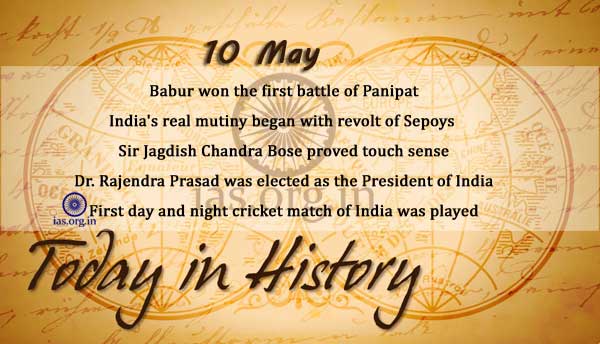
1526

Babur won the first battle of Panipat and entered in North India’s capital Agra.

1857

India’s real mutiny begins with the revolt of Sepoys of Meerut near Delhi the next day.

1869

On this day in 1869, the presidents of the Union Pacific and Central Pacific railroads met in Promontory, Utah, and drove a ceremonial last spike into a rail line that connected their railroads. This made transcontinental railroad travel possible for the first time in U.S. history. No longer would western-bound travellers need to take the long and dangerous journey by wagon train, and the West would surely lose some of its wild charm with the new connection to the civilized East.

1901

Sir Jagdish Chandra Bose, Indian scientist, in the hall of the Royal Society, London, which was packed with eminent scientists on May 10, 1901 proved that “plants and animal have similar touch sense”

1909

Bellari Shammanna Keshvan, internationally famous librarian, was born.

1910

Robert Koch, nobel laureate, died of an heart attack.

1927

Nayantara Sahgal, famous writer and social reformer, was born.

1936

Dr. Mukhtar Ahmad Ansari, great freedom fighter, politician, journalist and muslim leader, passed away.

1940

Winston Churchill, First Lord of the Admiralty, was called to replace Neville Chamberlain as British prime minister following the latterโ€™s resignation after losing a confidence vote in the House of Commons.

1957

Dr. Rajendra Prasad was elected as the President of India for a second term.

1981

The first day and night cricket match of India was played at the flood-lit ground of the Wilson College Gymkhana (Bombay)

1982

Karnataka Kranti Ranga led by Devaraj Urs comes into being.

1993

Santosh Yadav became the first Indian woman to reach the Everest for the second time.

1994

In South Africa, Nelson Rolihlahla Mandela was sworn in as the first black president of South Africa. In his inaugural address, Mandela, who spent 27 years of his life as a political prisoner of the South African government, declared that โ€œthe time for the healing of the wounds has come.โ€ Two weeks earlier to this event, more than 22 million South Africans had turned out to cast ballots in the countryโ€™s first-ever multiracial parliamentary elections. An overwhelming majority chose Mandela and his African National Congress (ANC) party to lead the country.

1996

Eight climbers died on Mount Everest during a storm on this day in 1996. It was the worst loss of life ever on the mountain on a single day. Author Jon Krakauer, who himself attempted to climb the peak that year, wrote a best-selling book about the incident, Into Thin Air, which was published in 1997. A total of 15 people perished during the spring 1996 climbing season at Everest. Between 1980 and 2002, 91 climbers died during the attempt.

1999

Tamil Nadu Government withdrew the controversial Prevention of Terrorist Activities (POTA) Bill.

Related Articles:

Today in History – 9 May

Today in History – 8 May

Today in History – 7 May

Today in History – 6 May

Probability Distribution in Quantum Physics: A Deep Dive

0
probaility distribution

Table of Contents

  1. Introduction
  2. Classical vs Quantum Probability
  3. The Wave Function and Probability Amplitude
  4. Born Rule: From Amplitudes to Probabilities
  5. Measurement and Collapse of the Wave Function
  6. Probability Densities in One-Dimensional Systems
  7. Discrete vs Continuous Probability Distributions
  8. Expectation Values and Operators
  9. Probability Currents
  10. Double-Slit Experiment
  11. Quantum Entanglement and Joint Probabilities
  12. Density Matrix Formalism
  13. Path Integrals and Probabilistic Histories
  14. Interpretational Perspectives
  15. Applications
  16. Conclusion

1. Introduction

In classical physics, the future behavior of a system is entirely deterministic if we know its initial conditions. However, in quantum physics, probability is woven into the fabric of reality. Unlike classical randomnessโ€”often stemming from ignoranceโ€”quantum probabilities reflect a fundamental indeterminacy in nature.

This article explores the concept of probability distribution in quantum physics: what it means, how it’s defined, and why itโ€™s central to the interpretation and application of quantum mechanics.


2. Classical vs Quantum Probability

In classical systems, probability often arises from incomplete knowledge. For example, the probability of rolling a six on a die is 1/6โ€‹, assuming fair conditionsโ€”but this reflects our ignorance of the actual physical dynamics at play.

In contrast, quantum probability is inherent. Even with perfect knowledge of the quantum state, outcomes of measurements are fundamentally probabilistic. This difference is not just philosophical but embedded in the mathematics of quantum theory.


3. The Wave Function and Probability Amplitude

The state of a quantum system is described by a wave function, usually denoted ฯˆ(x,t) for a one-dimensional position-based system. This wave function is a complex-valued function whose modulus squared represents a probability density.

$$ |\psi(x,t)|^2 = \text{Probability density at position } x \text{ and time } t $$

This doesnโ€™t mean the particle is at a particular point until we observe it; it means we can only calculate the likelihood of finding it at that point upon measurement.


4. Born Rule: From Amplitudes to Probabilities

The Born Rule, introduced by Max Born in 1926, formalizes how we extract measurable probabilities from the wave function. If ฯˆ(x,t) is the wave function for a particle, the probability of finding it between positions a and b is:

$$ P(a \leq x \leq b) = \int_a^b |\psi(x,t)|^2 \, dx $$

This rule marks a radical departure from classical physics, emphasizing that the square of a complex amplitude yields a real, observable probability.


5. Measurement and Collapse of the Wave Function

Quantum measurement introduces another probabilistic wrinkle: upon observation, the wave function collapses to a specific eigenstate corresponding to the measurement outcome.

Before measurement, a system exists in a superposition of possible states. Measurement โ€˜choosesโ€™ one of these, seemingly at random, guided by the Born probabilities.

For example, in a position measurement:

  • Before: ฯˆ(x) spread across space
  • After: ฯˆ(x) becomes sharply peaked at the observed value x0x_0x0โ€‹

The probability distribution pre-measurement is replaced by a deterministic post-measurement state.


6. Probability Densities in One-Dimensional Systems

Letโ€™s consider a particle in a one-dimensional infinite potential well (quantum box) of length L. Its normalized wave functions are:

$$ \psi_n(x) = \sqrt{\frac{2}{L}} \sin\left(\frac{n \pi x}{L}\right) $$

The corresponding probability density is:

$$ |\psi_n(x)|^2 = \frac{2}{L} \sin^2\left(\frac{n \pi x}{L}\right) $$

This distribution has nodes and antinodes, unlike classical uniform distribution, and the probability of finding the particle is zero at the walls and specific points inside the well.


7. Discrete vs Continuous Probability Distributions

Quantum systems can have:

  • Discrete probability distributions โ€” e.g., measuring energy levels in a hydrogen atom.
  • Continuous probability distributions โ€” e.g., measuring position or momentum of a free particle.

For discrete states |nโŸฉ, the probability is:

$$ P(n) = |\langle n | \psi \rangle|^2 $$

For continuous variables x:

$$ P(x) = |\psi(x)|^2, \quad \int_{-\infty}^{\infty} P(x) \, dx = 1 $$

This normalization ensures total certainty: the particle must be somewhere.


8. Expectation Values and Operators

Probabilities allow us to compute expectation values, or quantum averages. For an observable represented by operator O^, the expectation value in state ฯˆ is:

$$ \langle \hat{O} \rangle = \int \psi^*(x) \hat{O} \psi(x) \, dx $$

Examples:

  • Position:
$$ \langle x \rangle = \int x |\psi(x)|^2 dx $$
  • Momentum:
$$ \langle p \rangle = \int \psi^*(x)\left(-i\hbar \frac{d}{dx}\right) \psi(x) dx $$

These reflect the center-of-mass or average behavior over many identical measurements.


9. Probability Currents

To track how probability moves through space, we define the probability current density:
Probability current ( j(x,t) ):

$$ j(x,t) = \frac{\hbar}{2mi} \left[ \psi^*(x,t) \frac{\partial \psi(x,t)}{\partial x} – \psi(x,t) \frac{\partial \psi^*(x,t)}{\partial x} \right] $$

Together with the probability density |ฯˆ|2, this satisfies the continuity equation (conservation of probability):

$$ \frac{\partial |\psi|^2}{\partial t} + \frac{\partial j}{\partial x} = 0 $$

This ensures conservation of probability, akin to mass or charge conservation in classical fields.


10. Double-Slit Experiment

The double-slit experiment demonstrates the probabilistic and wave-like nature of quantum particles. When electrons (or photons) pass through two slits, an interference pattern emergesโ€”even when particles go through one at a time.

Each individual detection appears random, but the ensemble distribution aligns perfectly with the square of the total wave amplitudeโ€”reflecting probabilities, not deterministic paths.

Each detection is random, but the probability distribution over many events forms an interference pattern:

$$ P(x) = |\psi_1(x) + \psi_2(x)|^2 $$

where ( \psi_1(x) ) and ( \psi_2(x) ) are amplitudes from each slit.


11. Quantum Entanglement and Joint Probability Distributions

Entangled particles share a joint quantum state. The probability distribution of one particle depends on measurements made on the other, regardless of distanceโ€”a core feature of quantum nonlocality.

For entangled states |ฮจโŸฉ, joint probability P(a,b) for outcomes a and b is:

$$ P(a, b) = |\langle a, b | \Psi \rangle|^2 $$

These probabilitie leads to nonlocal correlations, that violate classical expectations, as shown by Bell inequalities, but remain consistent with quantum formalism.


12. Quantum Probability in Density Matrix Formalism

In mixed states or open systems, we often use the density matrix ฯ where probabilities are extracted via:

$$ P(a) = \text{Tr}(\rho \hat{P}_a) $$

where P^aโ€‹ is the projection operator for outcome aaa. The density matrix generalizes the notion of a pure state to probabilistic ensembles.


13. Path Integrals and Probabilistic Summation

Richard Feynman’s path integral formulation provides a different probabilistic perspective. Instead of wave functions alone, we sum over all possible paths a particle can take from point A to B:

$$ \text{Amplitude} = \sum_{\text{paths}} e^{i S[\text{path}]/\hbar} $$

The interference of these amplitudes determines probabilitiesโ€”an elegant synthesis of quantum and classical perspectives.


14. Quantum Bayesianism (QBism) and Interpretations

Different interpretations of quantum mechanics offer varied views on probability:

  • Copenhagen: Probability reflects intrinsic indeterminacy and wave function collapse.
  • Many Worlds: All outcomes occur in branching universes; probabilities reflect frequency.
  • QBism: Probabilities are Bayesian degrees of belief, personal to the observer.

Each approach reshapes the meaning of the quantum probability distribution while remaining consistent with experimental outcomes.


15. Applications

Probability distributions in quantum mechanics underlie:

  • Quantum algorithms (e.g., Groverโ€™s, Shorโ€™s) which rely on interference and amplitude manipulation.
  • Quantum cryptography, where measurement probability ensures security.
  • Scattering theory, where cross-sections are derived from probability distributions over angular and energy outcomes.
  • Quantum tomography, where states are reconstructed from measured probabilities.

16. Conclusion

Probability distributions in quantum physics are not just tools for making predictionsโ€”they are central to understanding what the theory says about reality itself. The wave function, Born Rule, and collapse postulate form the probabilistic scaffolding upon which the entire structure of quantum mechanics is built.

As research into quantum computing, field theory, and gravity deepens, our grasp of quantum probability continues to evolveโ€”not only mathematically but philosophically, pushing the boundaries of both science and metaphysics.