





Introduction
The Civil Disobedience Movement was one of the most significant mass movements in India’s struggle for independence from British colonial rule. Led by Mahatma Gandhi, it was officially launched on 12 March 1930 with the objective of challenging British authority through non-violent resistance and the deliberate violation of unjust colonial laws.
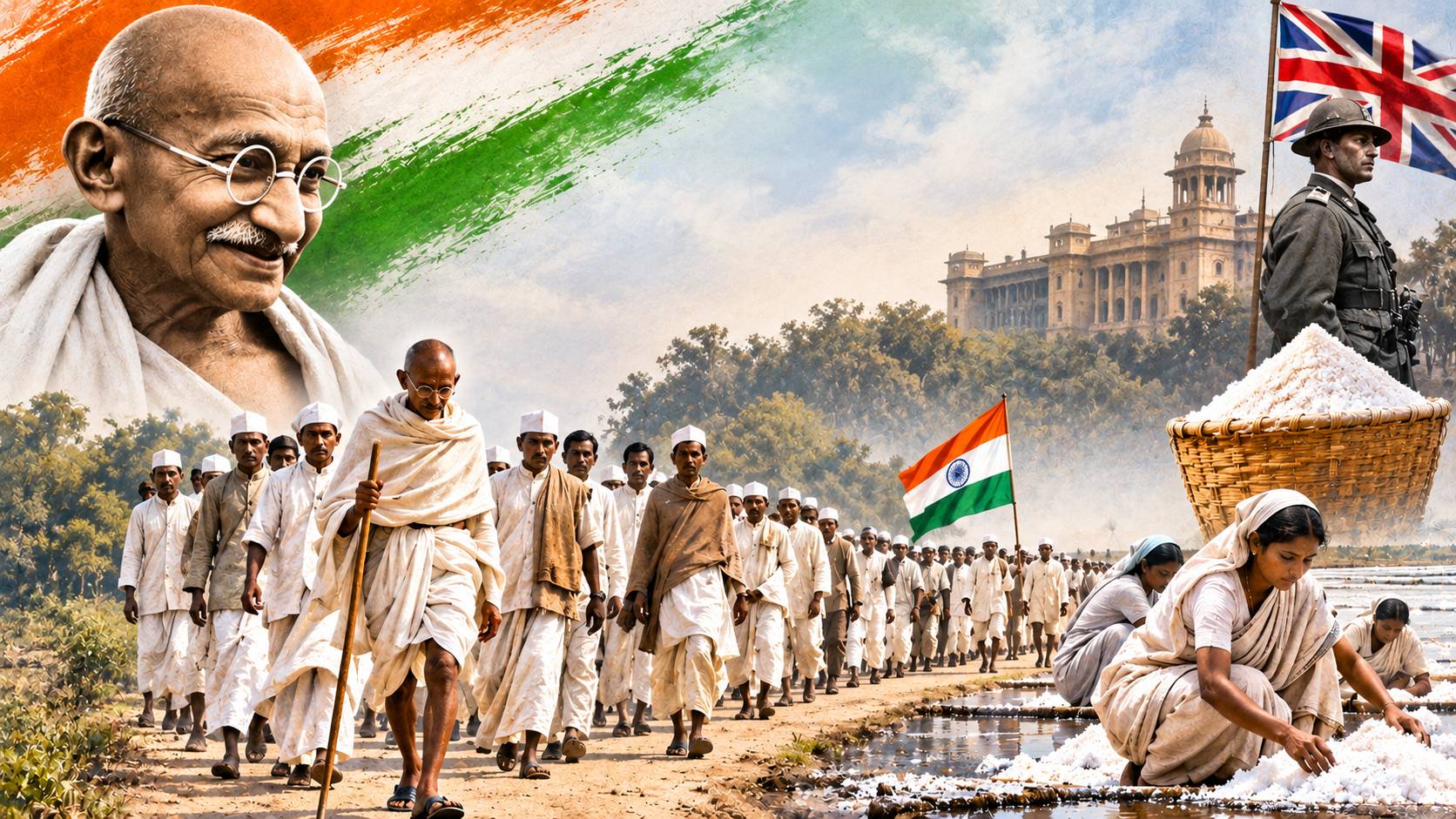
The movement began with the historic Dandi March, during which Gandhi and his followers walked from Sabarmati Ashram in Gujarat to the coastal village of Dandi to break the British salt law. The manufacture of salt by Indians was restricted under British regulations, making salt a powerful symbol of colonial exploitation.
Unlike earlier political movements, the Civil Disobedience Movement encouraged people to openly disobey specific British laws, refuse to pay certain taxes, boycott foreign goods and promote indigenous products.
It spread across different parts of India and involved students, women, peasants, workers, merchants and other sections of society.
The movement led to widespread arrests, including the imprisonment of Mahatma Gandhi and thousands of other nationalists. Although it did not immediately achieve independence, it significantly weakened British authority and strengthened the Indian national movement.
1. Background of the Civil Disobedience Movement
The Civil Disobedience Movement emerged from growing dissatisfaction with British colonial rule and the failure of constitutional reforms to meet Indian political aspirations.
Several developments during the 1920s contributed to its launch.
1.1 Simon Commission (1927)
The British government appointed the Simon Commission in November 1927 to review the working of constitutional reforms in India.
The commission consisted entirely of British members and did not include a single Indian representative.
Indian political organisations strongly opposed this exclusion.
The commission arrived in India in February 1928 and faced widespread protests under the slogan:
“Simon Go Back!”
During one such protest in Lahore, nationalist leader Lala Lajpat Rai was seriously injured in a police lathi charge. He died on 17 November 1928.
The incident intensified anti-British sentiments across India.
1.2 Nehru Report (1928)
In response to the Simon Commission, Indian political leaders prepared their own constitutional proposals.
A committee headed by Motilal Nehru presented the Nehru Report in 1928.
It recommended Dominion Status for India within the British Commonwealth.
However, many younger nationalist leaders, including Jawaharlal Nehru and Subhas Chandra Bose, demanded complete independence rather than Dominion Status.
1.3 Lahore Session of the Indian National Congress (1929)
The Lahore Session of the Indian National Congress was held in December 1929 under the presidency of Jawaharlal Nehru.
This session marked a major turning point in India’s freedom struggle.
Important decisions included:
- The demand for Purna Swaraj (Complete Independence) was adopted as the goal of the Indian National Congress.
- The Congress decided to launch a programme of civil disobedience.
- 26 January 1930 was declared the first Independence Day by the Congress.
- People were encouraged to take a pledge to fight for complete independence.
The declaration of Purna Swaraj provided the political foundation for the Civil Disobedience Movement.
1.4 Economic Depression and Colonial Exploitation
The Great Depression of 1929 severely affected the Indian economy.
Agricultural prices declined, rural indebtedness increased and peasants faced growing economic difficulties.
At the same time, British taxation policies continued to place a heavy burden on ordinary Indians.
The salt tax was particularly unpopular because salt was an essential commodity consumed by everyone, irrespective of income.
These economic conditions created widespread support for Gandhi’s proposed movement.
2. Causes of the Civil Disobedience Movement
Several political, economic and social factors contributed to the launch of the Civil Disobedience Movement.
2.1 Demand for Complete Independence
The Indian National Congress adopted Purna Swaraj as its official objective in December 1929.
The British government had failed to provide a satisfactory constitutional settlement, increasing the demand for complete independence.
2.2 Failure of Constitutional Reforms
The exclusion of Indians from the Simon Commission and the failure to accept nationalist demands created widespread disappointment.
Indian leaders increasingly believed that constitutional negotiations alone would not secure independence.
2.3 British Economic Exploitation
British colonial policies adversely affected Indian agriculture, industries and trade.
Heavy taxation, declining agricultural prices and restrictions on indigenous industries contributed to public dissatisfaction.
2.4 Salt Tax and Monopoly
The British government imposed taxes and restrictions on the production and sale of salt.
Since salt was an essential necessity, the tax affected rich and poor alike.
Gandhi selected the salt law as the central issue of the movement because it provided an opportunity to unite different sections of Indian society.
2.5 Impact of the Great Depression
The worldwide economic crisis beginning in 1929 worsened economic conditions in India.
Falling agricultural prices and reduced incomes created hardship among farmers and rural communities.
The economic situation increased opposition to colonial taxation.
3. Gandhi’s Eleven Demands
Before launching the movement, Mahatma Gandhi attempted to negotiate with the British government.
On 31 January 1930, Gandhi sent a letter to Viceroy Lord Irwin presenting eleven demands.
These demands addressed political, economic and administrative issues.
The major demands included:
- Reduction in land revenue assessments.
- Abolition of the salt tax and government monopoly over salt.
- Reduction in military expenditure.
- Reduction in the salaries of higher-ranking civil servants.
- Release of political prisoners not convicted of violence.
- Reduction in the rupee-sterling exchange ratio.
- Protection of Indian textile industries through tariffs.
- Prohibition of intoxicating liquor.
- Reform of the Criminal Investigation Department.
- Acceptance of coastal shipping regulations favouring Indian interests.
- Withdrawal of restrictions on Indian firearms licences for self-defence.
Gandhi gave the government an opportunity to respond to these demands.
However, the British government did not accept them.
Consequently, Gandhi decided to launch the Civil Disobedience Movement.
4. Dandi March (12 March–6 April 1930)
The Dandi March, also known as the Salt March, marked the beginning of the Civil Disobedience Movement.
On 12 March 1930, Mahatma Gandhi began a march from Sabarmati Ashram near Ahmedabad to the coastal village of Dandi in Gujarat.
He was accompanied by 78 carefully selected volunteers.
The march covered approximately 385 kilometres over 24 days.
During the journey, Gandhi addressed villagers, encouraged people to join the freedom struggle and explained the importance of non-violent resistance.
On 6 April 1930, Gandhi reached Dandi and broke the British salt law by making salt from seawater.
This act became a powerful symbol of resistance against British colonial rule.
Significance of the Dandi March
The Dandi March had several important consequences:
- It marked the formal beginning of the Civil Disobedience Movement.
- It transformed the salt tax into a nationwide political issue.
- It encouraged ordinary Indians to challenge British authority.
- It attracted international attention to India’s freedom struggle.
- It inspired similar salt protests across the country.
- It demonstrated the power of non-violent mass mobilisation.
The Salt Satyagraha became one of the most memorable events in India’s independence movement.
5. Spread of the Civil Disobedience Movement Across India
Following the Dandi March, the movement spread to different regions of India.
People began breaking colonial laws and participating in various forms of non-violent resistance.
5.1 Salt Satyagraha
People manufactured salt illegally in coastal regions and openly violated British salt regulations.
Salt protests were organised in Gujarat, Tamil Nadu, Bengal, Maharashtra and other regions.
In Tamil Nadu, C. Rajagopalachari led a salt march from Tiruchirappalli to Vedaranyam in April 1930.
5.2 Boycott of Foreign Goods
People boycotted British-made goods, particularly foreign textiles.
Foreign cloth was publicly burned, and the use of khadi and indigenous products was encouraged.
5.3 Refusal to Pay Taxes
In several regions, peasants refused to pay certain taxes and land revenue demands.
This form of resistance was particularly visible in areas where agricultural communities were facing economic hardship.
5.4 Picketing of Liquor Shops
Women and other volunteers participated in peaceful demonstrations outside liquor shops to discourage the consumption of alcohol.
5.5 Resignation from Government Positions
Some government employees and village officials resigned from their positions as a form of protest against colonial administration.
5.6 Participation of Women
Women played an important role in the Civil Disobedience Movement.
Sarojini Naidu, Kamaladevi Chattopadhyay, Kamala Nehru and numerous other women participated in protests, demonstrations and the manufacture of illegal salt.
Their participation expanded the social base of the national movement.
6. British Government’s Response
The British government responded to the movement with widespread repression.
Authorities attempted to suppress demonstrations and prevent the spread of civil disobedience.
Major actions included:
- Arresting political leaders and activists.
- Banning public meetings and organisations.
- Using police force against peaceful protesters.
- Confiscating property in certain areas.
- Imposing restrictions on nationalist publications.
- Conducting mass arrests across the country.
Mahatma Gandhi was arrested on 5 May 1930, before he could lead a planned raid on the Dharasana Salt Works.
After his arrest, other nationalist leaders continued the movement.
At Dharasana, a major non-violent protest was led by Abbas Tyabji initially and subsequently by Sarojini Naidu.
The British police brutally attacked the unarmed demonstrators. The incident attracted international attention and exposed the violent nature of colonial repression.
7. Gandhi-Irwin Pact (1931)
The growing scale of the Civil Disobedience Movement created pressure on the British government to negotiate with Indian political leaders.
In January 1931, Mahatma Gandhi and several other Congress leaders were released from prison.
Negotiations between Gandhi and Viceroy Lord Irwin resulted in the signing of the Gandhi-Irwin Pact on 5 March 1931.
The agreement marked an important stage in the Indian national movement.
Major Provisions of the Gandhi-Irwin Pact
The major provisions included:
- The Indian National Congress agreed to suspend the Civil Disobedience Movement.
- The Congress agreed to participate in the Second Round Table Conference in London.
- The British government agreed to release political prisoners who had not been convicted of violence.
- The government agreed to permit the peaceful picketing of liquor and foreign cloth shops.
- Confiscated properties of certain participants were to be restored if they had not already been sold.
- People living near the coast were permitted to manufacture salt for personal consumption, subject to regulations.
Significance of the Pact
The Gandhi-Irwin Pact was significant because:
- The British government formally recognised the Congress as a negotiating partner.
- Gandhi agreed to participate in the Second Round Table Conference.
- Political prisoners were released under the agreed conditions.
- The pact demonstrated the political influence of the national movement.
However, the agreement did not grant India independence or accept the Congress demand for Purna Swaraj.
8. Second Round Table Conference (1931)
Following the Gandhi-Irwin Pact, Mahatma Gandhi attended the Second Round Table Conference in London in September 1931 as the representative of the Indian National Congress.
The conference discussed India’s constitutional future and political representation.
However, it failed to reach an agreement on several important issues, including minority representation and the structure of constitutional reforms.
Gandhi returned to India disappointed.
Meanwhile, the political situation had changed under the new British Prime Minister Ramsay MacDonald and Viceroy Lord Willingdon.
The government adopted a more repressive approach towards nationalist activities.
In January 1932, Gandhi and other Congress leaders were arrested, and the Civil Disobedience Movement was resumed.
9. Resumption and Withdrawal of the Movement
After the failure of the Second Round Table Conference, the Indian National Congress resumed the Civil Disobedience Movement in January 1932.
The British government once again imposed restrictions and arrested thousands of activists.
Gandhi continued his resistance against colonial policies.
During this period, the Communal Award was announced by British Prime Minister Ramsay MacDonald on 16 August 1932.
It provided separate electorates for several communities, including the Depressed Classes.
Gandhi strongly opposed separate electorates for the Depressed Classes and began a fast unto death in September 1932 while imprisoned in Yerwada Central Jail.
The disagreement was resolved through the Poona Pact, signed on 24 September 1932, between representatives of caste Hindus and B. R. Ambedkar, who represented the Depressed Classes.
The pact replaced separate electorates for the Depressed Classes with reserved seats in joint electorates.
Despite continued protests, the movement gradually lost momentum due to extensive government repression and organisational difficulties.
In May 1933, Gandhi suspended the mass civil disobedience campaign and shifted attention towards individual satyagraha and constructive social work.
The Indian National Congress formally withdrew the Civil Disobedience Movement in April 1934.
10. Significance of the Civil Disobedience Movement
The Civil Disobedience Movement was a major milestone in India’s freedom struggle.
Although it did not immediately achieve independence, it had far-reaching political and social consequences.
10.1 Mass Participation
The movement brought together people from different sections of Indian society, including peasants, women, students, traders and workers.
It expanded the reach of the national movement beyond urban political organisations.
10.2 Strengthening of Nationalism
The movement strengthened nationalist feelings and encouraged people to challenge British colonial authority.
It popularised the idea that ordinary citizens could participate directly in the struggle for independence.
10.3 International Recognition
The Dandi March and subsequent protests attracted international media attention.
Gandhi became an internationally recognised symbol of non-violent resistance.
10.4 Women’s Participation
The movement encouraged large-scale participation of women in political activities.
Women emerged as important participants and organisers in the national movement.
10.5 Weakening of British Authority
The widespread violation of colonial laws demonstrated the difficulties faced by the British government in maintaining its authority without widespread Indian cooperation.
10.6 Development of Mass Political Resistance
The movement established civil disobedience as an effective method of challenging unjust laws.
It influenced later struggles for civil rights and democratic freedoms in different parts of the world.
11. Limitations of the Civil Disobedience Movement
Despite its achievements, the movement faced several limitations:
- It did not secure immediate independence for India.
- The movement faced severe British repression.
- Participation varied across different regions and social groups.
- Some sections of industrial workers did not participate on a large scale.
- The movement did not achieve complete political unity among different communities.
- Negotiations with the British government failed to produce a satisfactory constitutional settlement.
Nevertheless, the movement made a lasting contribution to India’s independence struggle.
12. Difference Between Non-Cooperation Movement and Civil Disobedience Movement
Both movements were led by Mahatma Gandhi and relied on non-violent resistance. However, there were important differences between them.
| Basis | Non-Cooperation Movement | Civil Disobedience Movement |
|---|---|---|
| Period | 1920–1922 | 1930–1934 |
| Main objective | Withdrawal of cooperation with British institutions | Deliberate violation of unjust colonial laws |
| Major event | Boycott of foreign goods and government institutions | Dandi March and Salt Satyagraha |
| Beginning | August 1920 | 12 March 1930 |
| Important leader | Mahatma Gandhi | Mahatma Gandhi |
| Withdrawal | February 1922, after Chauri Chaura | Gradually suspended and formally withdrawn in 1934 |
| Main method | Boycott and non-cooperation | Non-payment of certain taxes, breaking colonial laws and boycott |
Conclusion
The Civil Disobedience Movement was a defining chapter in India’s struggle for independence. Launched by Mahatma Gandhi in 1930, it transformed the freedom struggle into a nationwide campaign of non-violent resistance against British colonial rule.
The historic Dandi March, the widespread Salt Satyagraha and the participation of millions of Indians demonstrated the strength of organised mass movements.
Although the movement did not immediately achieve its objective of complete independence, it weakened British authority, strengthened Indian nationalism and increased international awareness of India’s demand for freedom.
The movement also established the importance of civil disobedience and non-violent resistance as powerful instruments of political change.
Its legacy remains an important part of India’s democratic and national history.